
The week ending 20 March was particularly packed with meetings of central banks, most of which signalled or at least hinted at upcoming hikes to tackle expected rising inflation. Some major currencies, like the euro, made gains while the dollar and gold declined as participants priced in hawkishness. This article summarises the reaction to the central banks’ statements then looks briefly at the charts of XAUUSD and GBPUSD.
The Reserve Bank of Australia (RBA), Bank of Canada (BoC), Federal Reserve (Fed), Bank of Japan (BoJ), Bank of England (BoE) and European Central Bank (ECB) were the main relevant central banks meeting in recent days. All held their rates except for the RBA, which hiked as expected to 4.1%. However, the overall impression from all the meetings was clearly hawkish.
Markets haven’t priced in a specific number of hikes this year for some central banks, but others, such as the BoE, are widely expected to hike at least twice by the end of 2026. This is a pivot from the previous direction of travel; the BoE, especially, had seemed almost certain to cut on 19 March until the start of the Gulf conflict and the effective closure of the Strait of Hormuz.
The situation for the Fed is somewhat less clear at the time of writing. Although the Fed itself might still be ready to cut once this year at it signalled previously in late 2025, this isn’t the expectation of traders:
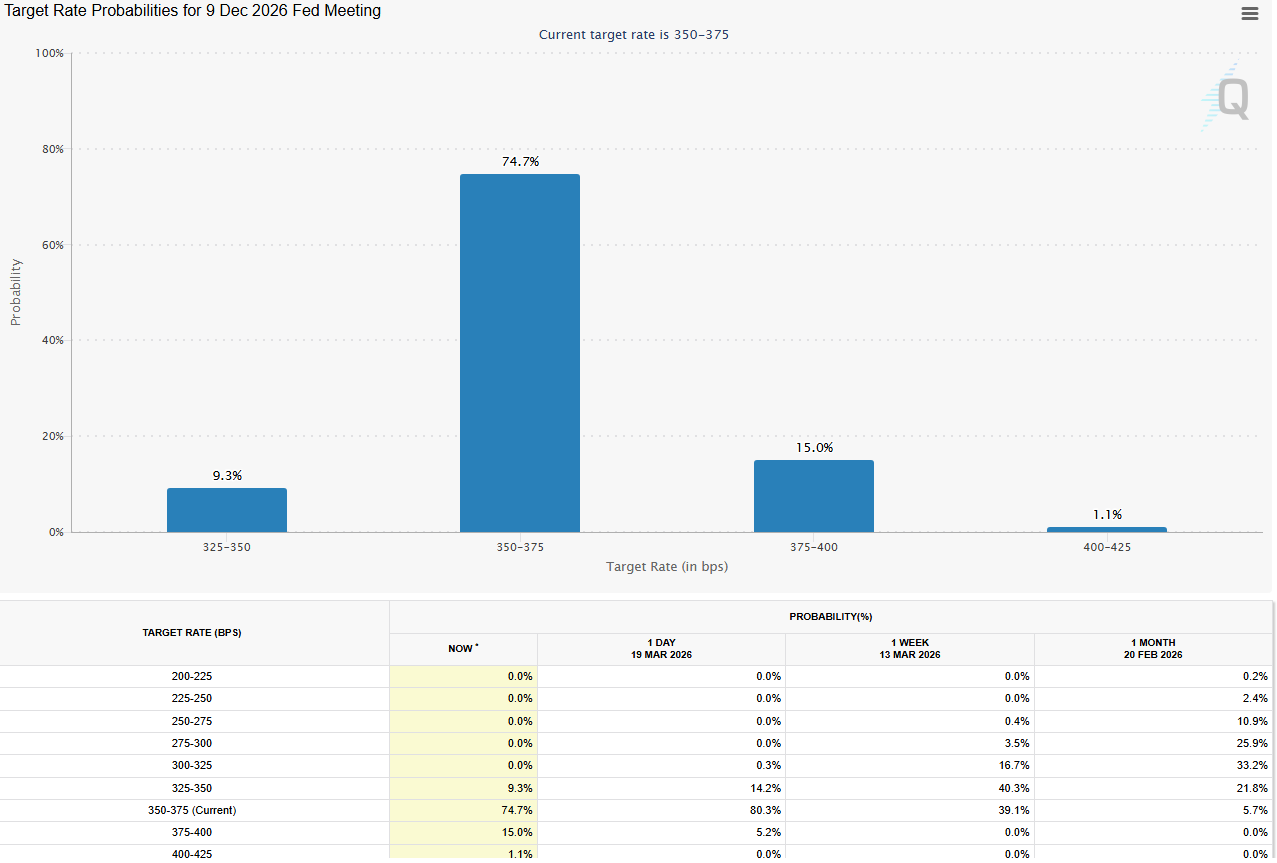
While there’s now a large majority of participants expecting the Fed to hold at the current 3.5-3.75% into 2027, the minority expecting a hike has grown significantly from zero around this time last week. Traders should be prepared for more rapid changes in probabilities over the next few days, depending on comments from senior members of the Fed, the progress of the conflict in the Gulf, oil’s movements, and more.
The last full week of March is relatively uneventful in terms of major data, with only Japan and Britain scheduled to release inflation. The focus for many markets in the next few days is likely to remain on military operations against energy infrastructure in the Gulf and ongoing efforts by the American government to clear the Strait of Hormuz for shipping.

Gold Smashes Below $5,000 as the Fed Seems Ready to Pivot
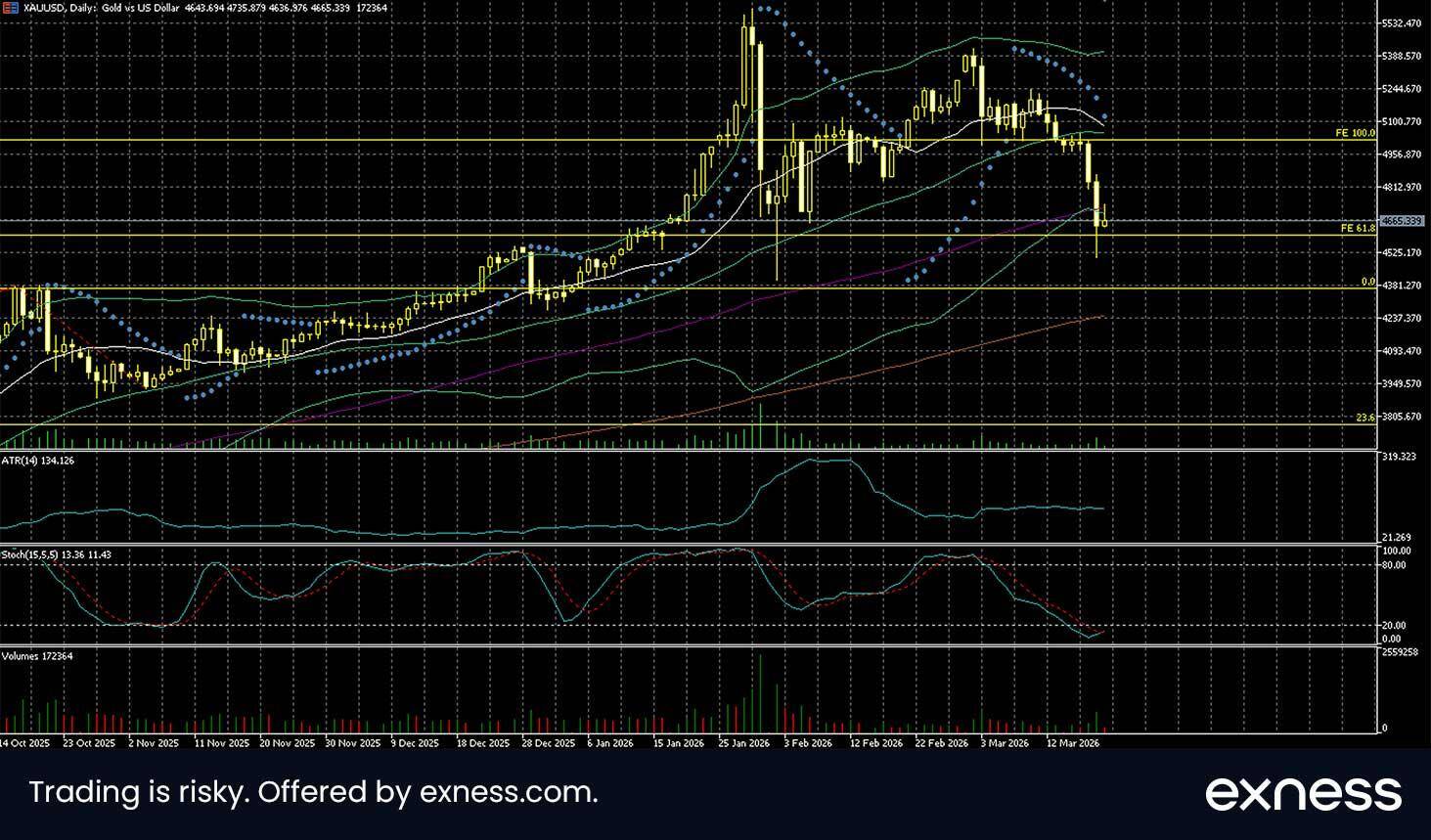
Gold declined spectacularly for two days running on 18 and 19 March as the Fed seemed much less likely to cut rates this year, with many participants increasingly expecting hikes instead. Although gold might normally gain under such circumstances of likely significant economic disruption, the readiness of central banks to fight inflation and the relatively higher importance of the dollar as a political rather than economic haven are much more important factors at least for now. Participants appear to have priced in a relatively long conflict in the Gulf.
The break below $5,000 paused late on 19 March around $4,600 and the 61.8% weekly Fibonacci extension; this was previously a possible resistance in January and the approximate area of 2 February’s bounce, so it might be an important support. The price is clearly oversold based on the slow stochastic and Bollinger Bands. ATR isn’t increasing clearly primarily because the average is skewed by the huge volatility from late January and early February.
Given the general fundamental situation and the momentum of 18-19 March’s decline, more losses seem possible but perhaps not immediately with the price so clearly oversold. The next main support could be the 0% weekly Fibonacci retracement around $4,370, December 2025’s high. $5,000 might now flip to being a possible resistance. A short-term sideways trend between around $4,600 and $5,000 before another round of losses is a potential scenario but traders are looking ahead to 3 April’s NFP for clues on movement further ahead.
Gold Price Forecast
Every new Gold analysis as it publishes, today's technical signal and key levels, live price — on one page.
See all Gold forecastsCable Bounces as the BoE Turns Hawkish
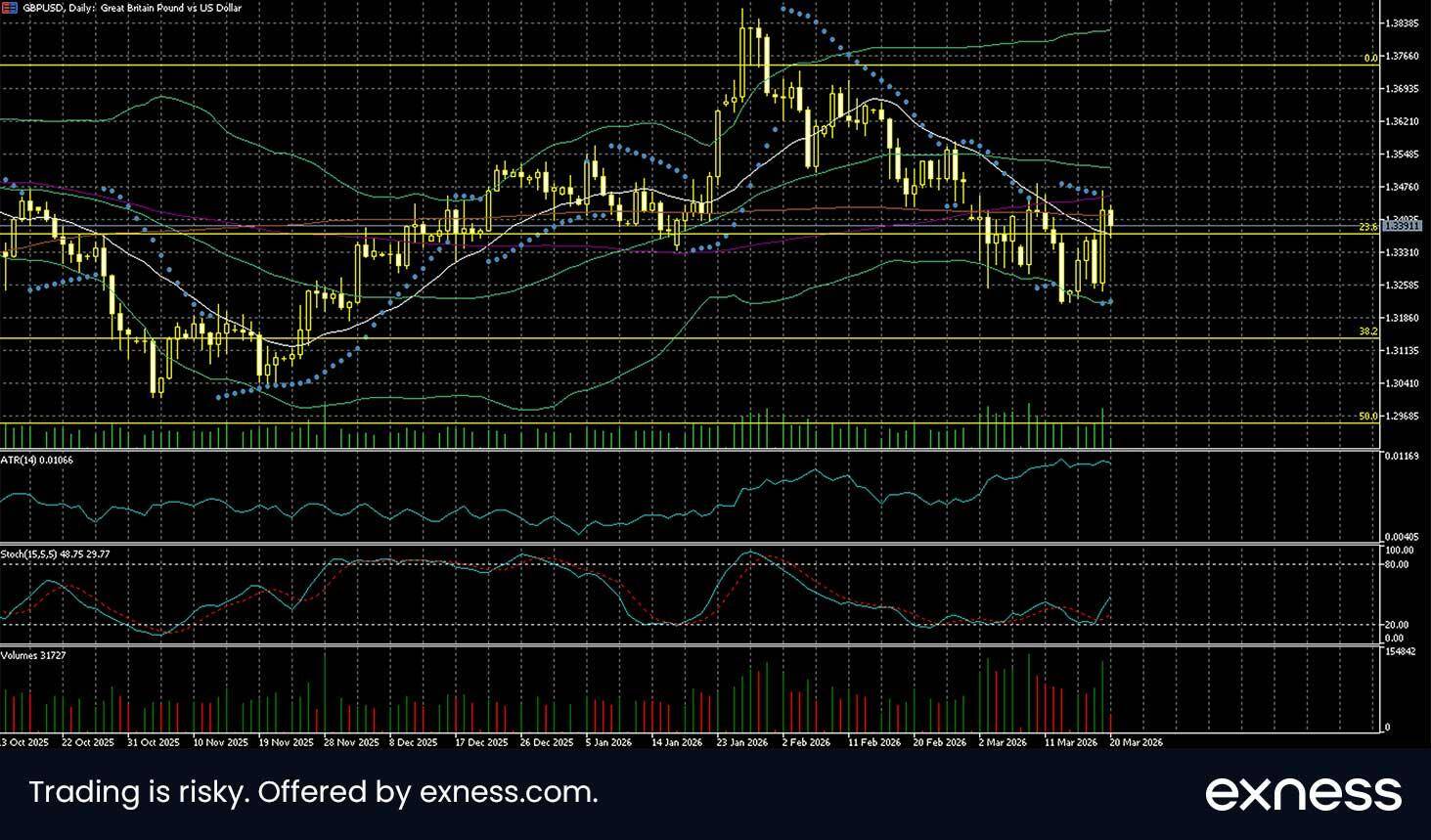
The BoE’s hold on 19 March and the increasing probability of two or possibly even three hikes in the rest of 2026 drove the pound to gain in many of its pairs, including against the dollar. Although there’s been some negativity around significantly higher British governmental borrowing in February than expected, the BoE’s apparent readiness to pivot strongly has been more important. Compared to the USA, Britain’s economy is significantly more vulnerable to likely much higher prices of oil and gas due to the ongoing conflict in the Gulf.
The 23.6% weekly Fibonacci retracement around $1.337 remains an important technical reference. Overall, the recent bounce seems to have potential to continue, given that volume has supported it so far, it came around an upward crossover of the slow stochastic, and ATR isn’t clearly dropping. The area around $1.34 and the 200 SMA is a possible resistance which the price tested on 20 March. If there’s a break above there, $1.35 around the value area between the 50 and 100 SMAs might be another resistance.
$1.30 seems like an obvious support in the medium to longer term, but for now, it seems unlikely that this would be tested soon, barring significant new fundamental developments or a clear shift in sentiment. $1.32 was the latest low; this might drive a bounce if tested. The key event coming up for cable is British inflation on 25 March: this covers February, so it’s too early to see an impact from the Gulf conflict, but it might be useful for establishing context.
This article was submitted by Michael Stark, an analyst at Exness.
For the latest analysis, ideas for trading and more, follow Michael on X: @MStarkExness.
The opinions in this article are personal to the writer; they do not represent those of Exness. This is not a recommendation to trade.