



Geopolitical Factors and Economic Sentiments
The allure of gold has been further enhanced by ongoing geopolitical tensions and uncertainties within European politics.
Despite the Federal Reserve’s indication of a possible single rate cut in 2024, a surge in U.S. Treasury yields has rekindled interest in the dollar, potentially restraining further gains in gold prices.
Interest Rate Speculations and Market Impact
Market participants are treading carefully, wary of the timing for the anticipated rate cuts by the Fed. Although the central bank signaled a reduction in the rate cuts expected this year—from three to one—recent weak economic data from the U.S., including disappointing retail sales and subdued consumer prices, suggest that monetary easing could occur sooner than later, possibly as early as September.
Risks from Global Conflicts
Escalating military actions, such as Ukrainian drone attacks on Russian infrastructure and escalating tensions between Israel and Hezbollah, are critical concerns.
These events, coupled with political instability in France, underscore gold’s role as a safe haven during times of crisis.
Major Economic Events Today
Investors are bracing for pivotal updates from major central banks and crucial economic indicators. The spotlight is on the Swiss National Bank (SNB) and the Bank of England (BoE), both of which have key policy meetings that could influence market dynamics significantly.
In the United States, attention is drawn to several important data releases: Unemployment Claims are expected at 235,000, a slight improvement from the previous 242,000.
Building Permits are forecasted to show a modest increase to 1.45 million from 1.44 million, indicating potential growth in the housing sector. Additionally, the Philly Fed Manufacturing Index is anticipated to rise slightly to 4.8 from 4.5, suggesting a marginal expansion in regional manufacturing activity.
Short-term Forecast
Gold (XAU/USD) is anticipated to remain bullish above the pivot of $2,338.10, with potential resistance at $2,347.51 and $2,355.48.
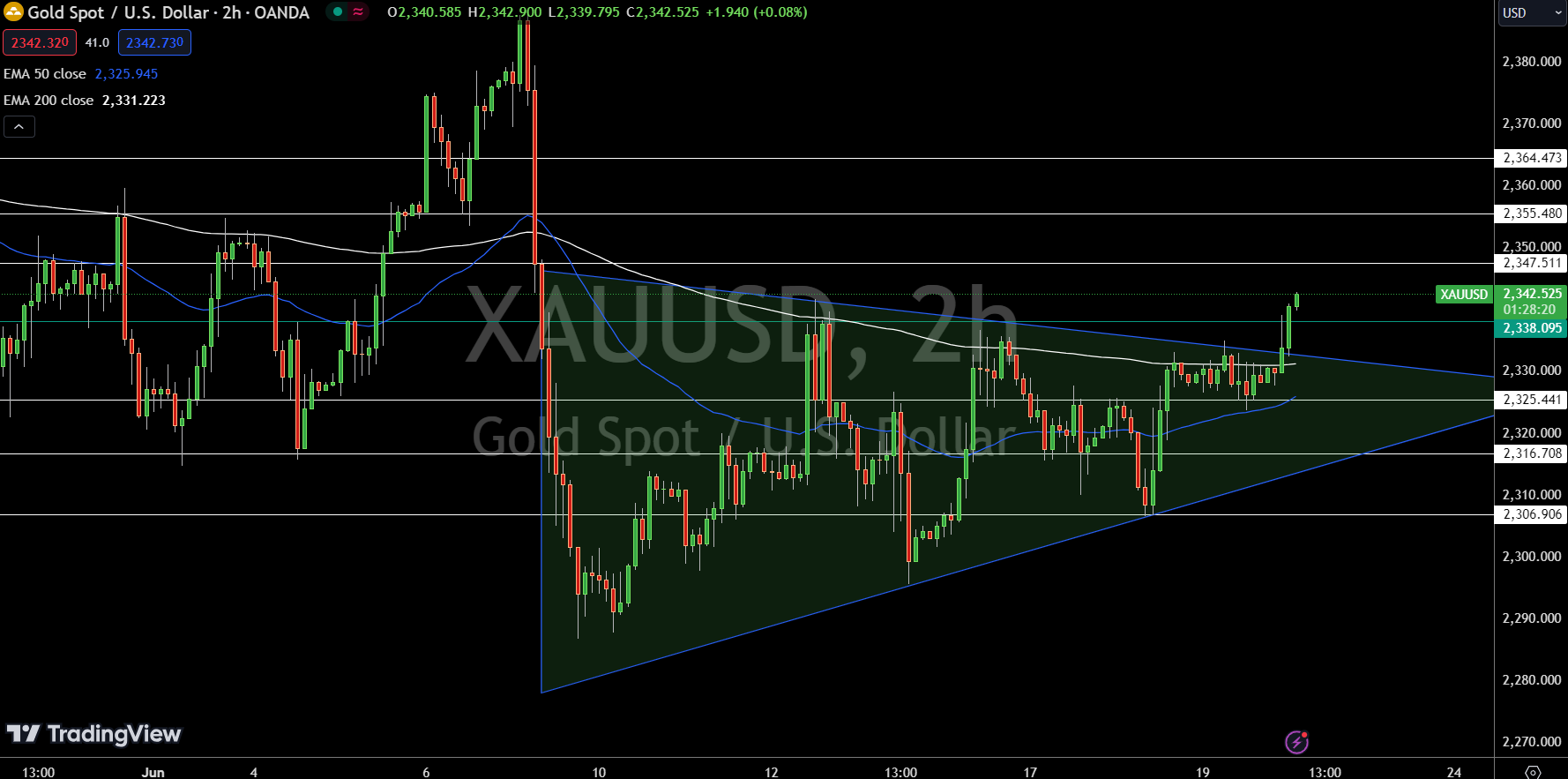
Conversely, support can be found at $2,311.36, with additional layers at $2,316.71 and $2,306.91.
Technical indicators reveal a Relative Strength Index poised around neutral. The 50-day Exponential Moving Average (EMA) sits at $2,325.95, while the 200-day EMA is at $2,331.22, suggesting a robust support zone. The current market stance is bullish above the pivot of $2,338.10; however, falling below this mark could initiate a steep decline.