


Spot Gold Heads for Second Straight Weekly Loss
Gold is stuck. The Iran deal talk is pulling crude oil lower, which should ease inflation pressure and help the metal. It is not helping. Traders are looking past the oil decline and pricing in a Federal Reserve that is not finished tightening.
The CME FedWatch tool shows 58% probability of a rate hike by December. Next week’s Federal Reserve meeting on June 16-17 is the first chaired by new Fed Chair Kevin Warsh. The market does not expect a move at this meeting, but every signal about the future path matters when rate hike odds are this elevated.
Peter Grant, vice president and senior metals strategist at Zaner Metals, said the inflation problem is not going away just because crude oil drops. “I think that the inflation is going to linger for some time, even if oil prices do come down,” Grant said. “We’ve heard this story before and there’s some degree of skepticism.”
At 14:37 GMT, Spot Gold (XAUUSD) is trading at $4,187.85, down $23.34 or 0.55%. On track for the second consecutive weekly decline.
Oil Fell but Gold Did Not Care
Crude oil dropped more than 2% Friday after President Donald Trump said a deal with Iran could be signed as soon as this weekend. Reuters reported that a memorandum aimed at halting the conflict in the Gulf could be signed as early as Sunday, with Geneva as the likely location. Lower crude oil should take some inflation pressure off. The market is not buying it.
Peter Fertig, quantitative commodity research analyst, said gold is responding to inflation, not the geopolitical headlines. “Gold prices are moving in line with statements from the U.S. President, but the overriding influence remains inflation, with markets expecting rate hikes from the ECB and also anticipating that the Fed will follow,” Fertig said.
The European Central Bank already hiked this week. The Fed is expected to hold next week. But holding is not easing. The rate hike probability for December at 58% tells gold traders that the next move from the Fed is more likely to be up than down. That keeps the pressure on a metal that pays nothing while Treasury yields sit above 4.5%.
Gold Price Forecast
Every new Gold analysis as it publishes, today's technical signal and key levels, live price — on one page.
See all Gold forecastsThe Inflation Data This Week Made It Worse
U.S. producer prices rose more than expected in May. Consumer inflation climbed above 4% for the first time in three years. Both reports confirmed that price pressures are not fading fast enough for the Fed to back off. Energy costs drove the headlines, but core readings stayed elevated in the categories that matter most for policy, shelter and services.
Fertig warned that the path lower for gold depends on how steep the inflation acceleration gets. “If we see a further acceleration in the coming months, the $4,000 handle could be broken to the downside,” he said. ANZ lowered its year-end gold target by $400 to $5,200, citing recent volatility. The revision acknowledges that the rate environment has shifted against gold even though the longer-term supply and demand picture has not changed.
The Conflict Hurt Gold, Not Helped It
Gold has been under pressure since the Iran conflict escalated earlier this year. This conflict did the opposite. Rising crude oil fueled inflation fears. Inflation fears kept central banks restrictive. Restrictive policy crushed gold’s appeal against yield-bearing alternatives. Now crude oil is retreating on deal talk and gold is still falling. The inflation damage from months of elevated energy costs is already embedded in the data. One weekend deal does not reverse it.
Rolex raised global prices on its gold watches by an average of 5% this month, marking a rare second annual increase across the United States, Britain, and Hong Kong.
Daily Spot Gold (XAUUSD) Technical Analysis
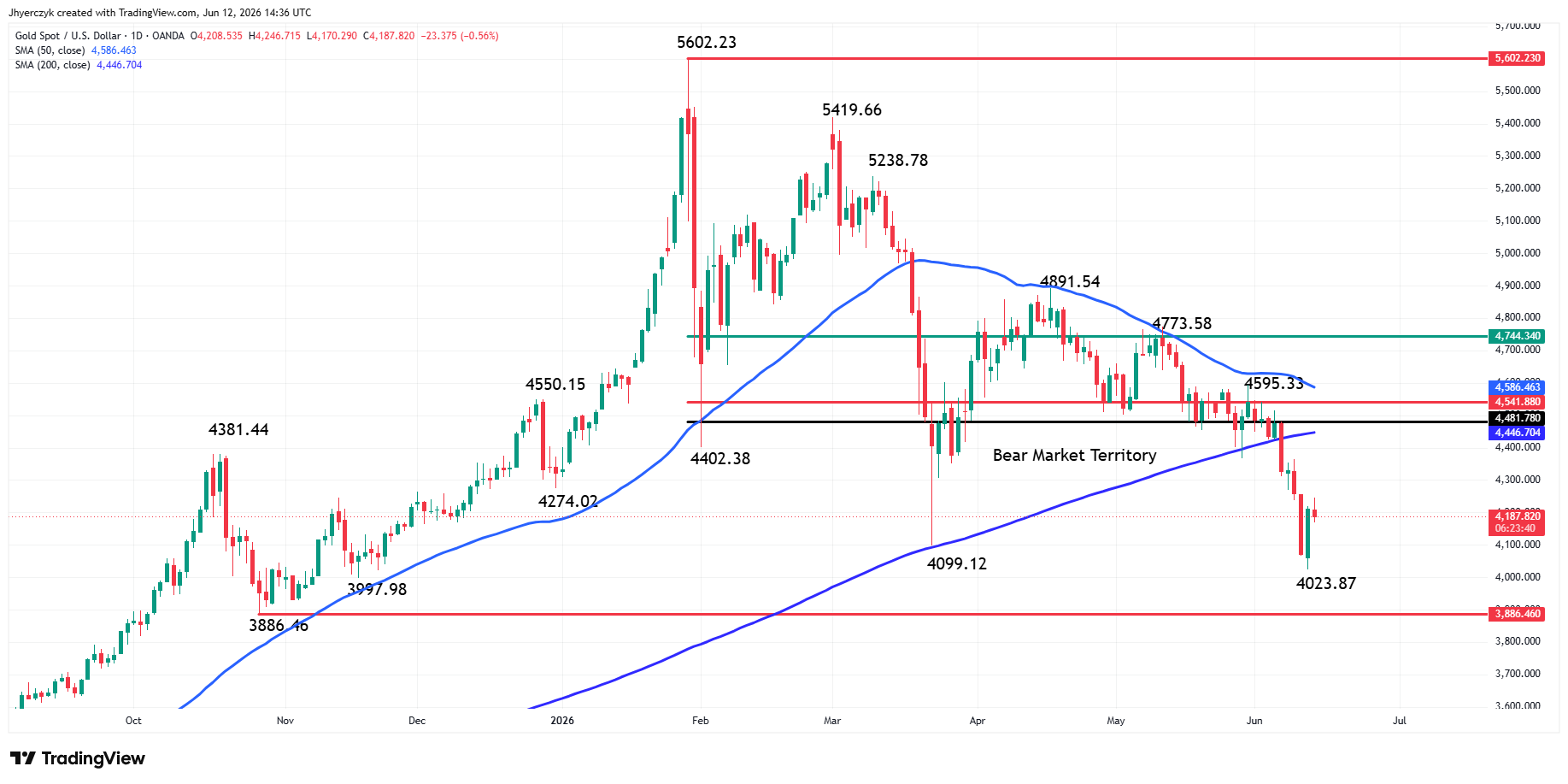
Daily Spot Gold (XAUUSD) is trading mixed mid-morning on Friday. The early session gain, however, was enough to turn yesterday’s low at $4,023.87 into a new minor bottom. It’s too early to draw in the minor retracement levels so our focus at this time will remain on the bigger picture outlook.
Our main trend is down according to the swing chart and moving averages. Our focus on the upside is the Bull/Bear line at $4,481.78. It separates the bear market from the bull market, or 20% from the record high.
The first moving average resistance is the 50-day at $4,446.69. The second resistance level is the 200-day at $4,586.41. We can see where they are and can recognize what they have meant to the market over the near-term. The 50-day MA has clearly been providing resistance for at least two months. The 200-day was the trigger point for an acceleration to the downside on Friday, June 5.
What we don’t know about the 50-day and 200-day MAs is their relationship to each other. We have a situation right now that shows the 200-day MA climbing and the 50-day MA trending lower. I think something will have to give when the 50-day crosses to the weak side of the 200-day MA. Conventional technical analysis calls it a “Death Cross.” It could signal that there has been a structural shift from a bull market to a prolonged, accelerating downtrend.
Now we know what has happened to the market since the Bull/Bear and 200-day MA breakdowns, but that’s price. With the moving average crossover, we have to start watching for time. Traders can deal with bear markets in price because they always have hope that the next level will turn the market. But with time, nobody has a clue when it will turn. We can create windows of time with cycles, anniversary dates, and square dates but we really don’t know.
Given that time and price information, the focus should be on the chart pattern. Closing price reversal bottoms and swing chart changes in trend are the best to use.
From the support angle, I didn’t have $4,023.87 as a target, but I do have $3,886.46. This is the October 28, 2025 main bottom that launched the major rally to $5,602.23.
What to Watch
Next week’s June 16-17 Federal Reserve meeting is the first under Fed Chair Kevin Warsh. No rate change is expected, but any signal supporting a December hike could pressure gold. The Iran deal talk has crude oil falling but the inflation data from this week is already baked in. Lower oil going forward helps, but it does not undo the CPI above 4% and the PPI that beat expectations.
My read on this is the downtrend is intact and the Death Cross forming between the 50-day and 200-day moving averages adds a time dimension to the bearish case. The Bull/Bear line at $4,481.78 is the ceiling. The 50-day at $4,446.69 is the first resistance below it.
On the downside, $4,023.87 is the new minor bottom. Below that, $3,886.46 is the October 2025 main bottom that launched the rally to the all-time high. Fertig said $4,000 could break if inflation accelerates further. The data this week supports that view. Until the Fed signals something different next week, rallies on gold are sells.
More Information in our Economic Calendar.