
Spot Gold Holds Near Records as Traders Set Up for a Holiday-Week Test of the Highs
Spot gold closed the week ending December 19 at $4,338.77, up $39.39 or 0.92%, finishing $42.67 below the $4,381.44 record high. Buyers stayed active on dips through the week, and the market held its tone even with the Fed pushing back on early-2026 easing expectations.

Gold Price Steady as Softer Inflation Offsets a Hawkish Fed Tone
November inflation cooled more than expected — core at 2.6%, headline at 2.7% versus 3.1% forecast — giving traders confidence that price pressures are easing. That kept the market leaning toward additional policy loosening even though the Fed signaled reluctance.
The 25 bp cut on December 10 brought the target to 3.50%–3.75%, but the dot plot showed only one more cut in 2026 and three officials dissented. Traders haven’t seen that level of internal division since 2019.
Rate-cut odds for January hover near 21%, with April treated as the more realistic window. Even with the hawkish tone, the easing already delivered continues to support spot gold.
Geopolitics Still Providing Support for Spot Gold
Tensions between the United States and Venezuela escalated after Washington halted sanctioned oil flows over a tanker seizure. Putin’s reaffirmed claims in Ukraine added to the risk backdrop. None of this looks close to resolution, and safe-haven demand stayed firm. With spot gold up 65% year-to-date — the strongest annual performance since 1979 — the geopolitical bid remains part of the structure.
Gold Price Forecast
Every new Gold analysis as it publishes, today's technical signal and key levels, live price — on one page.
See all Gold forecastsGold Analysis: Key Technical Levels Traders Care About This Week
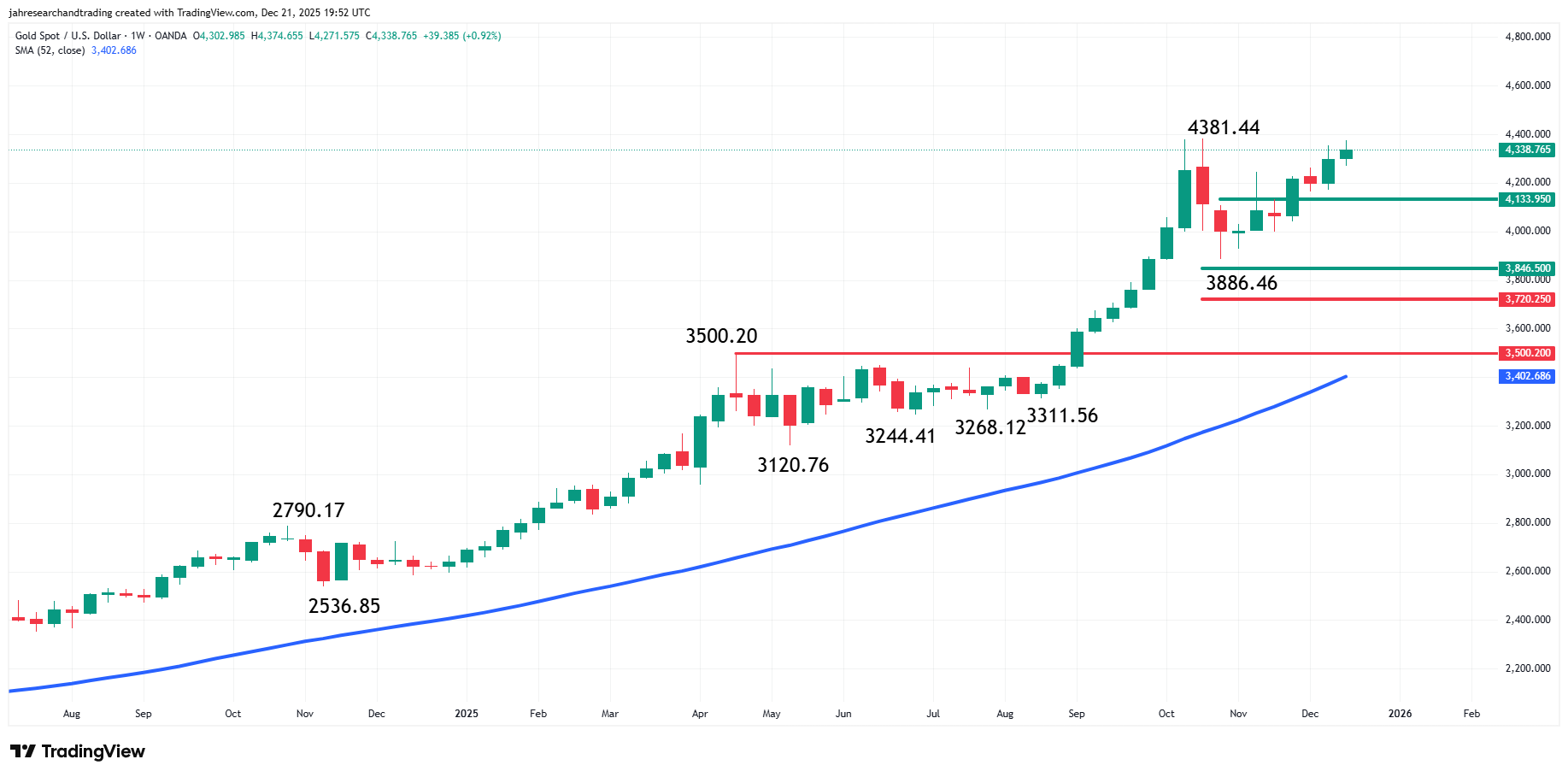
Holiday liquidity can stretch moves in both directions. The first short-term level traders are watching is the weekly pivot at $4,133.95 on XAU/USD. The next meaningful floor is the $3,886.46 swing bottom, positioned above the $3,846.50–$3,720.25 retracement zone. The longer-term trend stays bullish as long as price holds above the 52-week moving average at $3,402.69.
Central bank demand remains a strong tailwind. Roughly 220 tonnes were added in Q3, China extended its buying streak to 12 months, and Brazil re-entered the market after two years. ETF flows remain positive, and positioning still doesn’t look overstretched relative to price action.
Gold Price Forecast: Bulls Maintain Control Into Early 2026
A retest of $4,381.44 remains the primary upside focus. A sustained move through that main top could carry spot gold into the mid-$4,400s quickly, especially if early-2026 labor data softens and unemployment pushes above 4.5%. That would likely accelerate expectations for additional easing.
Short-term momentum holds as long as XAU/USD stays above $4,133.95. The intermediate bias remains supported while $3,886.46 is intact, and the longer-term bullish structure stays in place above the 52-week moving average at $3,402.69. Under those conditions, the bias stays bullish with room for another breakout attempt early in 2026.
More Information in our Economic Calendar.