
Market Overview
Gold and silver strengthened during early European trading on Tuesday as investors sought shelter from a combination of geopolitical tension and shifting monetary policy expectations. Heightened risks around global trade routes and energy infrastructure have added to market uncertainty, reinforcing demand for precious metals as portfolio hedges rather than speculative trades.
Disruptions to critical infrastructure in Eastern Europe and renewed uncertainty around energy flows have unsettled broader commodity markets. While the direct supply impact remains limited, analysts note that even localized disruptions can amplify risk sentiment.
According to the World Gold Council, central banks purchased more than 1,000 tonnes of gold for the second consecutive year in 2024, underlining institutional demand driven by diversification and geopolitical risk management. Silver, often more sensitive to industrial cycles, has benefited indirectly as investors rotate into hard assets amid uncertainty.

Monetary Policy Outlook Adds Support
Expectations of easier monetary conditions have provided an additional tailwind. Futures markets are pricing in multiple interest-rate cuts over the next year as inflation shows signs of cooling and labor-market momentum softens.
Lower rates typically reduce the opportunity cost of holding non-yielding assets such as gold, while also weakening real yields, a key driver for precious metals.
Federal Reserve officials have signaled a cautious approach, balancing inflation progress against slowing growth. Recent commentary suggests policy decisions will remain data-dependent, keeping investors focused on upcoming macro releases.
Data Watch Shapes Near-Term Sentiment
Attention is now turning to US growth and manufacturing indicators, including GDP revisions, durable goods orders, and employment data. Economists expect growth to moderate from earlier quarters, while manufacturing activity remains uneven.
Gold Price Forecast
Every new Gold analysis as it publishes, today's technical signal and key levels, live price — on one page.
See all Gold forecastsSofter-than-expected data could reinforce demand for gold and silver as defensive assets, while stronger readings may briefly favor the dollar. For now, precious metals continue to reflect a market positioning for resilience rather than risk.
Short-Term Forecast
Gold may consolidate between $4,430 and $4,550, while silver holds bullish bias above $68.15, with upside risks toward $71.90 if upcoming US data weakens and real yields remain pressured globally.
Gold Prices Forecast: Technical Analysis
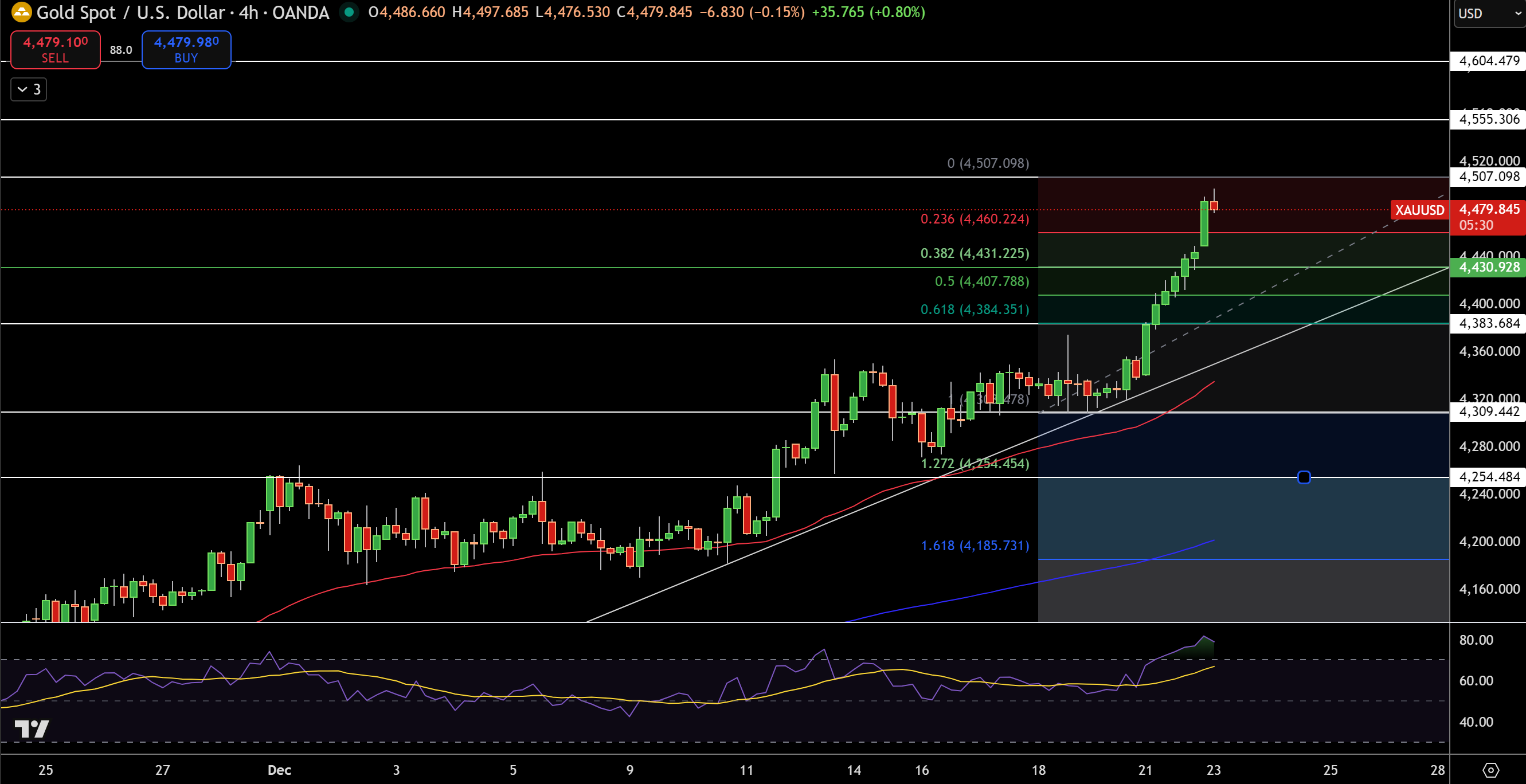
Gold is trading near $4,480 on the 4H chart after a sharp upside extension from the $4,185 base. Price remains inside a rising channel and recently tested the 0.236 Fibonacci level near $4,460, where selling pressure briefly emerged. Recent candles show long upper wicks near $4,507, signaling hesitation after the strong run.
The 50-EMA is rising steadily around $4,320, reinforcing trend support, while the 200-EMA below $4,200 confirms the broader bullish structure. RSI has pushed above 70, indicating strong momentum but also short-term exhaustion risk.
Immediate support sits near $4,430, aligned with the 0.382 retracement, while resistance remains at $4,520–$4,550. The trade idea is to buy pullbacks near $4,430, target $4,520, stop below $4,385.
Silver (XAG/USD) Price Forecast: Technical Outlook
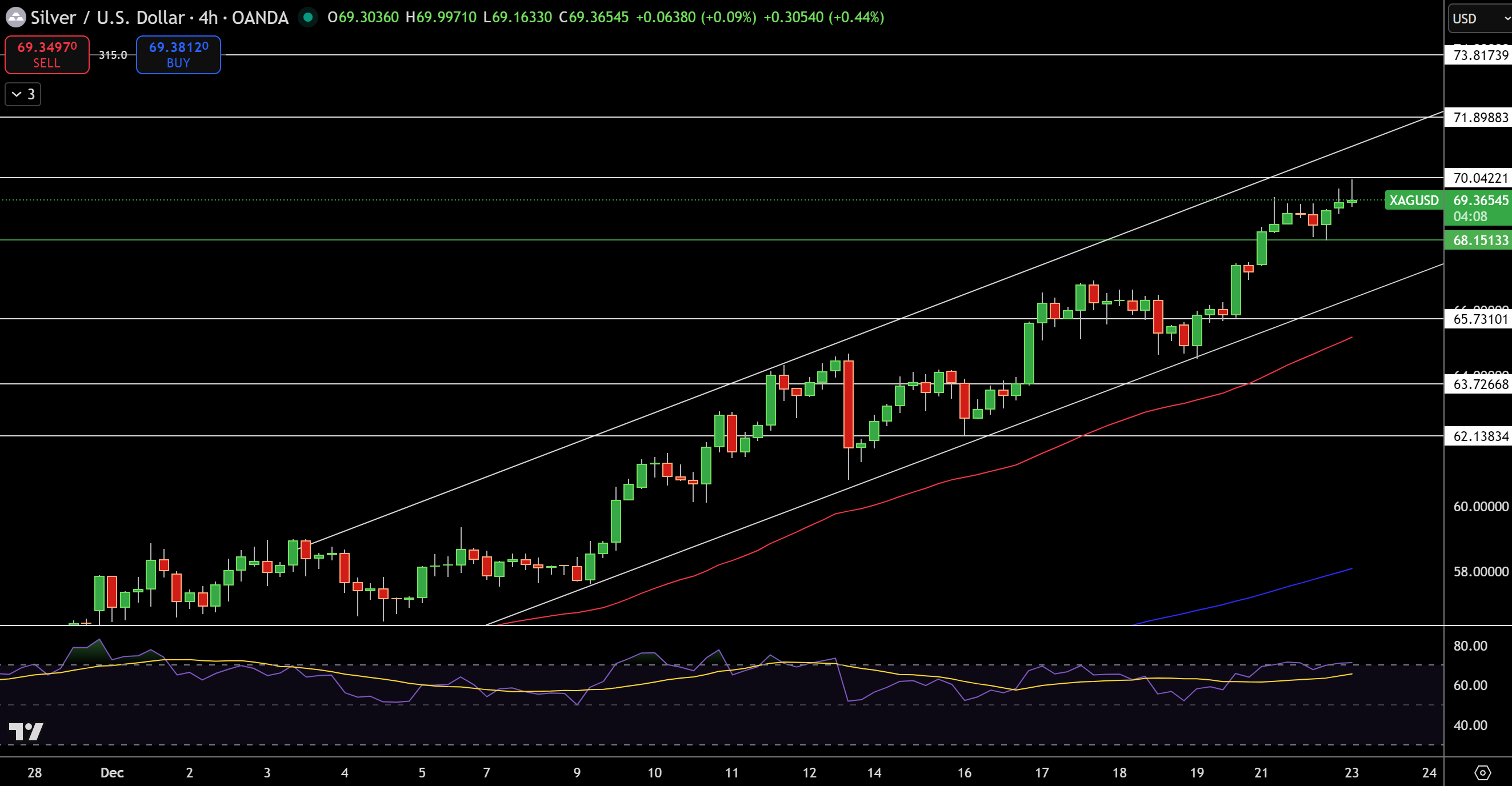
Silver is trading near $69.35 on the 4H chart, holding firm after a strong breakout from the mid-December consolidation. Price continues to move inside a well-defined ascending channel, with higher highs and higher lows intact.
Recent candles show small bodies near $70.00, suggesting brief consolidation rather than reversal after the sharp push higher. The 50-EMA is rising around $65.70, providing dynamic support, while the 200-EMA remains well below near $58.00, confirming the broader bullish trend.
RSI is hovering near 60, reflecting steady momentum without overbought conditions. Immediate support sits at $68.15, while resistance is layered near $70.40 and $71.90, aligned with prior highs and channel resistance. The trade idea is to buy on a pullback toward $68.20, target $71.80, stop below $66.90.