



December’s meeting of the Federal Reserve (‘the Fed’) and the cut to 3.5-3.75% triggered more losses for the dollar in most of its pairs, with the euro and pound gaining particularly against the greenback. However, projections are broadly slightly more optimistic and the Fed signalled only one cut next year. This article summarises expectations for the upcoming monetary policy, then looks briefly at the charts of EURUSD and GBPUSD.
The Fed’s meeting on December 10 saw a single cut to the funds rate, as widely expected. The consensus on that decision had fluctuated significantly for much of November between near certainty of a cut and about parity between single cut and hold. As it turned out, there was some dissent in the committee, with one member favouring a double cut and two others preferring to hold. A hold is likely next month with about 75% probability according to CME FedWatch, whereas there’s division in expectations for the decision in March:
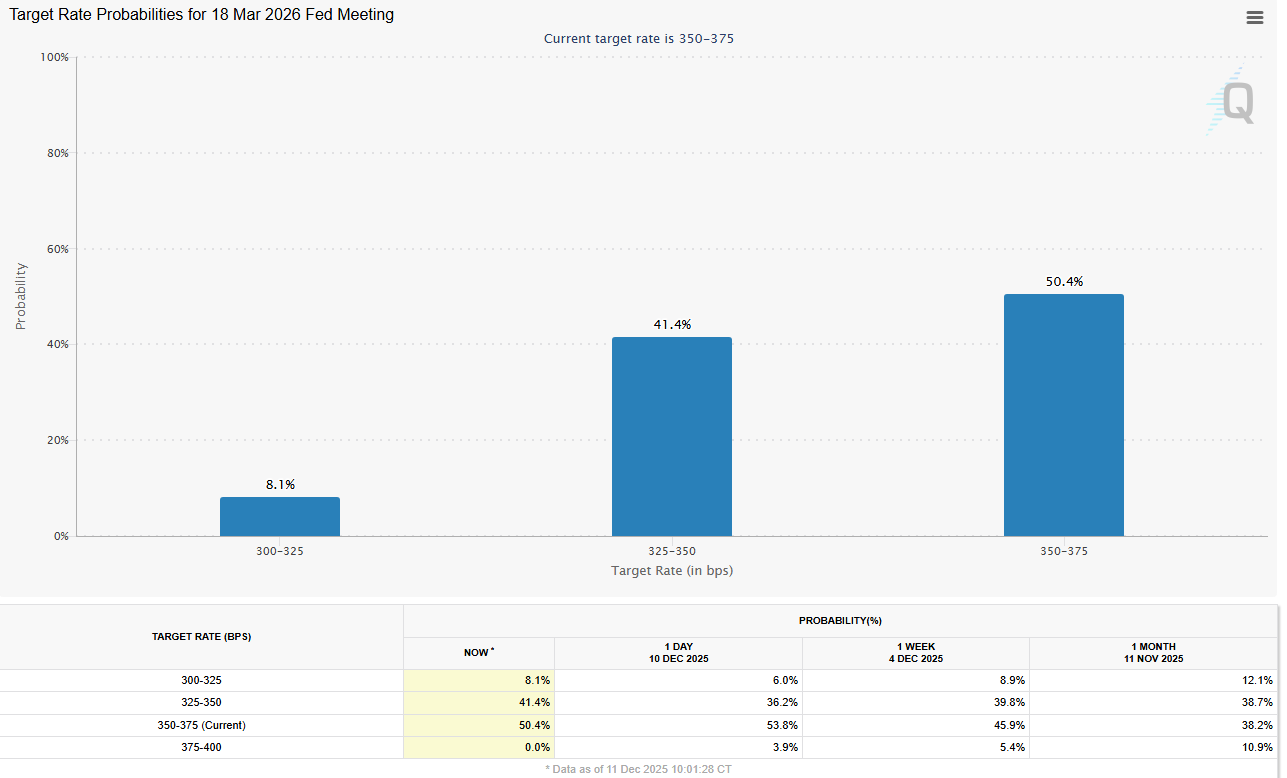
The probability of a hold hasn’t actually increased much compared to around this time last month, despite September 2025’s projections for 2026 remaining unchanged, i.e., one cut next year. Participants seem surer than the Fed that apparent headwinds in the USA, particularly the job market, mean that plural cuts will occur next year.
The unusually large amount of major data in the second half of December might help to confirm or challenge this assumption. 16 December’s double NFP for October and November is a critical release in the context of weaker jobs for much of 2025, although the numbers might be less reliable than usual due to the length of the government shutdown. 18 December’s inflation is also key: this seems particularly difficult to forecast, too, because of the shutdown. Further ahead, there’s likely to be more movement around GDP for the third quarter on 23 December.
In terms of monetary policy alone, it’s difficult to see ongoing, significant losses for the dollar in many of its pairs because the differential in rates with the euro and yen is unlikely to shrink much until next summer. However, traders have been focusing on employment recently, so weaker numbers on 16 December might drive more losses for the greenback.
Euro-dollar Pushes Above $1.17
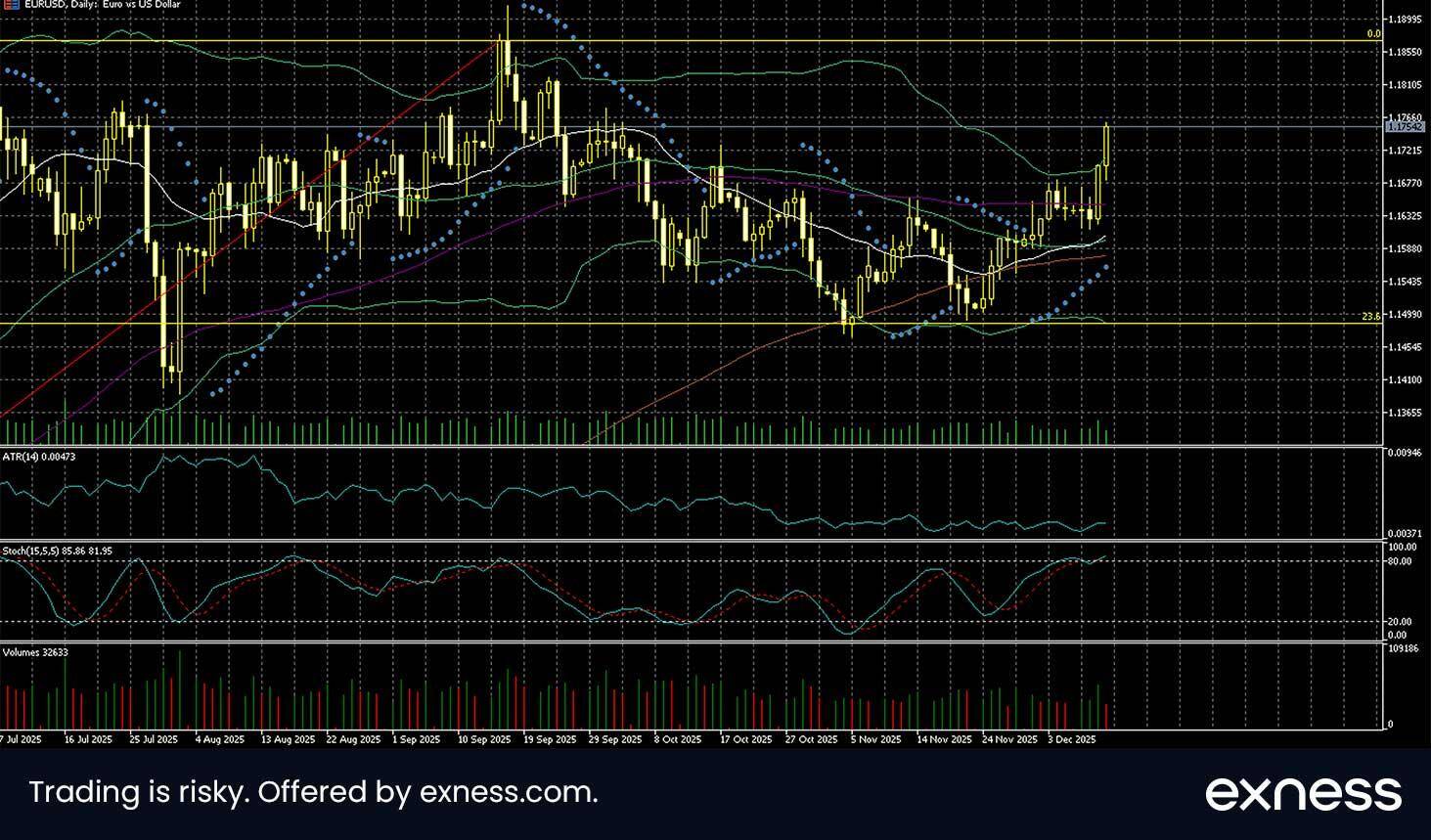
Euro-dollar’s recent gains continued in the aftermath of the Fed’s cut on 10 December, as senior members of the ECB commented on further cuts being likely unnecessary, and focus on political problems in the EU, primarily France, declined. The ECB will likely raise its forecasts for growth next year, while attention remains focused on the USA’s seemingly weakening labour market.
With only 11 December clearly above $1.17, it’s too early to call that day’s movement a decisive breakout, but since buying volume is at least not lower and the price is above all of the moving averages, it’d be possible to see more gains to come, just maybe not immediately. Both the slow stochastic and Bollinger Bands signal overbought. 16 September’s closing high around $1.187 is an obvious medium-term target.
The main candidate for a static area of support is the 23.6% weekly Fibonacci retracement around $1.149, but before that, all four moving averages, 20, 50, 100, and 200, are likely to be dynamic supports. The double NFP on 16 December could drive more significant movement.
EUR/USD Price Forecast
Every new EUR/USD analysis as it publishes, today's technical signal and key levels, live price — on one page.
See all EUR/USD forecastsCable’s Strong Bounce Continues for Now
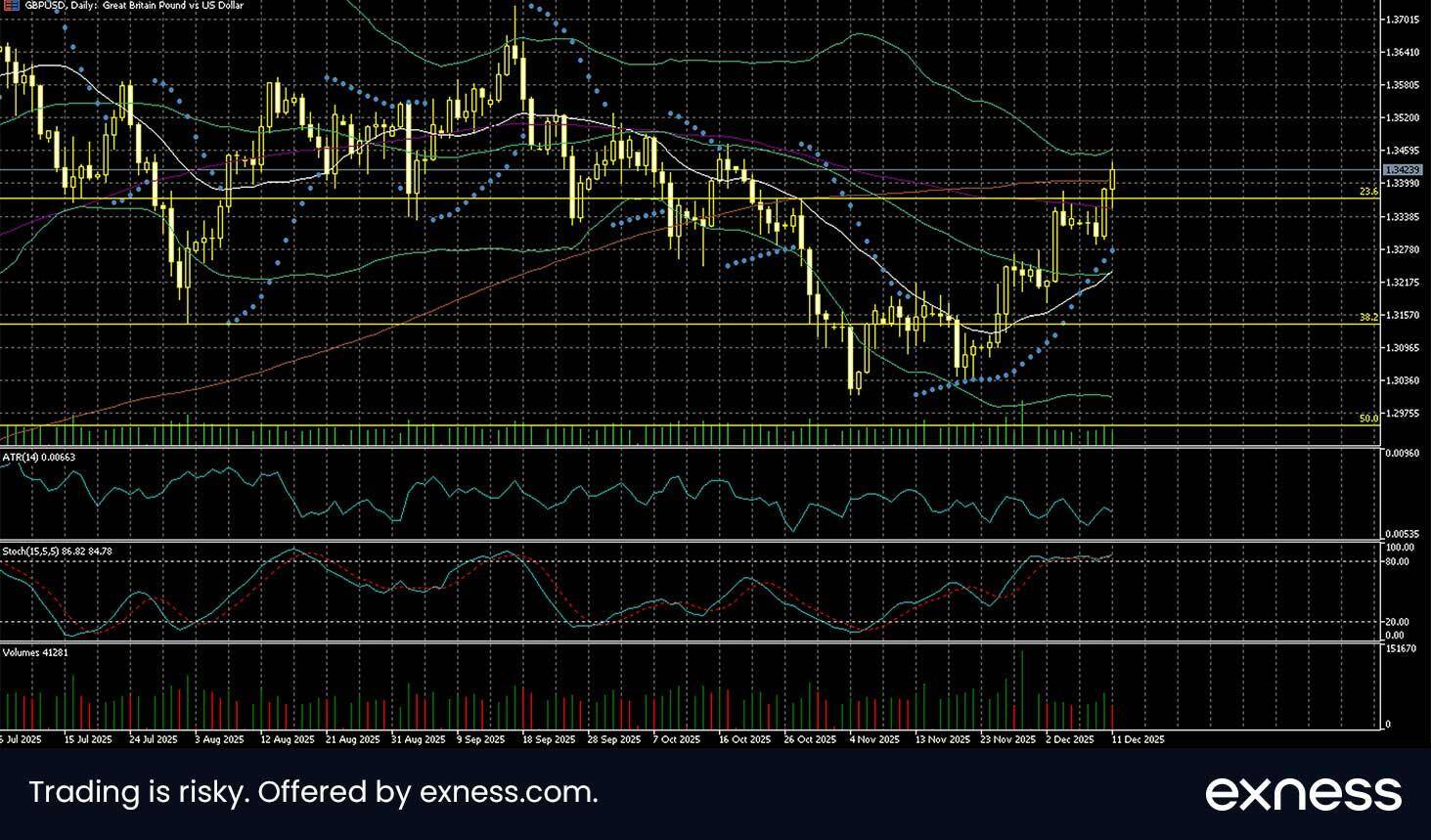
Cable moved further up on 11 December to highs of around six weeks as the dollar generally weakened. Possible political instability in Britain is out of focus now and a cut by the BoE on 18 December seems to be fully priced in with around 85% probability. Inflationary pressure in Britain remains overall high, though, so the BoE might be significantly less dovish in 2026, while most participants are expecting two cuts by the Fed next year.
Although cable’s bounce from November’s lows has been vigorous overall, this phase might be approaching exhaustion. The slow stochastic has signalled oversold for nearly a fortnight and buying volume has dropped since 28 November. $1.35 would be the next clear possible target, while the 23.6% weekly Fibonacci retracement around $1.337 is a technical reference.
Most of the round numbers are possible supports with different likely strengths. Another push all the way down to $1.30 seems very unlikely in the near future unless data and sentiment shift significantly. As for the euro-dollar, the double NFP on 16 December and American inflation two days later are centrally important releases which might make upcoming movements clearer.
This article was submitted by Michael Stark, financial content leader at Exness.
For the latest analysis, ideas for trading and more, follow Michael on X: @MStarkExness.
The opinions in this article are personal to the writer; they do not represent those of Exness. This is not a recommendation to trade.