
Market Overview
Crude oil and natural gas markets went up this week as things in the Middle East started to get really hairy and that’s just amplified concerns about supply. WTI futures touched $97 a barrel , showing a pretty sizeable 5% gain for the week even though they’ve ticked back a bit from their earlier highs.
The escalating air strikes in the Middle East and the fact that the Strait of Hormuz is still shut down are causing all sorts of problems – disrupting production and making it hard to get oil shipped out – which is all adding to worries about how tight global supply is going to be.
Tried efforts to calm things down have had a pretty limited impact. Releasing 400 million barrels from emergency stockpiles hasn’t made much of a dent in the price, nor have the temporary passes that let stranded Russian oil get loaded up and moved to market.
But all this is also leading to some calls – loud calls – for coordinated security measures to try and calm things down. And it’s all just a indication of just how volatile energy markets are right now.

Natural Gas Price Forecast: Is $3.37 the Launchpad for $3.60?
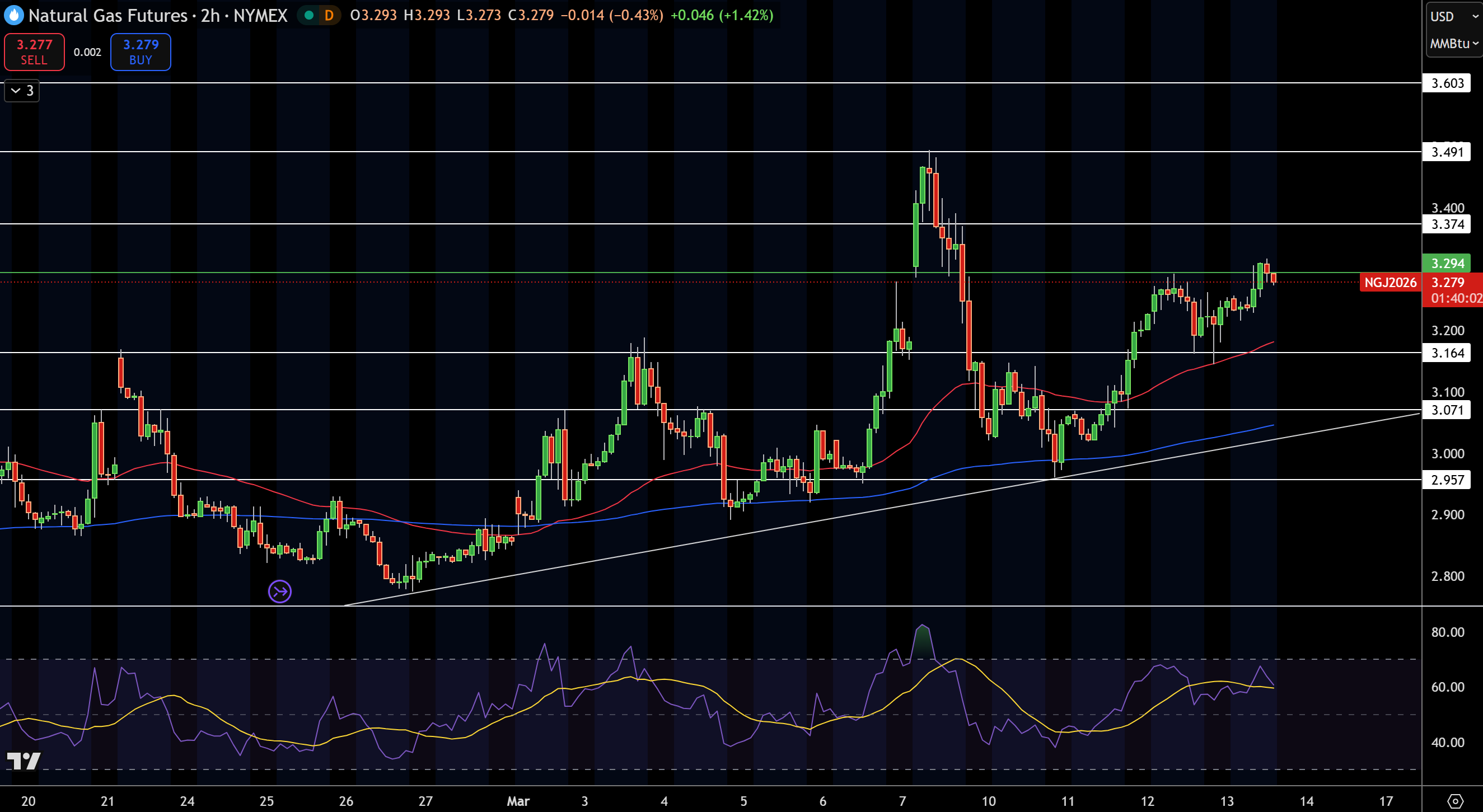
Natural Gas (NG) is doing a bit of trading just near $3.29 after rebounding from $3.00 support. The price has actually reclaimed both the 50- and 200-period MAs now and they’re starting to slope upwards – which is a good sign of improving momentum. The ascending trendline from the late February also remains intact, so that reinforces the short term bullish structure.
RSI is near 60 once again, which is a good sign of some fairly steady buying pressure going on, but not extreme conditions just yet. So right now we have some resistance up at $3.37 followed by $3.49. A confirmed breakout up there could be the start of some serious gains towards $3.60.
If we dont see a breakout then we could have failure to hold above $3.16 and that would weaken the momentum with a retest of the demand zone between $3.07 and $2.95.
Natural Gas Price Forecast
Every new Natural Gas analysis as it publishes, today's technical signal and key levels, live price — on one page.
See all Natural Gas forecastsWTI Crude Oil Forecast: Will $98 Break Trigger Rally Toward $103?
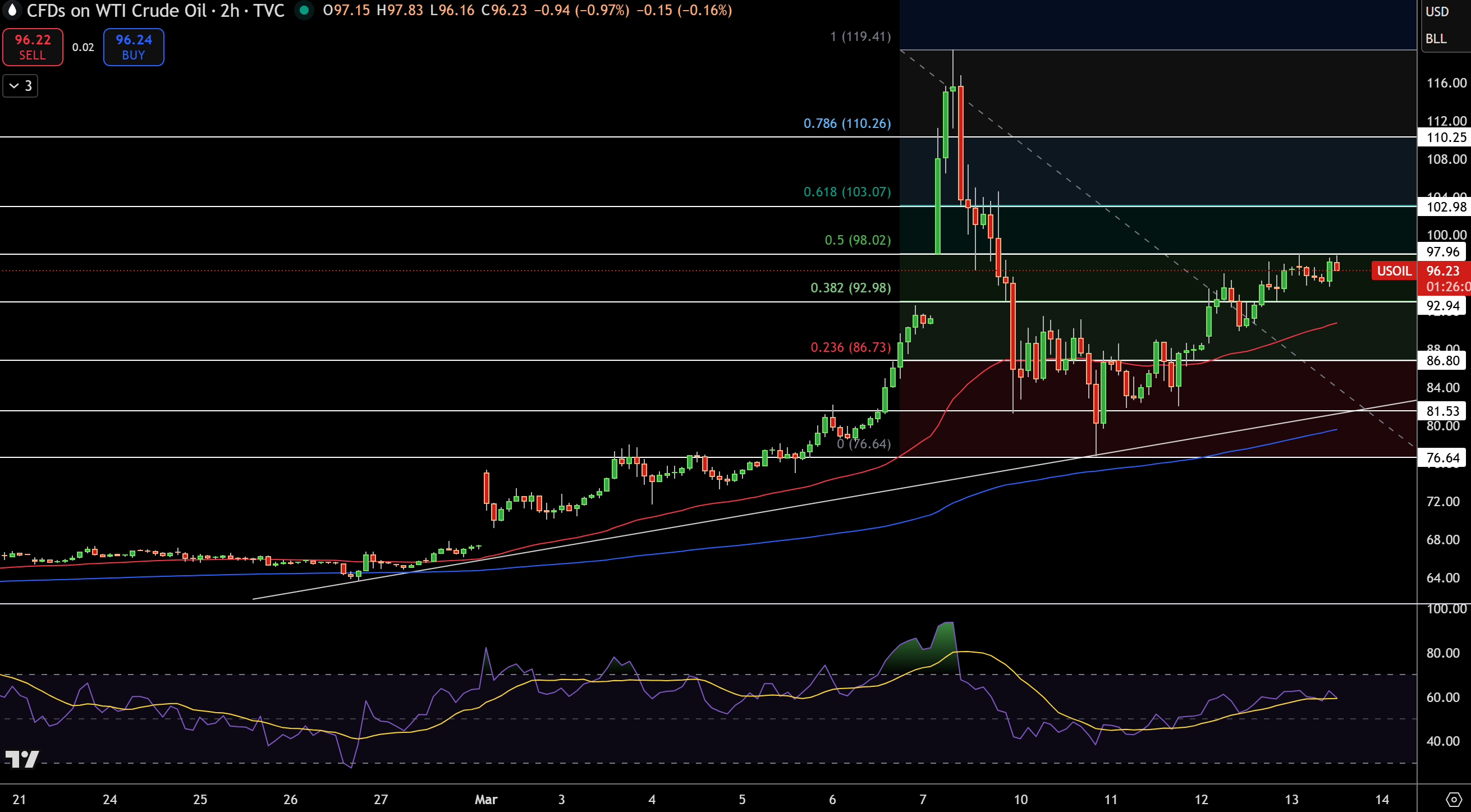
WTI (USOIL) finally steadying itself around $96 after a pretty sharp pullback from that $110 Fibonacci 0.786 zone. price has gone into consolidate mode between its 0.382 retracement at $92.98 and the psychological resistance area between $98 and $100. The 50-period moving average is flatlining whilst the 200-period MA is still heading upwards – which suggests that a broader bullish structure remains intact.
The RSI is hovering just around 60, which I suppose indicates moderate to fairly strong bullish momentum, assuming it isn’t overdone. A sustained break above $98 could be the key to exposing that $103 target (0.618 Fib) – but a failure to hold $92.90 would probably just turn the focus back towards $86.70 and – if it drops any further – $81.50 support.
Brent Oil Price Outlook: Can Bulls Clear $105 to Retest $113?
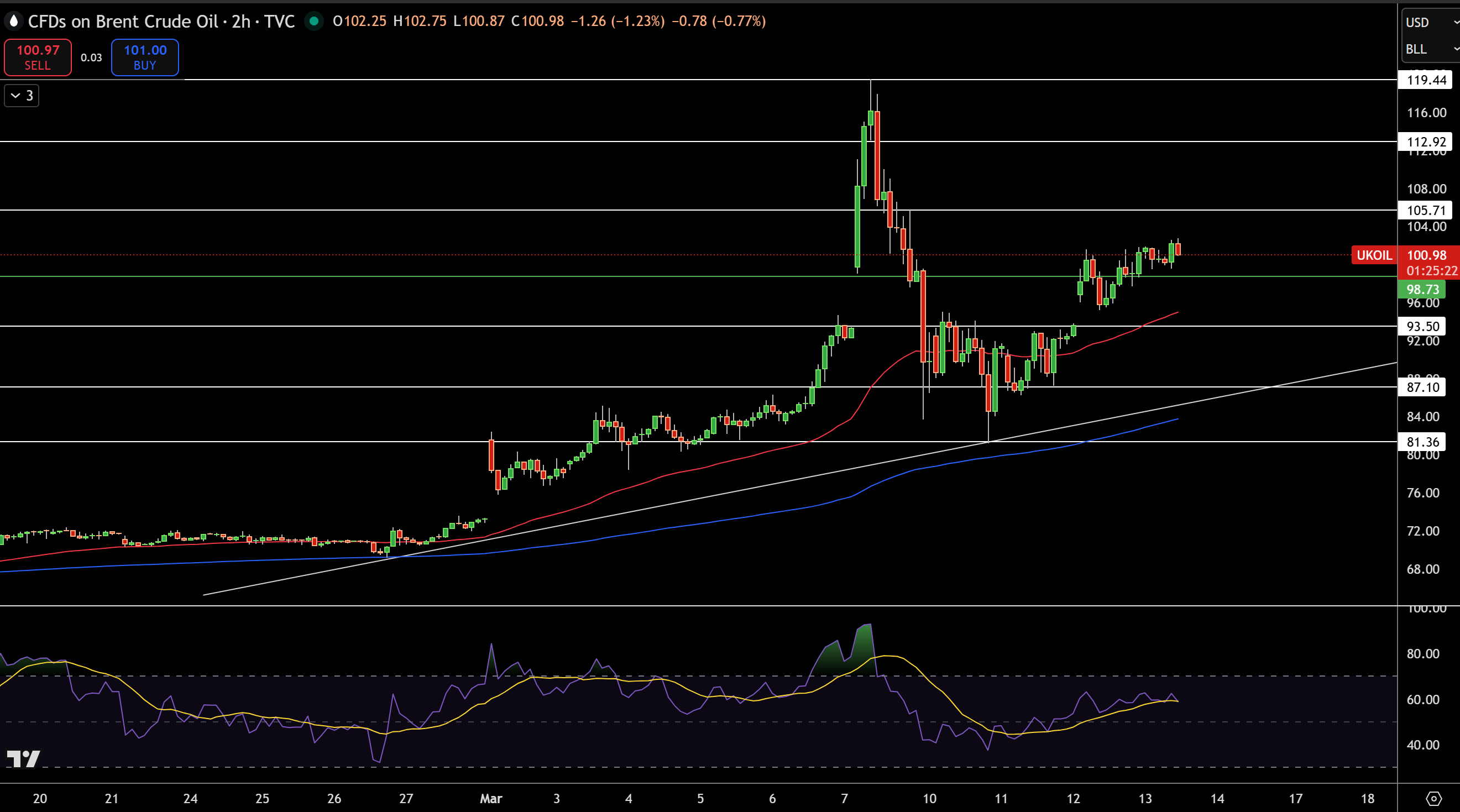
Brent (UKOIL) is doing some trading just near $101 after it rebounded from that $87-$90 support zone. As long as price remains above the rising 200-period MA the broader uptrend will be intact. However, the short term structure shows that higher highs are appearing, but resistance at $105.70 is putting the brakes on it at the moment.
The 50-period moving average is acting almost like a dynamic support point near $98.70, which reinforces the idea that there’s bullish bias whilst price remains above it. RSI’s starting to recover towards 60, which is a good sign of some strengthening of the momentum.
If we do see a breakout above $105.70 then we could possibly open up the $112.90 highs again. On the other hand if Brent drops below $98 then we’re likely to see a retest of $93.50 and the trendline support.