
Market Overview
Oil and natural gas prices have started to ease back a bit now that the latest EIA report has thrown a bearish curveball. The report was gloomy: gasoline inventory levels shot up by 5.8 million barrels, and distillate inventories rose by 5.0 million barrels.
Moreover, a strengthening US dollar is piling on the pressure. Despite all this bearishness, price falls are still being held back by the threat of geopolitical conflict. One thing that kept crude prices afloat, though, is the expectation that OPEC+ will put the brakes on any further output increases into early 2026, even though the IEA is warning of a crude surplus of 4.0 million barrels per day next year.
Moreover, strong demand from Asia, particularly in China, is helping to prop up prices, as China’s oil imports climbed by 10% last month to 12.2 million bpd, keeping oil and natural gas prices reasonably stable amid the overall volatility of global markets.

Natural Gas Price Forecast
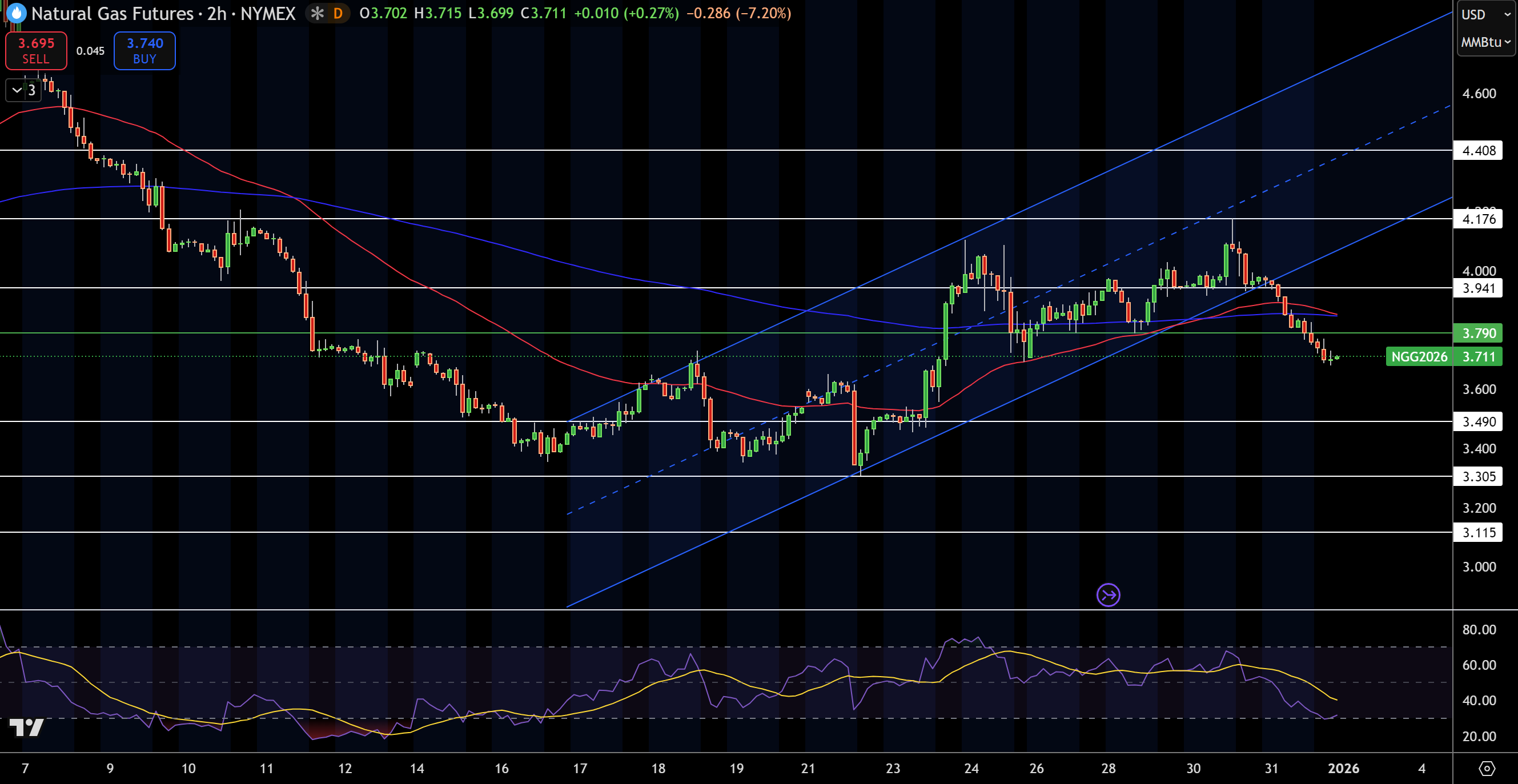
Natural Gas futures closed at around $3.71 as the market closed for the New Year holiday. Prices are mirroring their levels from December 31st. Looking at the 2-hour chart, you can see that the price has taken a step back, finding itself back within a rising trend channel and slipping beneath the channel midline after barely scraping by near $4.05.
The 50-Day EMA has also just switched from rising to falling around $3.85, and the 200-Day EMA is still well out of the way at $4.17, which will act as a ceiling.
The RSI is down towards 38, indicating some short-term weakness in the air. The current levels are clear: key support lies at $3.65 and $3.50, with resistance just above at $3.95.
WTI Oil Price Forecast
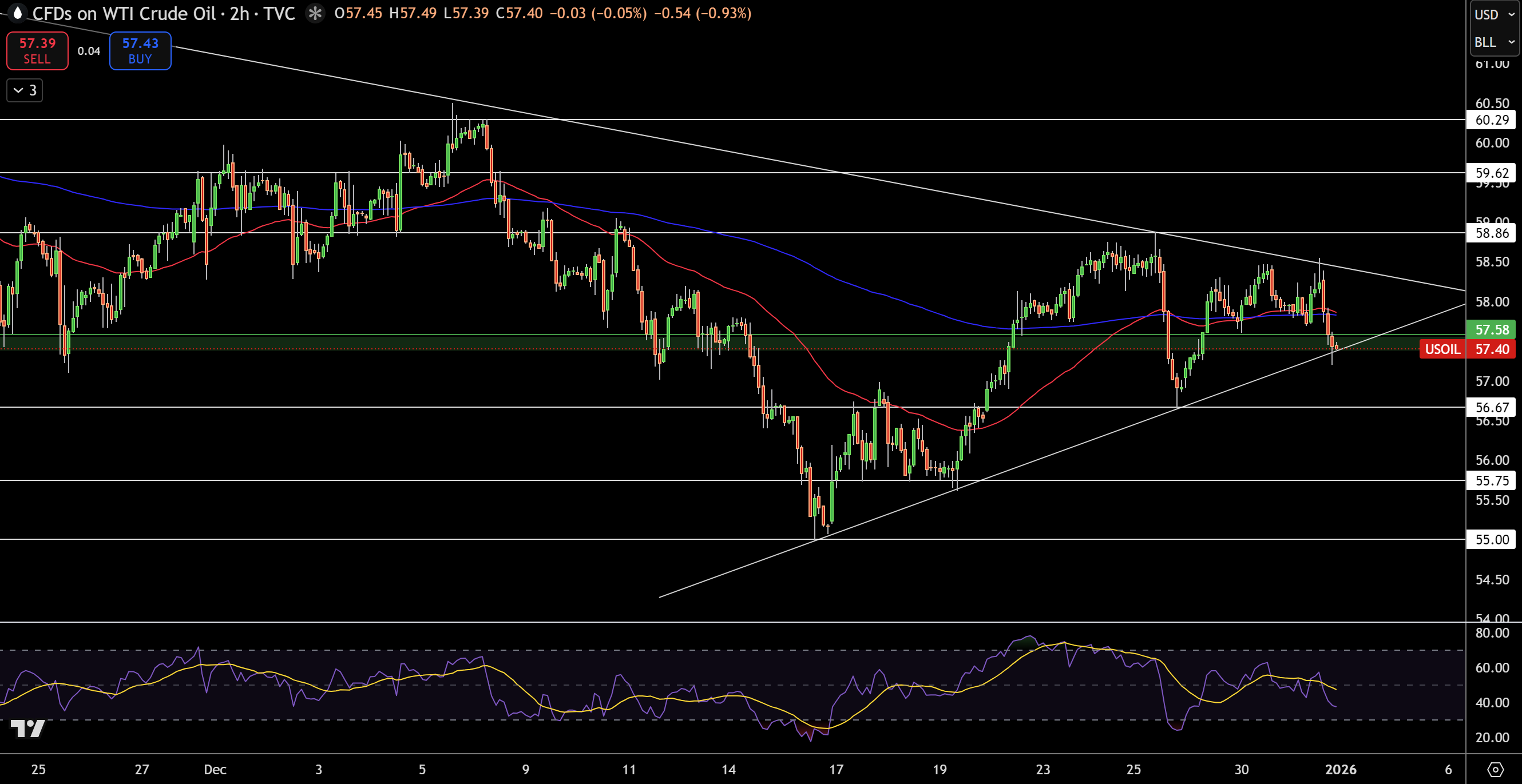
WTI crude oil is hovering around $57.40, with today’s prices reflected in the December 31 close, as the markets remain shut for the New Year’s holiday. On the 2-hour chart, you can see that the price is trading in a symmetrical triangle, a triangle formed by a falling upper trendline and a steadily rising support line that began in mid-December.
Natural Gas Price Forecast
Every new Natural Gas analysis as it publishes, today's technical signal and key levels, live price — on one page.
See all Natural Gas forecastsThe RSI is sitting right in the middle of the road; there’s nothing particular to see in terms of momentum. We’ve got support at $57.00, then $56.20, and then the resistance is $58.20 and $59.60. What we’re looking for in terms of a trade is a confirmed break above $58.20 for a long, with a target of $59.60. I’d put a stop loss at below $57.40.
Brent Oil Price Forecast
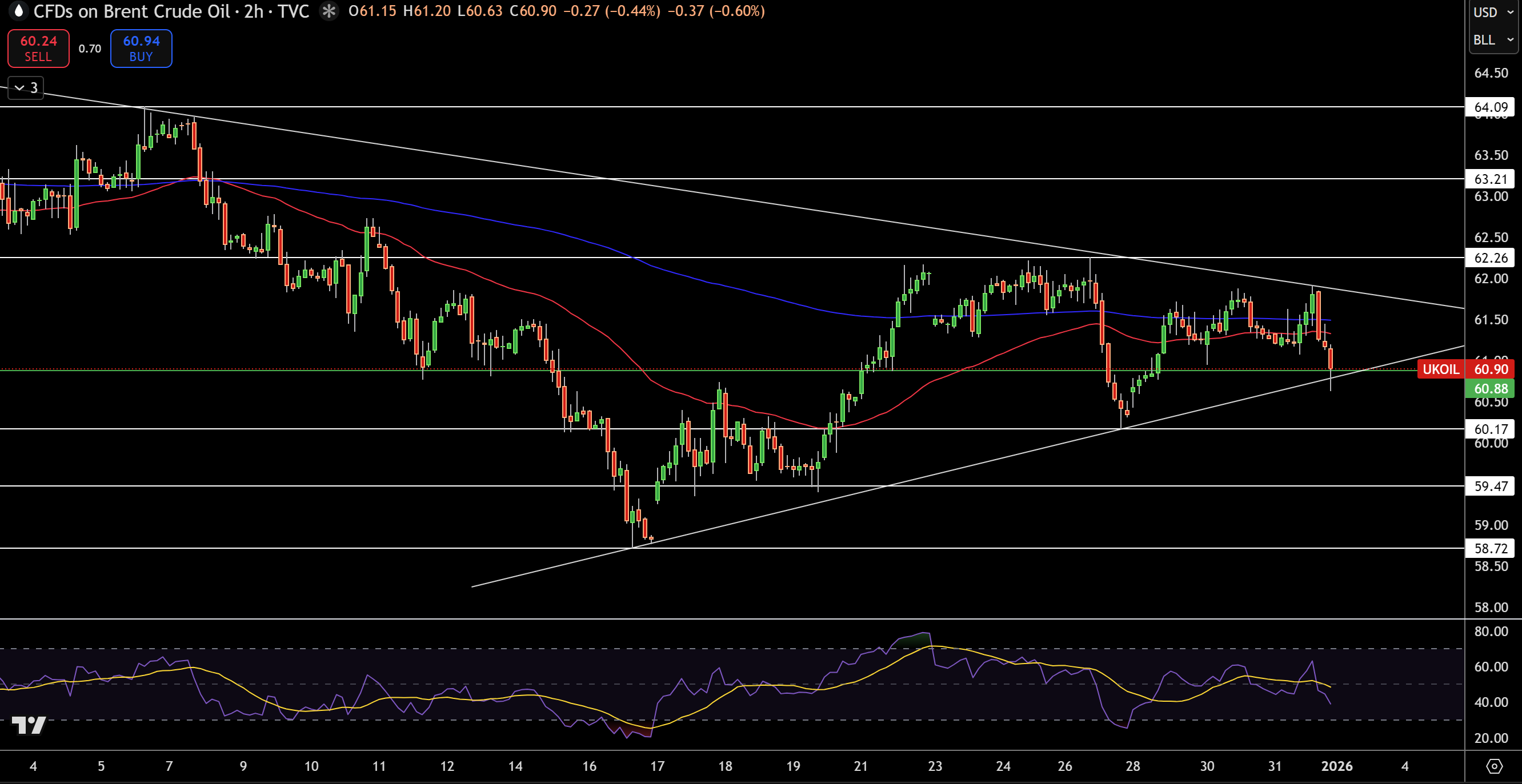
Brent crude closed on Dec 31st at around $60.90 as the market was closed for the New Year holiday. The 50-period EMA has been chugging along around the $61 mark, but the 200-period one at $62.30 is still putting a cap on any little rallies we see.
The leading indicator, RSI, is hovering around 45, which is neutral for momentum. Talking about support, Brent got it at $60.20, then $59.50, but the resistance that’s been holding everything back has been around $61.80 and $62.30.
So the trade market is looking at is to go long if we break above $61.80, and my target would be $63.20. In the meantime, it’s worth keeping an eye out to stop this trade if we fall below $60.20.