



Oil and Gas Fundamentals Reflect Supply Discipline and Seasonal Demand
Global oil markets remain steady, with the supply from non-OPEC nations, particularly the United States, offsetting the production discipline of OPEC+ on July 1. Meanwhile, global refining capacity is being used at an elevated level in response to seasonal demand for transportation fuel and petrochemicals. Crude oil and product inventory movements in some major storage areas are modest given that the supply/demand fundamentals remain well matched. U.S. crude stock data for the period indicated minimal net change, with operating inventories in some key hubs at working minimum levels.
The U.S. downstream demand was also robust with demand for refined products supported by the steady economic activity and seasonal transportation needs.
The U.S. dry gas production was again on a new record. The additional supply was due mainly to associated production from the oil patch. The LNG sector is operating at a high rate in July. Domestic gas inventory build remains healthy during the injection season with working gas volumes at levels above their long-term average and weather in general. U.S. gas fundamentals for July indicate a market well supported by record-high levels of domestic gas production with significant LNG exports and steady domestic demand from the power sector and other uses.

Natural Gas Futures Rise to $3.220 – Green Channel Momentum on 2h
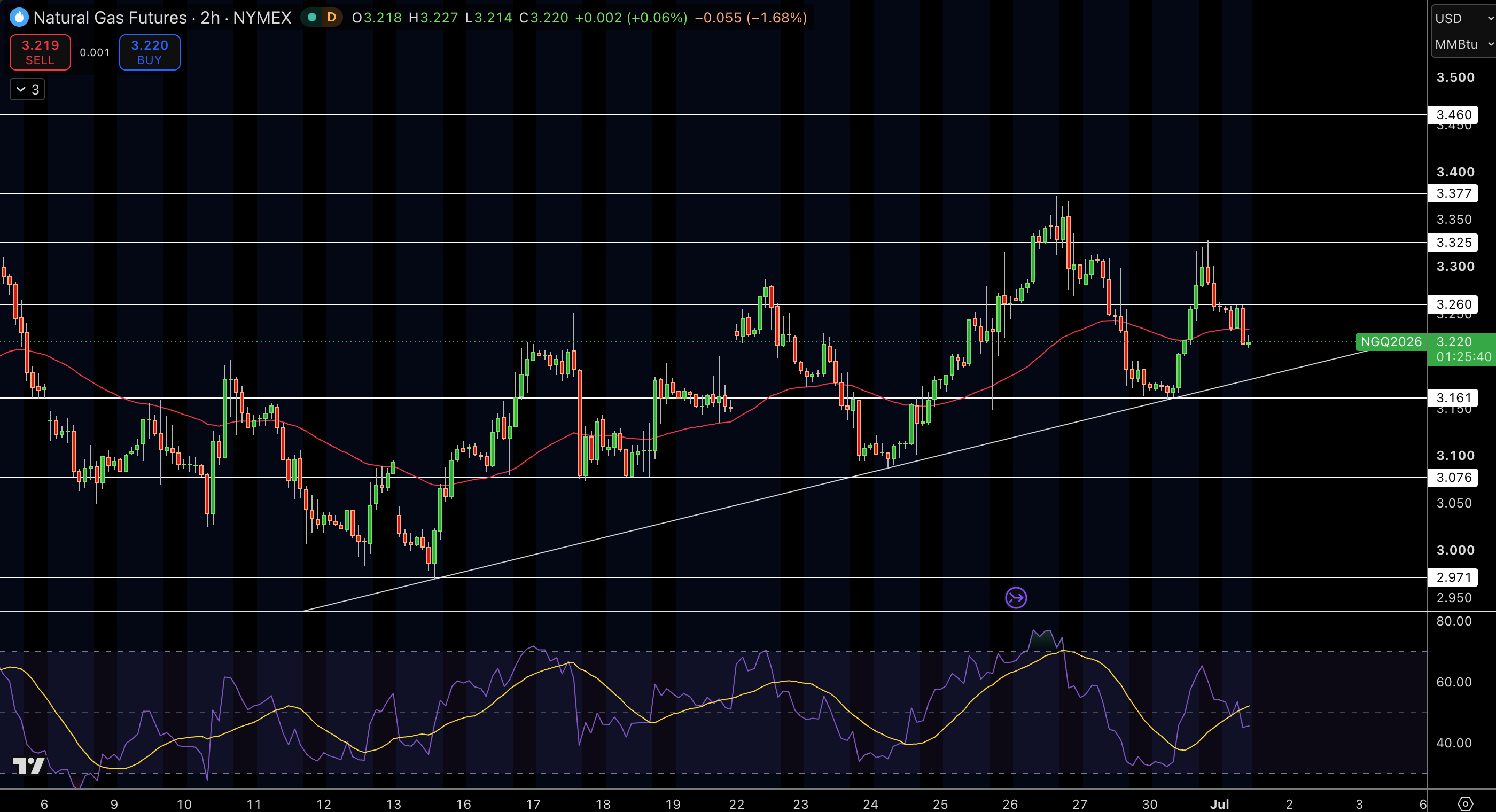
Futures for natural gas are trading at $3.220 on the NYMEX 2-hour chart. Green and red candles held up inside the blue ascending channel at $3.18 above the red MA. The swing low at $3.099 saw bullish rejection wicks on the upside, implying that buyers are in control on dips. RSI is around 52 and this points to a neutral-to-bullish market sentiment.
Based on the volume profile, we see that $3.12 is a strong support pivot area. On the Fibonacci extension, $3.229 to $3.260 is the next resistance zone. The market structure remains bullish above $3.099, and we continue to benefit from the clean ascending channel. We can see the pattern of higher highs and higher lows which gives buyers an opportunity to enter during the dip.
Trade Idea: Buy $3.220, targeting $3.260, with a stop at $3.12.
WTI Crude Oil Holds $69.64 – Blue Support Zone Defense on 2h
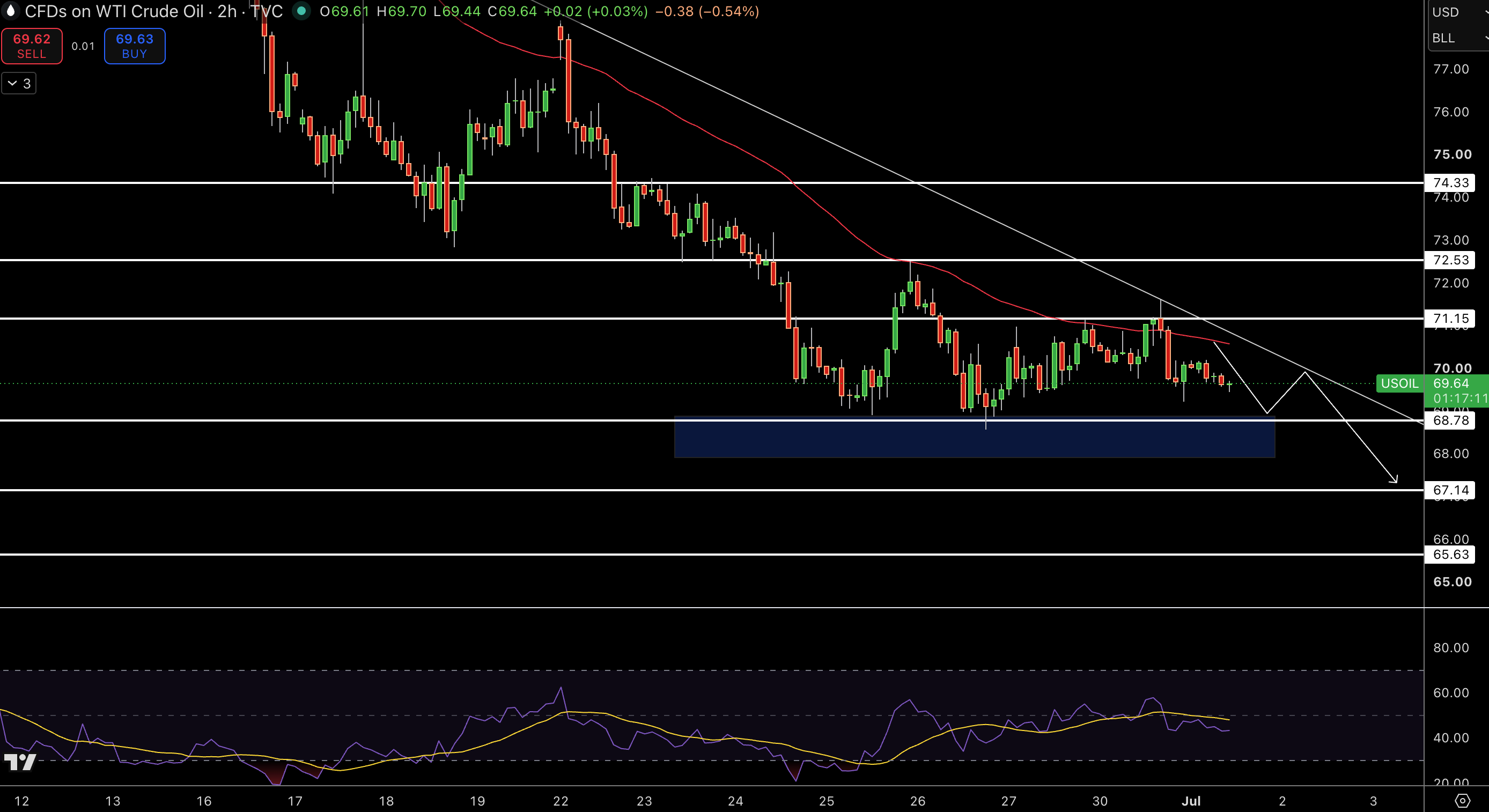
The 2-hour chart for WTI is at $69.64. Green and red candles defended the blue support zone close to $68.78 after turning back the rise near the red MA at $72.53. We can see bullish rejection wicks on both sides, implying that buyer absorption is taking place within the support zone, with higher lows holding. RSI is hovering close to 50 and this points to neutral market momentum.
Natural Gas Price Forecast
Every new Natural Gas analysis as it publishes, today's technical signal and key levels, live price — on one page.
See all Natural Gas forecastsBased on the volume profile, we have a fair value cluster that is emerging from $69 to $71. The white descending trendline is acting as the upper boundary around the $71.15 level. We still have a neutral-to-bullish market structure above the support zone despite the overall downward trend. Higher lows continue to allow buyers to step in during the dip.
Trade Idea: Buy $69.64, targeting $71.15, with a stop at $68.78.
Brent Crude Oil Holds $73.06 – Blue Descending Channel Floor on 2h
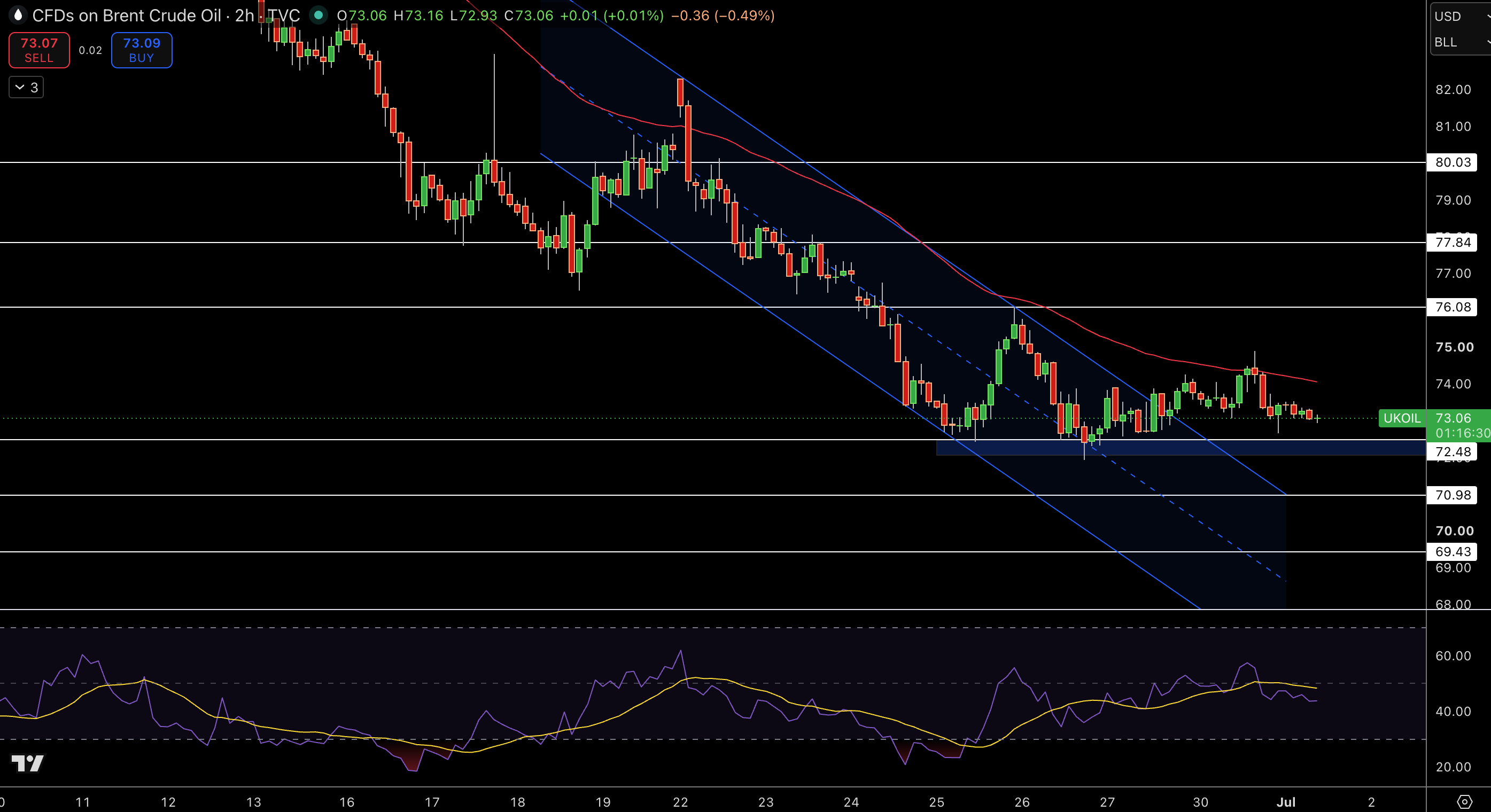
The 2-hour chart for Brent is at $73.06. Green and red candles tested the floor of the blue descending channel near $72.48, following the retreat near the red MA at $78.27. We are seeing bullish wicks from both sides, pointing towards buyer absorption at support with the lack of follow-through. RSI is close to 50 and this suggests neutral market sentiment.
On the volume profile, a fair value cluster is emerging at $73 to $74. The resistance zone at $74.49 to $76.08 is the next key level. We still have a neutral-to-bullish market structure above the floor of the channel despite the broader downtrend. Higher lows allow buyers to participate on pullbacks.
Trade Idea: Buy $73.06, targeting $76.08, with a stop at $72.48.


