Gold (XAUUSD) prices remain under pressure as there is no sign of improvement in the peace efforts between the United States and Iran. There was some relief earlier priced into the market after a potential breakthrough in diplomacy. But Iran’s refusal to meet senior U.S. envoys shows that the ceasefire process is still fragile. This increases the risk of inflation as any renewed tensions in the region could drive oil prices higher. The higher inflation risk hurts gold as the market expects the Fed to remain hawkish. This environment introduced another round of selling pressure in the gold market to push the prices below $4,000.
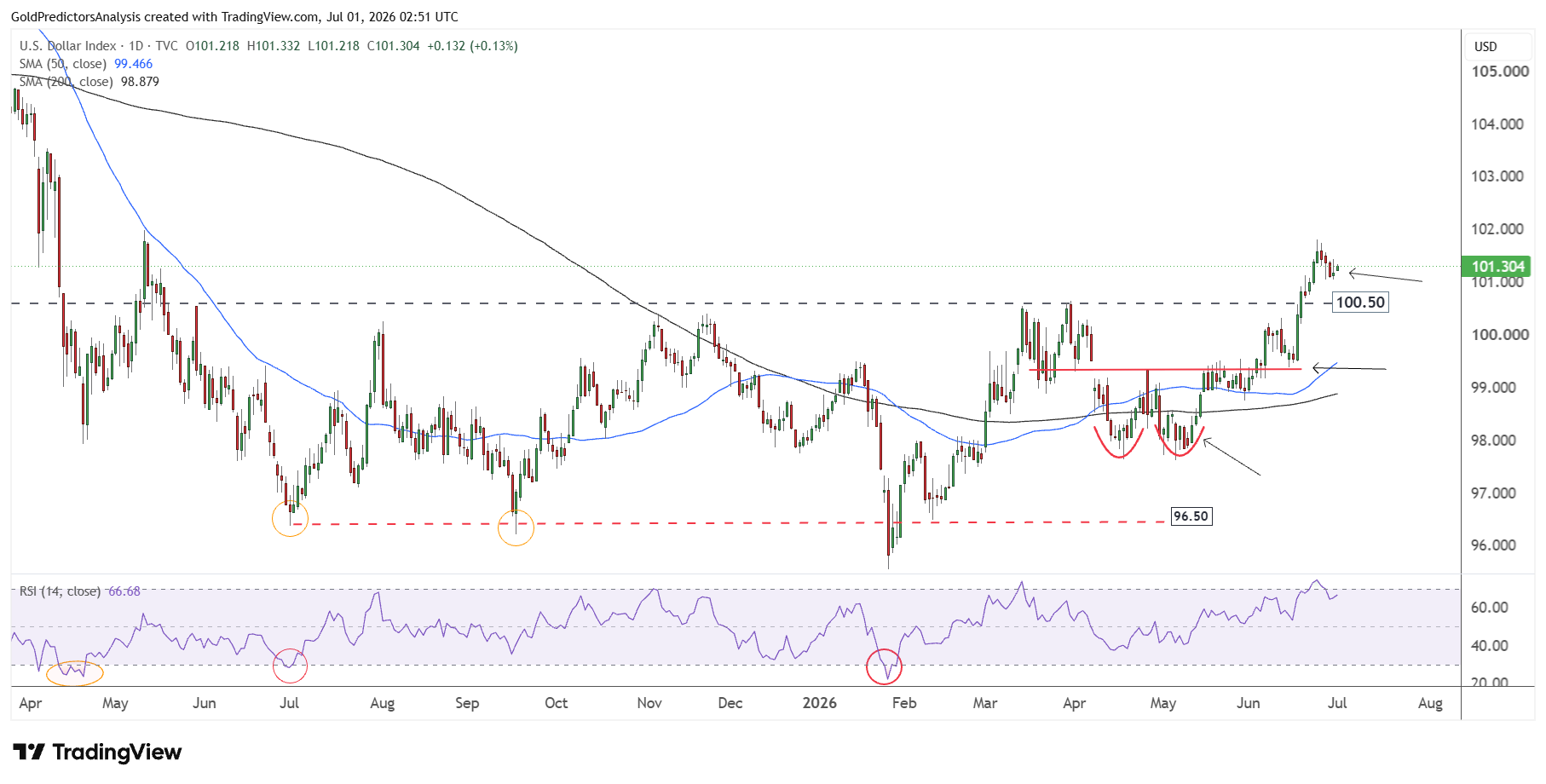
The expectations of higher interest rates have kept the US dollar strong, as seen in the chart below. The index has already broken the 100.50 in June. The index consolidates above this level and looks for further upside in July. This may keep the gold and silver prices under pressure in the short term.
The silver (XAG) price drop is even steeper than the gold price because it is sensitive to growth sentiment and monetary policy. Spot silver remains under pressure below $60 as traders reduced exposure in precious metals ahead of the ADP and nonfarm payrolls. The Fed’s hawkish measure may be further justified by the robust jobs report that could drive silver prices down in the near term. But the big picture for metals remains strongly bullish.

Gold Price Forecast – $3,900 Support Comes into Focus
XAUUSD Daily Chart Points to Oversold Rebound Risk
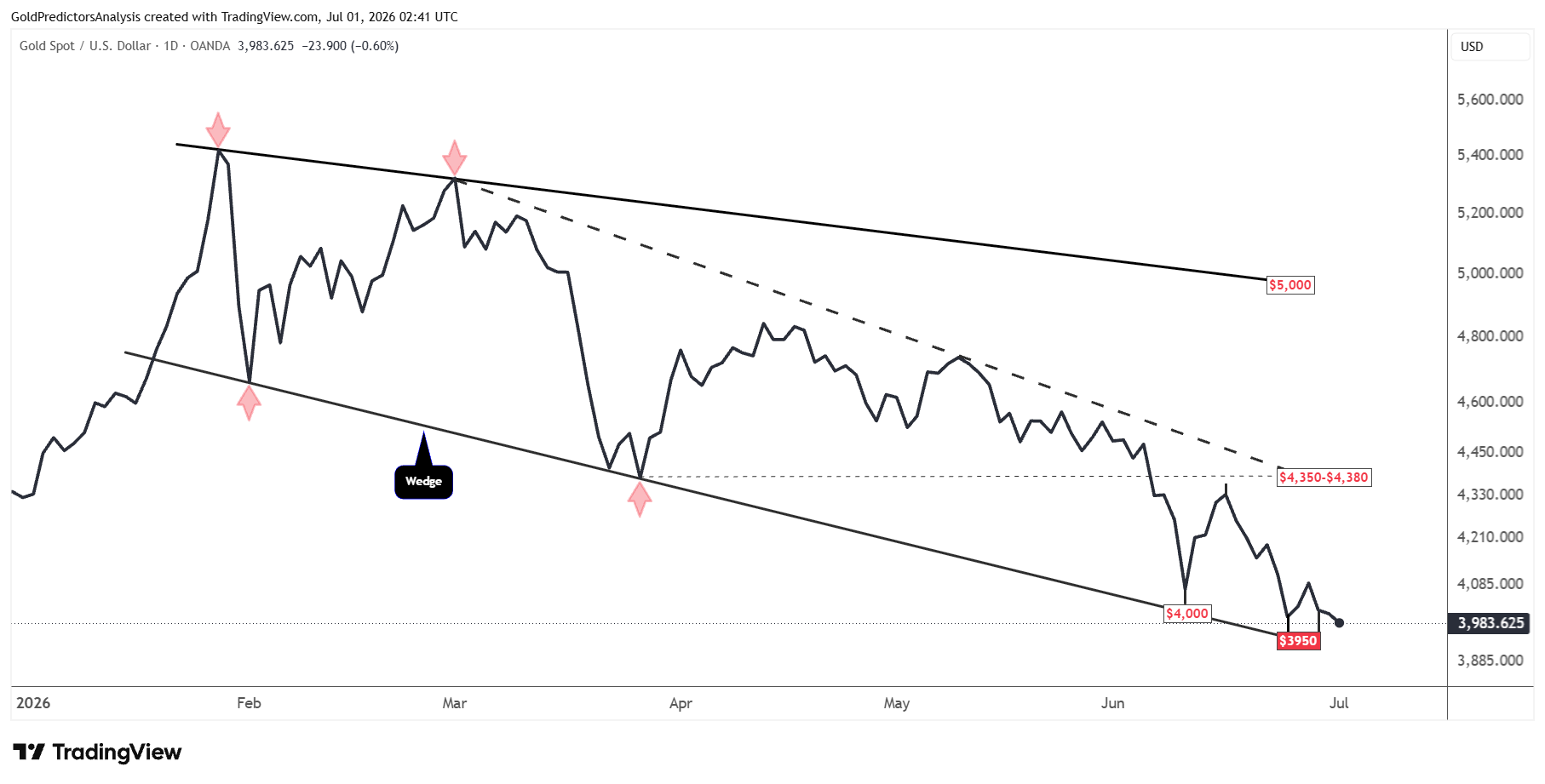
The daily chart for spot gold shows that the price is consolidating at the lower end of strong support at $3,950. This support is seen in the wedge pattern. A break below $3,900 will likely trigger another strong drop. But since the price has reached extremely oversold level, a rebound may develop in the short term. For gold to continue higher, the price must break above $4,350.
Gold Price Forecast
Every new Gold analysis as it publishes, today's technical signal and key levels, live price — on one page.
See all Gold forecastsXAUUSD 4-Hour Chart Shows Bearish Pressure Below $4,350
The 4-hour chart for spot gold also shows that the price is under extreme bearish pressure and is consolidating between $3,900 and $4,000. This support band is defined by the red trend lines that are drawn from the lows formed in November 2025. A break below $3,930 will likely trigger another strong drop in gold prices. However, the $4,350 level remains the key level. Any strong recovery in the gold market must stay below $4,350 in the short term.
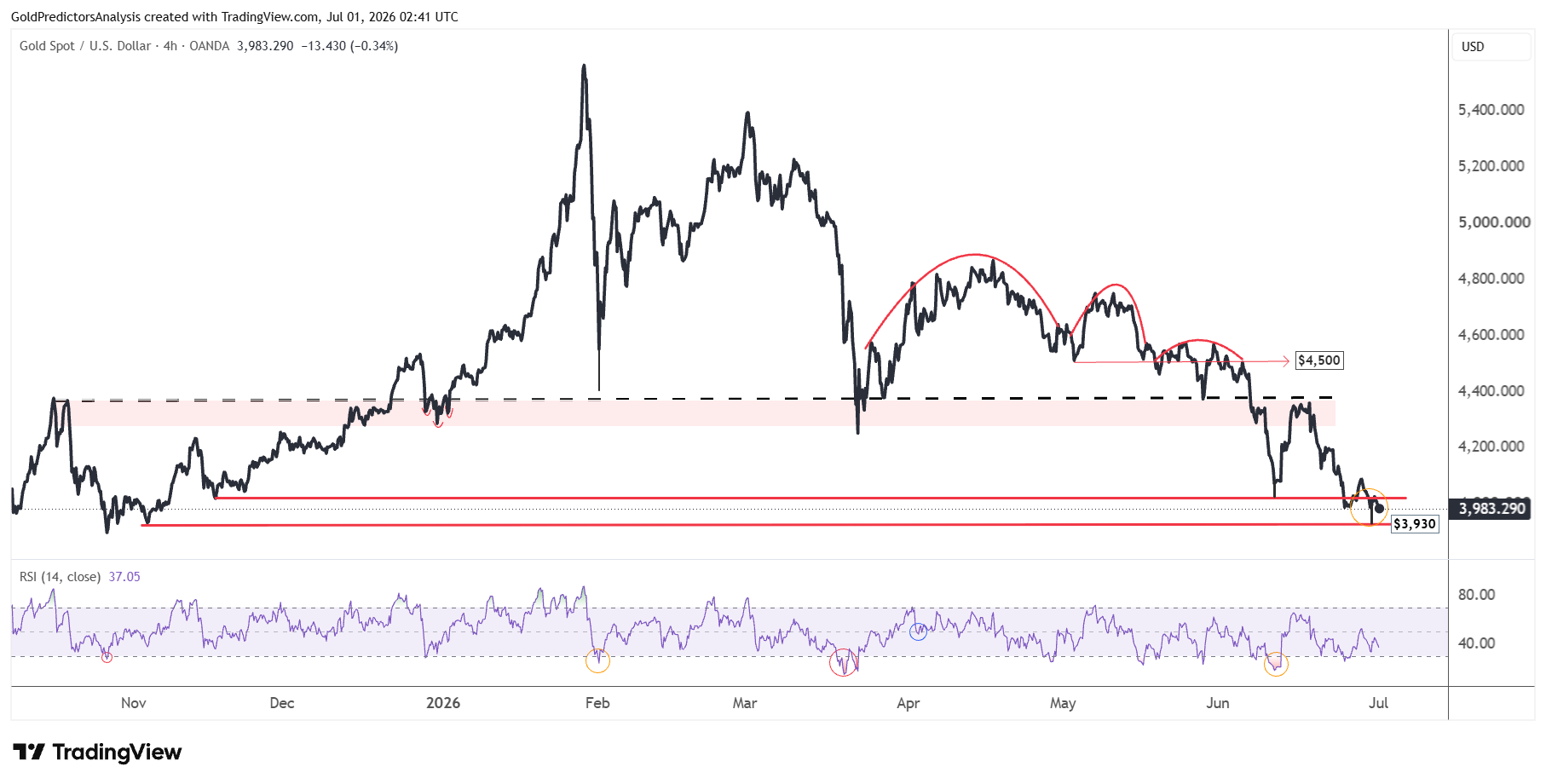
The strong support in the gold market is also observed using the descending broadening wedge pattern. The price is attempting to consolidate around these levels, and the price ranges are thinning. Moreover, the RSI has also continued to trade below the mid-level since 18 June 2026.
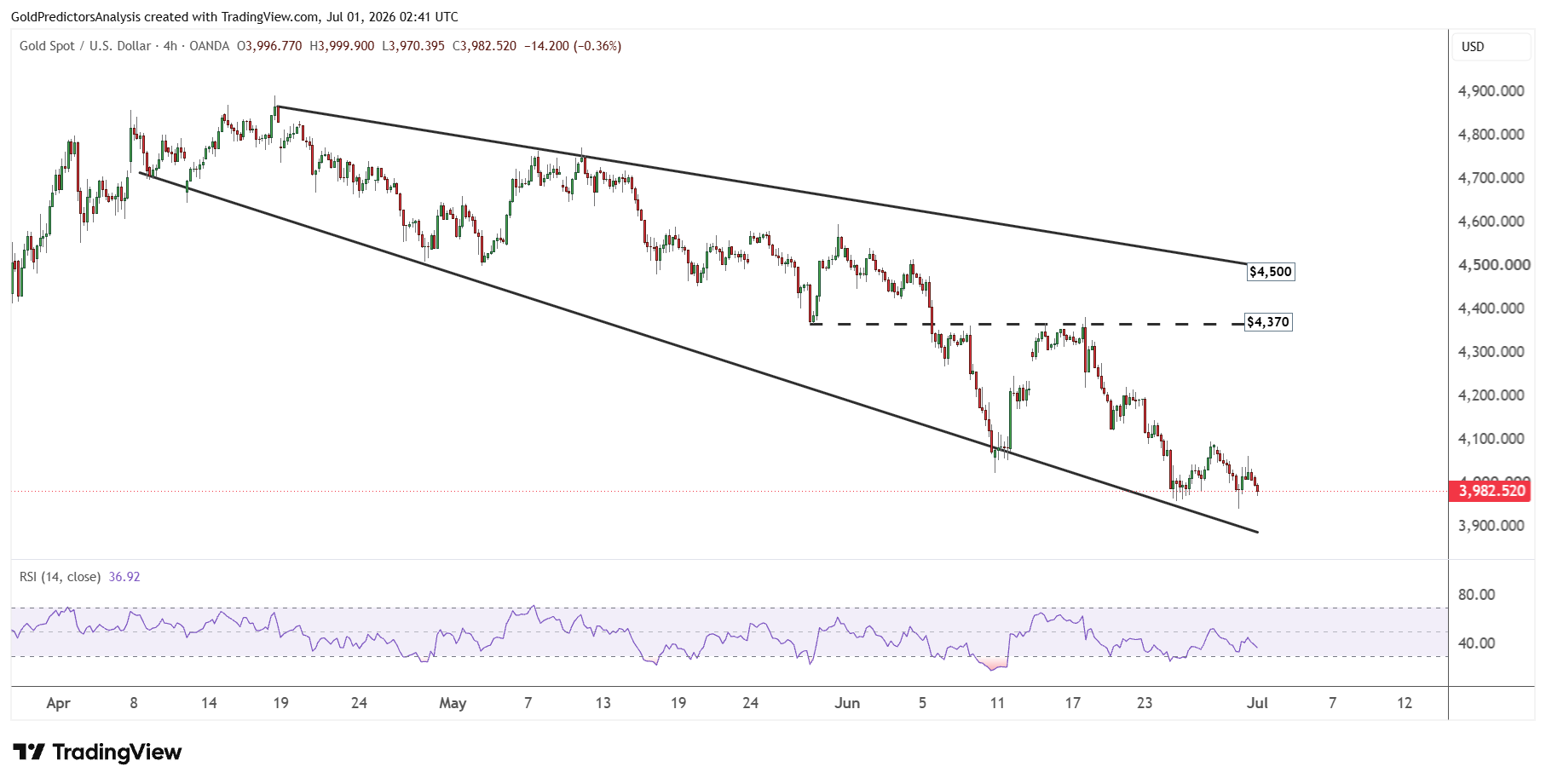
This indicates that the gold remains under pressure in the short term. Spot gold must break above $4,100 to open the door for further upside towards $4,200. The break above $4,200 will likely push the price towards $4,370. However, the immediate support now remains at the $3,900 area.
Silver Price Forecast – $55 Support Comes Under Pressure
XAGUSD Daily Chart Tests Major Support Zone
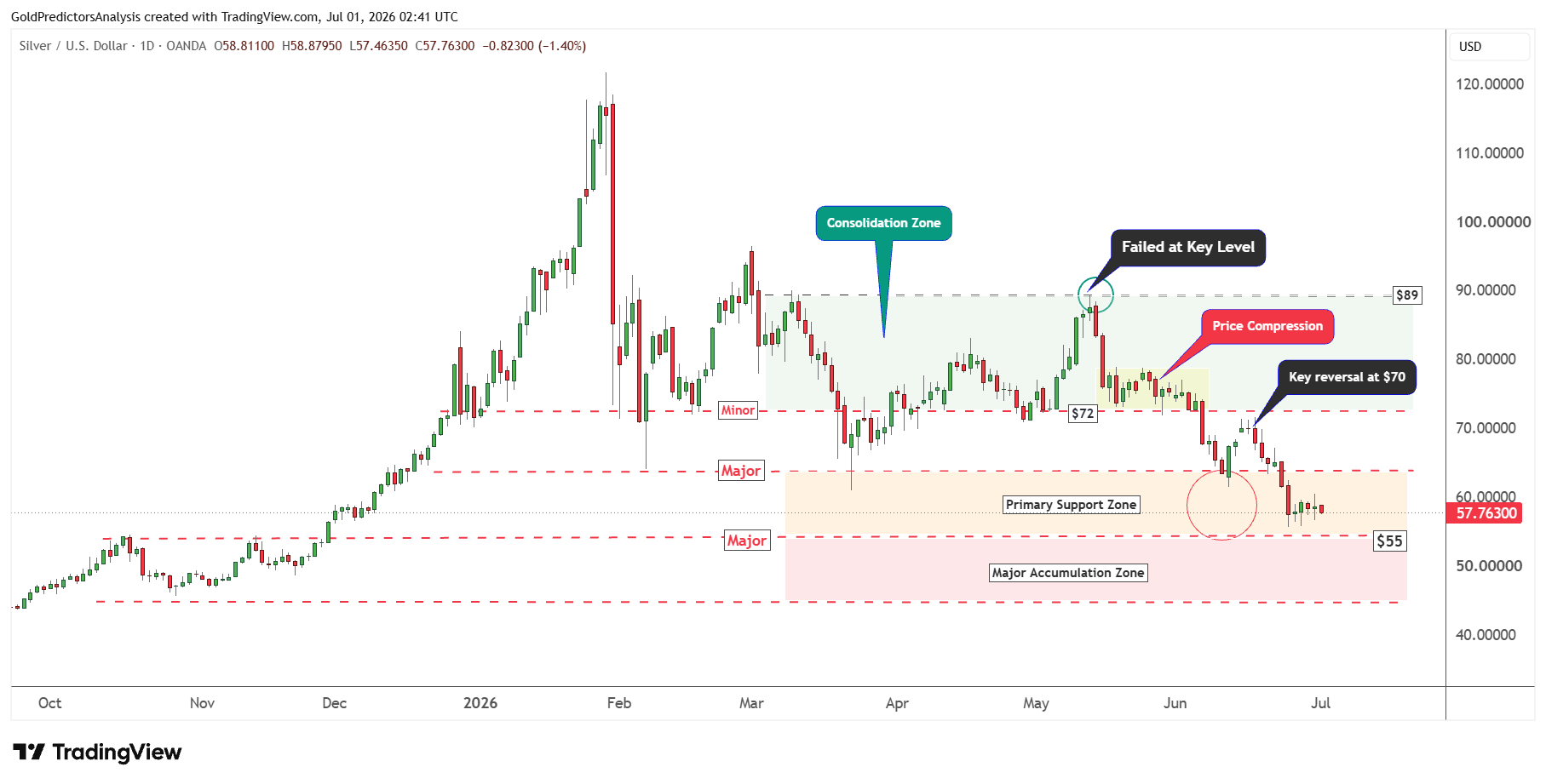
The daily chart for spot silver also shows extreme pressure in silver prices. The price is now consolidating around the lower boundary of the primary support at $55. A break below $55 will likely push silver prices towards the major accumulation zone between $45 and $55. As long as the silver remains above $45, the prices will likely form a bottom and continue to rally.
The recent consolidation in silver prices since 24 June 2026 suggests extreme bearish pressure in prices and indicates further downside if prices break below $55.
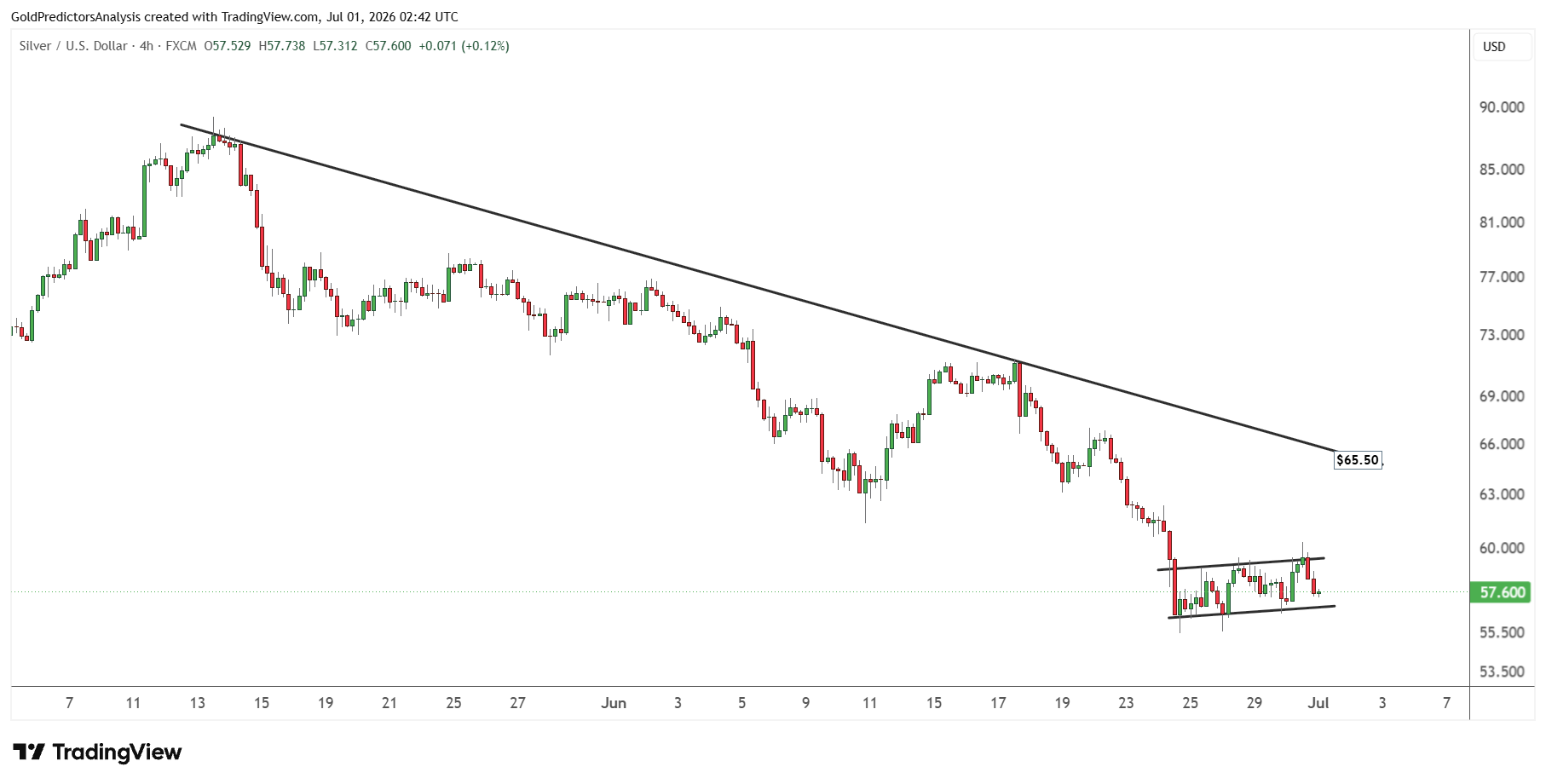
XAGUSD 4-Hour Chart Shows Bearish Channel Below $60
The 4-hour chart for spot silver also shows this bearish pressure in the form of a channel pattern that is formed between $55 and $60. A break above $60 is required to push silver prices higher. A break below $55 will likely push silver prices towards the major accumulation zone at the lower boundary of the major support.
Bottom Line
Gold and silver prices continue to face short term pressure due to the stronger U.S. dollar, hawkish Fed and fragile U.S.-Iran ceasefire. The spot gold must hold $3,900 to prevent another significant drop. But a break above $4,100 may create a recovery to $4,200 and $4,370. Silver also remains weak below $60. A break below $55 may push the spot silver into the $45 to $55 accumulation zone. But the future of both metals remains bullish with inflation risks, geopolitical uncertainty and central bank diversification. The market is now looking for U.S. jobs data, Fed signals and the next major move in the dollar to see if gold and silver are able to rally from these major support zones.
Read more: Debt Fears Strengthen Long-Term Bull Case for Gold