



July Natural Gas Recovers on LNG
July Nymex natural gas settled at $3.068 on Friday, gaining 3.3 cents or 1.07%. Thursday’s 3.08% selloff on the Energy Information Administration storage report set the tone for the week. Friday’s recovery came from a completely different corner. LNG export demand picked up, weather forecasts stayed hot, and traders who sold Thursday were not willing to stay short into the weekend.

Natural Gas Forecast: Bullish Structure Holds Below $3.03
Forecasts · Natural Gas · 3 min readDaily July Natural Gas Technical Analysis
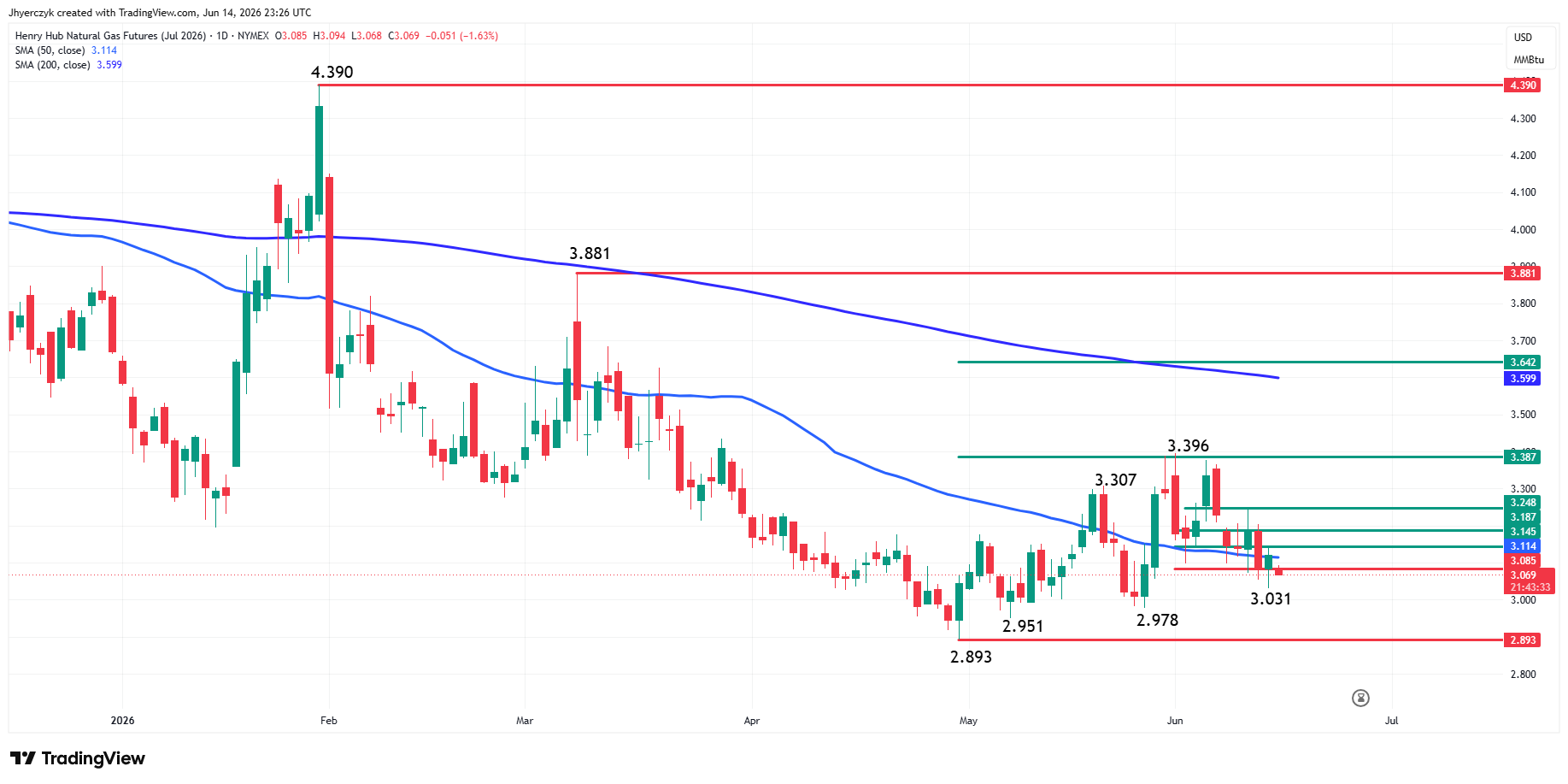
July Natural Gas is sending mixed signals on the daily chart. The main swing chart is in an uptrend, but the minor swing chart is trending lower, which means the momentum is down. A trade through $2.978 changes the main trend to down. Additional swing chart targets are $2.978, $2.951 and $2.893. A move through $3.396 will reaffirm the uptrend.
50% and 61.8% retracement levels have been a major influence on the market for the last two months. Based on the market’s current position at $3.068, potential resistance levels are laddered at $3.085, $3.145, $3.187 and $3.248. The major 50% resistance is $3.387. The market posted its recent swing top at $3.396 on June 1.
Traders have also been influenced by the 50-day moving average at $3.114. Currently, July natural gas is trading on the weak side of this indicator. Keep an eye on it because it could become important from now until the contract rollover later in the month. At this time, it’s resistance but it could act like a pivot and shift to support very quickly.
At the start of the week, we’re going to see how the market reacts to any weakness that approaches the swing bottoms at $2.978 and $2.951. There has been a tendency to reverse upward into the close as the market neared support. Friday’s low at $3.031 was one such occasion. This suggests accumulation by traders willing to be patient enough to wait for a catalyst to drive the market to the bullish side of the 50-day MA at $3.114.
Natural Gas Price Forecast
Every new Natural Gas analysis as it publishes, today's technical signal and key levels, live price — on one page.
See all Natural Gas forecastsHow Bearish Was the Storage Build?
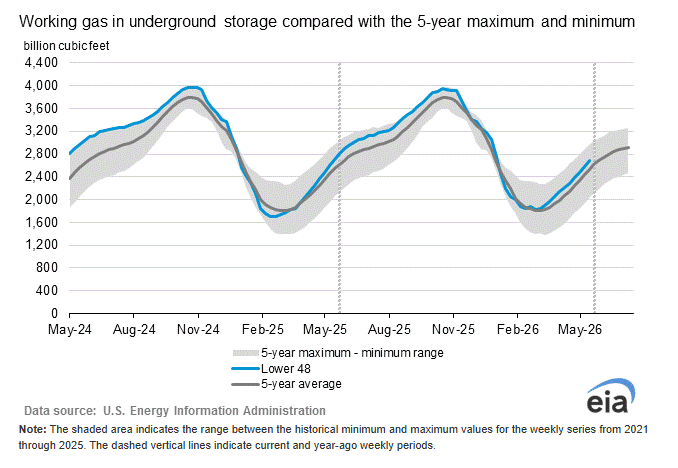
The Energy Information Administration reported a 108 bcf injection for the week ending June 5. The Street expected 100 bcf. The five-year average build for this week is 95 bcf. Bearish from every angle, and Thursday’s selloff priced it in fast.
One report does not settle the summer storage picture though. LNG exports at current levels combined with six weeks of cooling demand ahead will determine whether 108 bcf builds are the trend or the exception. Traders punished the number on Thursday, but Friday’s recovery says they are not willing to stay short on it heading into a weekend with the Fed meeting and Iran deal both unresolved.
LNG Flows Jumped 12%
BloombergNEF estimated LNG net flows to U.S. export terminals at 19.1 bcf per day, up 11.9% from the prior week. That volume is staying out of domestic storage, and it is the single biggest offset the bulls have against Thursday’s bearish 108 bcf build. Without the export pull, the storage surplus would already be running away from the market.
Qatar’s Ras Laffan Industrial City makes the export story more than a one-week trade. European and Asian buyers who depended on those cargoes from that damaged facility have been scrambling for replacements, with U.S. terminals sitting at the top of every shortlist. Strait of Hormuz shipping disruptions are making the alternatives even harder to find. The pull on American gas from overseas has legs that extend well past this summer.
Rig Count Hits Eight-Month Low
Baker Hughes reported U.S. natural gas rigs fell by three to 121 for the week ending June 12. That is the lowest count in eight months, well below the 134-rig high from earlier this year. Production is still running strong at 111.7 bcf per day, up 4.2% year-over-year according to BloombergNEF. The Energy Information Administration projects output holding near 111.0 bcf per day.
Falling rigs and rising production do not stay disconnected forever, and fewer rigs drilling today means slower supply growth down the road even if the timing remains uncertain. The market is not pricing that in yet.
How Long Does the Heat Last?
NatGasWeather sees the majority of the country running hot through the weekend. Highs in the 80s and 90s across large portions, with some areas pushing toward 100. Chicago and the East Coast are looking at the 90s for the next several days.
The forecast gets complicated after Sunday. Weather systems moving across the Northern Plains through June 17 bring cooler air in the 60s and 70s, while Commodity Weather Group projects below-average temperatures across parts of the Midwest through June 16. Cooling demand should weaken as the heat backs off. A hot weekend that fades into a mild week is a pattern natural gas traders have seen plenty of times before, and pricing in the heat without knowing what follows next week is a risk nobody wants to take with the Fed meeting landing on the same calendar.
What I’m Watching
LNG export demand is doing the heavy lifting against the bearish storage data right now, and the Ras Laffan damage combined with the Strait of Hormuz disruption give the export story staying power well beyond this week. Monday’s weather model updates are the next catalyst that decides who controls the short-term trade. Extended heat keeps the bulls in control, but a cooler revision hands the momentum right back to the storage bears who got validated by Thursday’s 108 bcf build.
Trader reaction to the 50-day moving average at $3.114 will set the tone on Monday. This level is within striking distance based on the current price at $3.068. Friday’s low at $3.031 drew buyers near support, which suggests patient traders are accumulating as they await the next bullish catalyst, which is likely to be a shift in the weather. Clearing the 50-day MA could change the entire conversation from neutral to bullish. A sustained move under the 50-day MA will indicate the conditions aren’t right for a rally yet.
More Information in our Economic Calendar.


