Short-Term Pressure Within Trend Channel
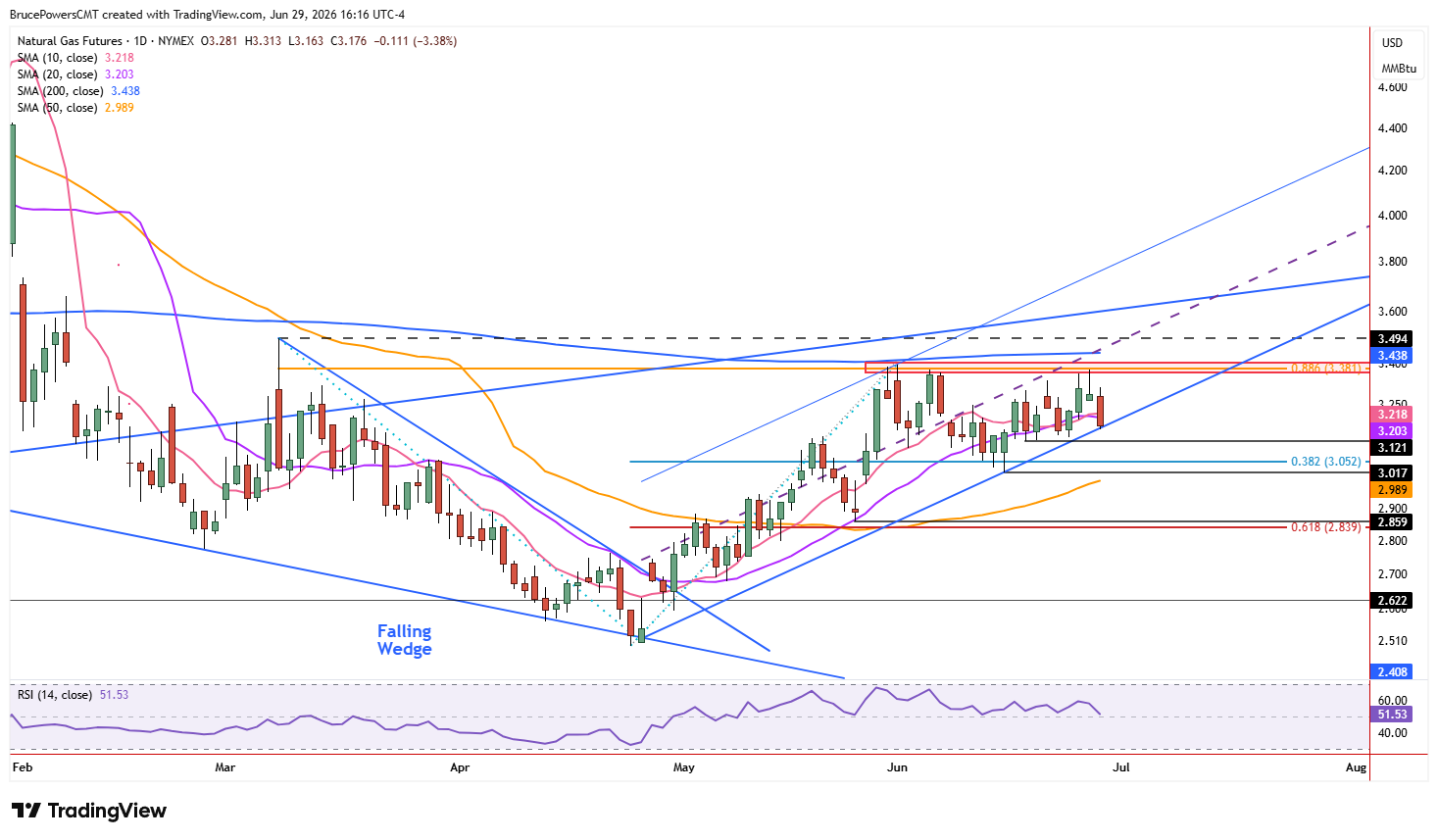
Natural gas faced short-term downward pressure, with price action contained within a short-term trend channel. However, a bearish reversal of an inverse hammer candlestick pattern from Friday was triggered, followed by a decline to a three-day low of $3.17. The breakdown from Friday established a lower swing low with the session’s high of $3.38. That was also the third attempt to break through a resistance zone that stopped earlier advances at $3.40 and near $3.38. The 200-day moving average near $3.44 marks the top of the price zone that appears unlikely to be broken in the near term, which could lead to further downside pressure.

Uptrend Line: Key Support Under Repeated Test
The low for Monday was a third touch of the uptrend line and therefore a key short-term support level. If it holds, the uptrend line is further validated, and if it breaks, a new bearish signal will be provided, regardless. If the low of the session at $3.17 fails to hold as support, a break of the trendline will also trigger, which is short-term bearish. Further bearish signs would then be needed to validate increasing selling pressure. An interim swing low at $3.12 would then present the next decision area, and if support is not seen then the more significant higher swing low at $3.02 becomes a target.
Broader Support Structure and Consolidation Base
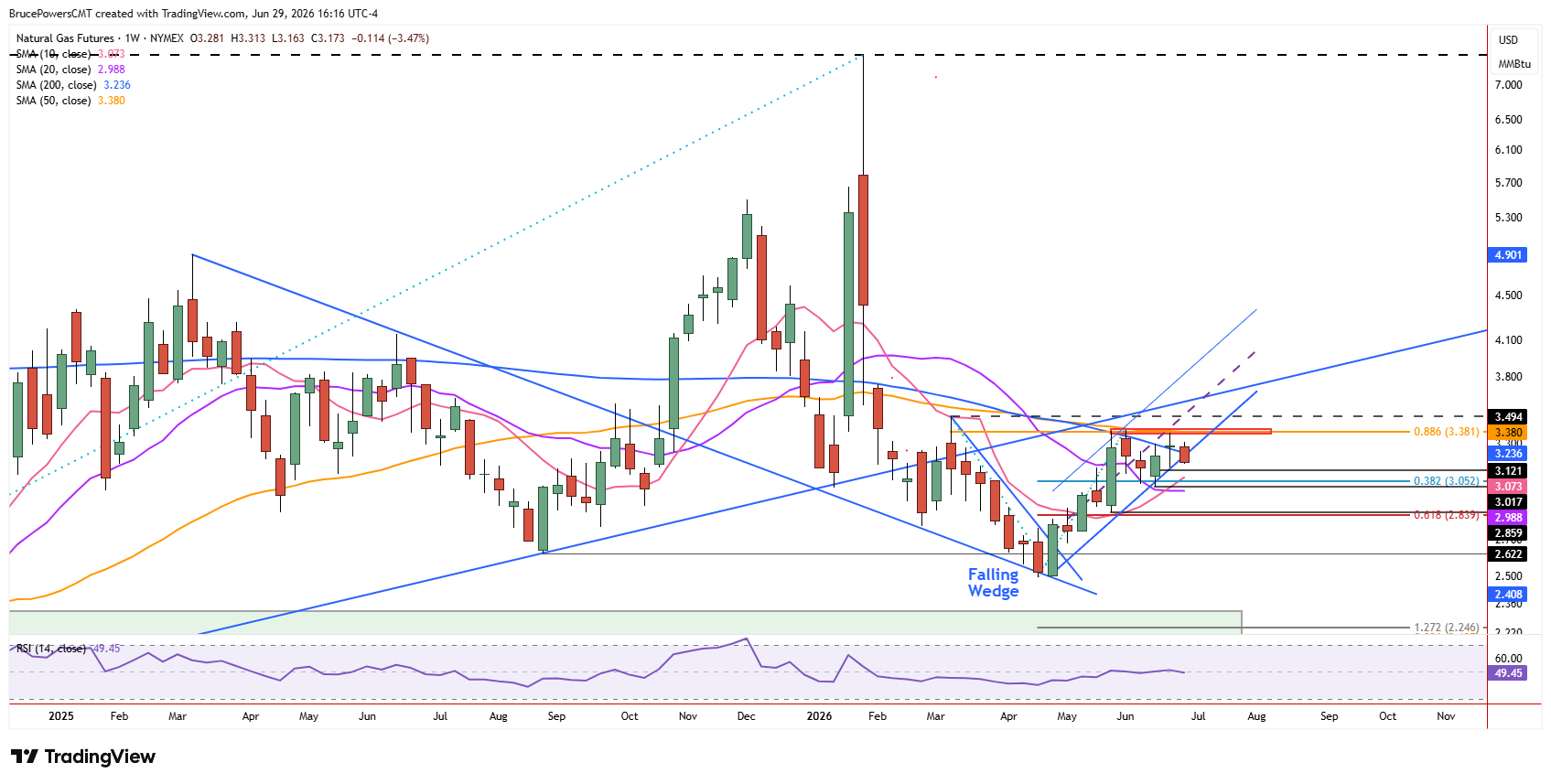
Despite the signs of a trend reversal that would signal on a failure of the above noted price areas, the 50-day moving average provides the next more significant dynamic support zone since it was once tested as support in late May. It could provide a lower area of stabilization to support a continuation of sideways consolidation that has developed in June. A break of the trendline may not signal a reversal but rather a continuation of a range.
Retracement Structure and Underlying Demand
The pullback from the June 1 trend high of $3.40 completed a 38.2% Fibonacci retracement at $3.05 before bottoming, resulting in a higher swing low. In other words, buyers provided support leading to an advance and last week’s lower swing high near $3.38 after a relatively shallow retracement. That shows underlying demand. With the 50-day moving average soon to be rising above the $3.02 low, it takes on added significance and could provide support for further consolidation, unless the 200-day moving average is reclaimed.
Consolidation Framework
Overall, while short-term resistance and failed breakout attempt near $3.38 – $3.40 continue to cap advances, the market’s behavior around the uptrend line and higher swing lows suggests that natural gas remains in a broader consolidation phase.
Natural Gas Price Forecast
Every new Natural Gas analysis as it publishes, today's technical signal and key levels, live price — on one page.
See all Natural Gas forecastsIf you’d like to know more about how to trade natural gas, please visit our educational area.