Gold Dropped 1.75% as Oil Spike Rewrote the Rate Outlook in One Session
Spot Gold is trading at $4,017.02 at 19:47 GMT Monday, down $71.36 or 1.75%. The metal has lost more than 10% this month and is heading for its fourth consecutive monthly decline. The selloff from January’s record near $5,600 is now roughly 28% and Monday’s session showed no sign that the selling is finished.
The weekend strikes between the U.S. and Iran sent crude higher and gold lower on the same headlines. That tells you everything about which trade is running this market. Higher oil means hotter inflation. Hotter inflation means the Fed stays aggressive. Gold is paying for the oil spike through the rate channel and the safe-haven bid that normally surfaces during conflict is nowhere near strong enough to offset it.

Daily Spot Gold (XAUUSD) Technical Analysis
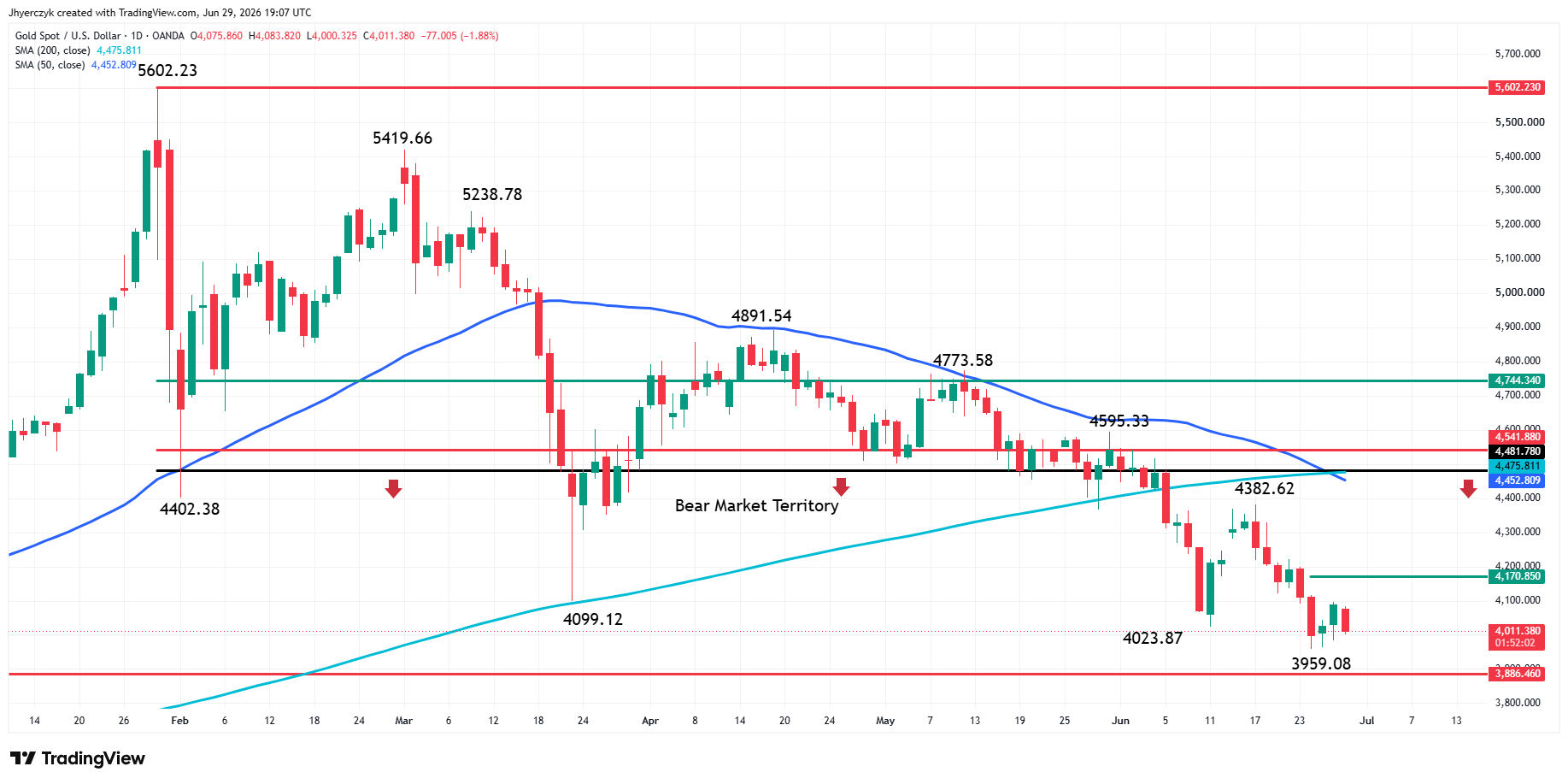
Spot gold is edging lower late in the session on Monday as traders continue to consolidate slightly above the recent multi-month low at $3959.08. Today’s trade is an inside move, which usually suggests investor indecision and impending volatility.
While most long-term investors are searching for value, short-term speculative buyers have been punished by relentless selling, driven by a strong downtrend on the daily swing chart and multiple bearish signals from the moving averages. These include the break down under the 50-day and 200-day moving averages at $4452.75 and $4475.80, respectively. And let’s not forget that the 50-day MA has crossed to the weak side of the 200-day MA, which in some circles is considered a bearish Death Cross formation.
Looking at the immediate setup on the daily chart, short-term support may be forming around last week’s low at $3959.08. This makes $4382.62 to $3959.08, our short-term trading range. If there is a short-covering rally this week, the first upside objective will be the pivot at $4170.85.
Trader reaction to the pivot at $4170.85 will determine if there is enough upside momentum to perhaps challenge the top at $4382.62 and the moving averages at $4452.75 and $4475.80.
The inability to recapture the 50% level at $4170.85 will mean the market is still in the strong hands of sellers. If this produces enough downside momentum then look for $3959.08 to fail as support with a test of the long-term bottom at $3886.46 likely.
I’ve seen a lot of chatter on social media downplaying the importance of the Death Cross. Most naysayers seem to think the market is too far into the correction and too far off the top to make it relevant. Until there is a short-term bullish set-up and an emerging bullish catalyst, I think it has to be watched closely. So far the 50-day MA has posted a very smooth downtrend, but we’re getting close to the point where it will start to slope hard to the downside. This may act as an extremely bearish catalyst, but it may have to be done in order to washout the weakest longs still holding on for the start of another bullish rally.
Essentially, what I’m saying is that I’m watching trend strength and that the widening separation of the 50-day MA and the 200-day MA will confirm that the long-term trend is becoming more decisively bearish.
Gold Price Forecast
Every new Gold analysis as it publishes, today's technical signal and key levels, live price — on one page.
See all Gold forecastsThe Iran Headlines Were Bearish for Gold and That Is Not Intuitive
Oil jumped on the weekend strikes. Crude rising on geopolitical conflict normally brings safe-haven buying into gold. Monday it brought selling instead. The market is reading every oil spike through the inflation lens first and the safety lens second. Higher crude means higher gasoline and transport costs feeding into broader price pressures. That pushes rate hike expectations higher and rate hike expectations are what has been driving gold lower for four straight months.
Markets are now pricing in the possibility of three Fed rate hikes this year with about a 60% chance of one arriving as early as September. That is a dramatic shift from earlier expectations of rate cuts. The Iran situation is not helping gold because it is helping oil and oil is helping the hawks make the case for tighter policy. The safe-haven bid exists but it is overwhelmed by the rate repricing.
The Dollar Is Working Against Gold From the Other Side
The dollar has been firm on the back of rising rate expectations and relatively strong U.S. economic signals. A stronger dollar makes gold more expensive for every buyer outside the United States. Asian and European demand weakens when the dollar climbs because their currencies buy fewer ounces at the same price.
Physical demand has softened in key Asian markets. Central banks have been steady buyers for years and that purchasing has not stopped. But even consistent central bank accumulation has not been enough to absorb the selling pressure created by higher rates and a stronger dollar running simultaneously. The buying provides a floor. It does not provide a reversal.
The Correction From $5,600 Is 28% and the Selling Has Been Orderly
Gold hit all-time highs near $5,600 in January when geopolitical fears and inflation concerns were both running in the metal’s favor. The rate outlook flipped, the dollar caught a bid, and 28% of the rally is gone. Longs who rode it from the bottom are cashing out. New shorts are pressing the trade on the bet that the rate cycle has more room to run. Both sides are selling for different reasons and neither is finished.
The correction has been orderly. No flash crashes. No capitulation days. Just steady selling session after session as the macro picture turned against the metal. Monday’s 1.75% decline fits the pattern. An inside move on the daily chart with gold consolidating above the multi-month low at $3,959.08 says the market is compressing before its next directional move. Whether that move is lower into the long-term bottom or higher on a short-covering rally depends on what the data says Thursday.
What to Watch
Thursday’s jobs report is the next catalyst for gold. Strong hiring reinforces the case for three rate hikes and the September probability stays near 60% or climbs higher. That keeps the dollar firm and yields rising, which is the combination that has been crushing gold all month. A miss on payrolls is the scenario where rate hike expectations ease and gold gets room to attempt a short-covering rally toward the pivot.
Gold is consolidating above the multi-month low in an inside day pattern. The trend is down with the Death Cross overhead and the moving averages widening their separation. Monday’s session proved again that geopolitical conflict is not bullish for gold in the current environment. As long as oil spikes feed inflation expectations and inflation expectations feed rate hike bets, every escalation in the Middle East is another reason to sell gold, not buy it. The rate trade is running this market and it runs until the data breaks the argument.
If you’d like to know more about how to trade gold, please visit our educational area.