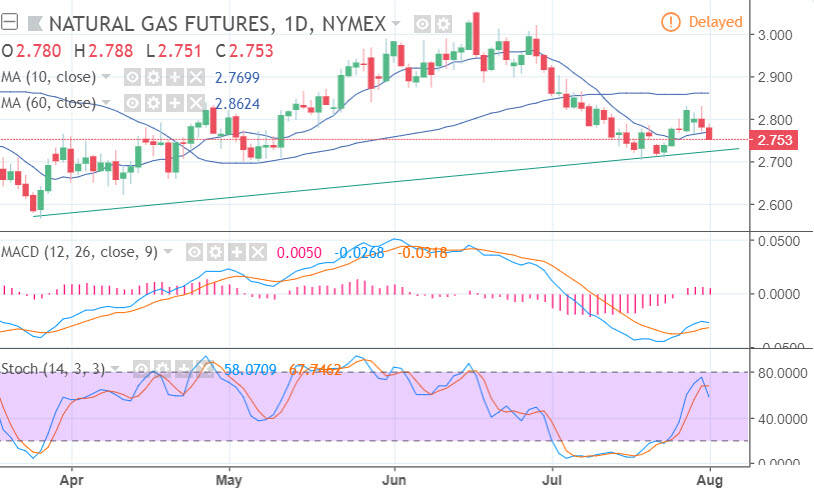
Natural gas prices moved lower on Wednesday for the second consecutive trading session. Weaker than expected U.S. manufacturing data offset a warmer than expected weather forecast. Prices slipped through support near the 10-day moving average at 2.77, and is poised to test target support near an upward sloping trend line that comes in near 2.72. Short-term momentum has turned negative as the fast stochastic generated a crossover sell signal, which reflects accelerating negative momentum. Traders now await the Department of Energy’s inventory report which will be released on Thursday. The average inventory draw estimated by Estimize is a build of 40 Bcf. Inventories remain at the lower end of the average 5-year range and prices are more than 12% below the 5-year average level.

Manufacturing Data was Softer than Expected
The first day of a new month generally brings a deluge of manufacturing data. Today the Institute for Supply Management’s Manufacturing reported that its index fell to 58.1, below expectations that it would come in at 59.5in July. While manufacturing demand for natural gas is secondary to demand which is driven by power, it still does not bode well for prices. The Energy Information Administration report that total U.S. consumption of natural gas fell by 2% compared with the previous report week. More moderate temperatures in the northern half of the Lower 48 states, led to a 6% week-over-week decline in natural gas consumed for power generation. The EIA also reported on Wednesday that distillate fuel demand which can be used as a substitute for natural gas averaged 3.9 million barrels per day, down by 5.9% from the same period last year.
The Weather Remains Warm
The warmer than normal weather that is forecast to cover most of the United States over the next 8-14 days should increase cooling demand. The ridge trough pattern that is forming should create robust demand for natural gas in the west and mid-west. If the pattern move east, demand should increase for the next 3-weeks during the heart of the summer cooling season.