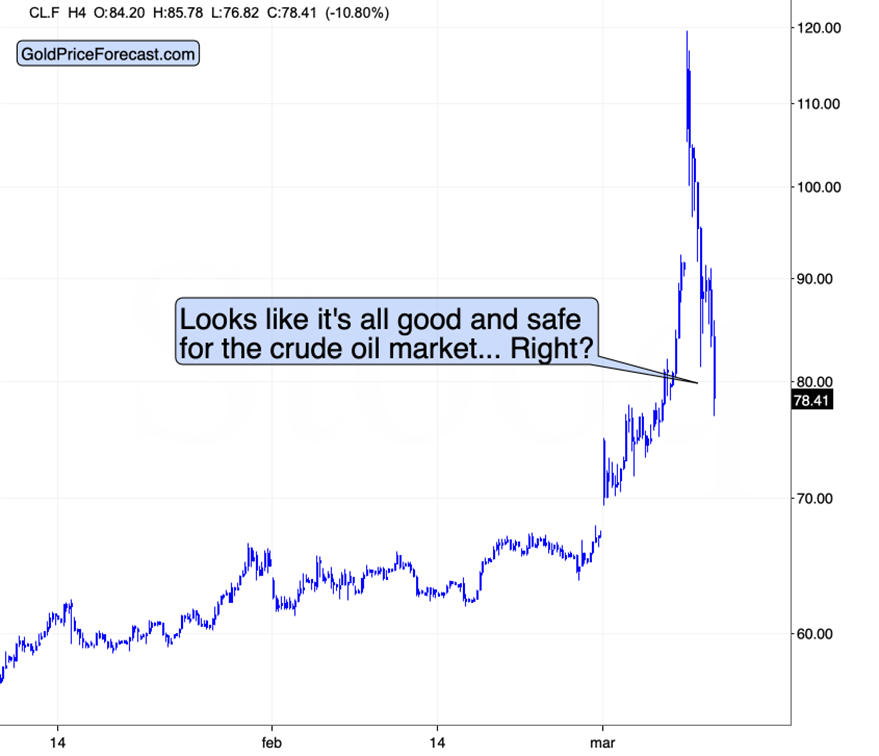
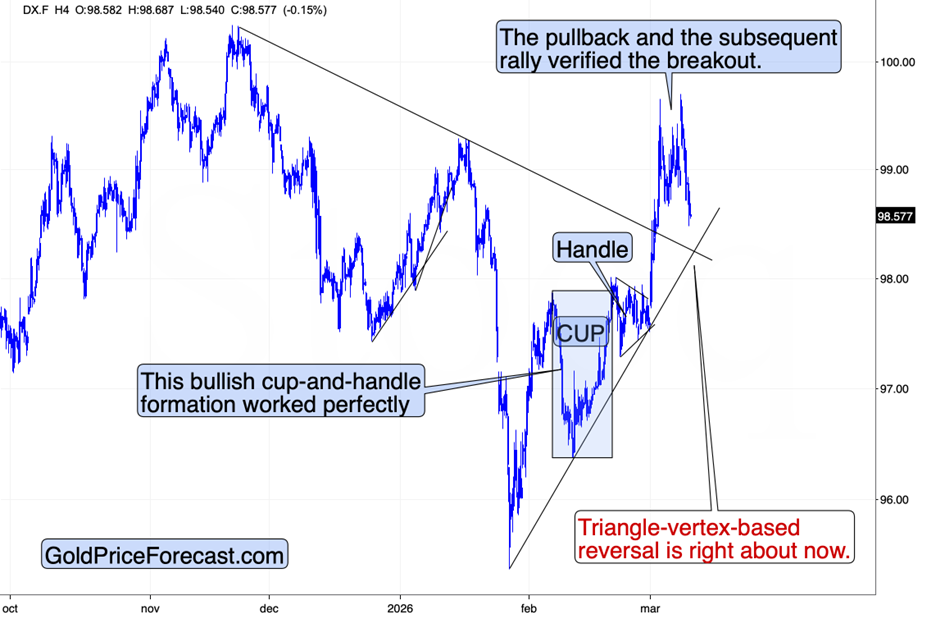
Yesterday’s session was one of the wildest in recent memory. Markets opened sharply lower, with the Dow down nearly 900 points and the S&P 500 falling 1.5% as oil touched $119.43 overnight. Gold price declined while the USD rallied to a new 2026 high.
Then, at around 3:15 PM ET, CBS News reporter Weijia Jiang posted on X that she had spoken with Trump by phone. His message: “The war is very complete, pretty much. They have no navy, no communications, they’ve got no Air Force.” He added that the US was “very far” ahead of his initial 4-5 week estimated timeframe. He also floated the idea of “taking over” the Strait of Hormuz.
Markets reversed instantly. The Dow erased its 900-point loss and closed up 239 points (+0.50%). The S&P 500 gained 0.83%. The Nasdaq rallied 1.38%. Oil dropped from above $100 to around $85. Gold bounced from ~$5,100 to ~$5,195. The dollar pulled back from 99.68.
Today (Tuesday), the moves continued in the same direction. Oil fell further, with WTI dropping to around $84 and Brent to $88, as the IEA announced an extraordinary meeting to discuss emergency stockpile releases. Stocks are searching for direction. Gold is trading near $5,195.
So, did anything change?
No.
Let me explain.

Hormuz Remains Blocked Despite White House Optimism
First, consider what Trump said vs. what is happening on the ground. The Strait of Hormuz remains closed. Iran’s new hardline Supreme Leader, Mojtaba Khamenei, has been in office for less than 48 hours and has given zero indication of compromise. The IRGC is still launching attacks across the Gulf. Iraq’s oil output is still down 70%. Kuwait, Bahrain, and Qatar are still under force majeure. Saudi Arabia is still cutting production.
Saying the war is “very complete” while ships still cannot sail through Hormuz is a statement of intent, not a statement of fact. Trump has done this before. Multiple times. With trade wars, with COVID, with the Ukraine conflict. He declares something “done” or “close to done” and markets react to the words. Then reality catches up.
Trump escalates to maximum pressure, then signals de-escalation at the moment of peak market panic, then the actual resolution takes much longer than the verbal signal suggests. The cycle between escalation and de-escalation is the pattern itself.
Second, oil is still at $84-88. Before the war started on February 28, WTI was trading near $67. Even after this “relief” move, oil is up 25-30% from pre-war levels. That’s enough to sustain all the bearish pressures I outlined yesterday: higher mining costs, inflationary pressure that keeps the Fed on hold, and a structural USD tailwind from the inflation differential.
Technically, it looks like USD’s consolidation is done or almost done. Why? Because two support lines cross more or less now and those triangle-vertex-based points were an accurate indication of trend reversals many times in the past – across many markets, including the USD Index.
This means that – in response – gold, silver, and mining stocks would be likely to turn south soon.
Now, silver has fantastic fundamentals, it’s in the sixth year of deficit and the inventories are shrinking. This means that the decline in its price could be short-lived – but I still think that it will happen.
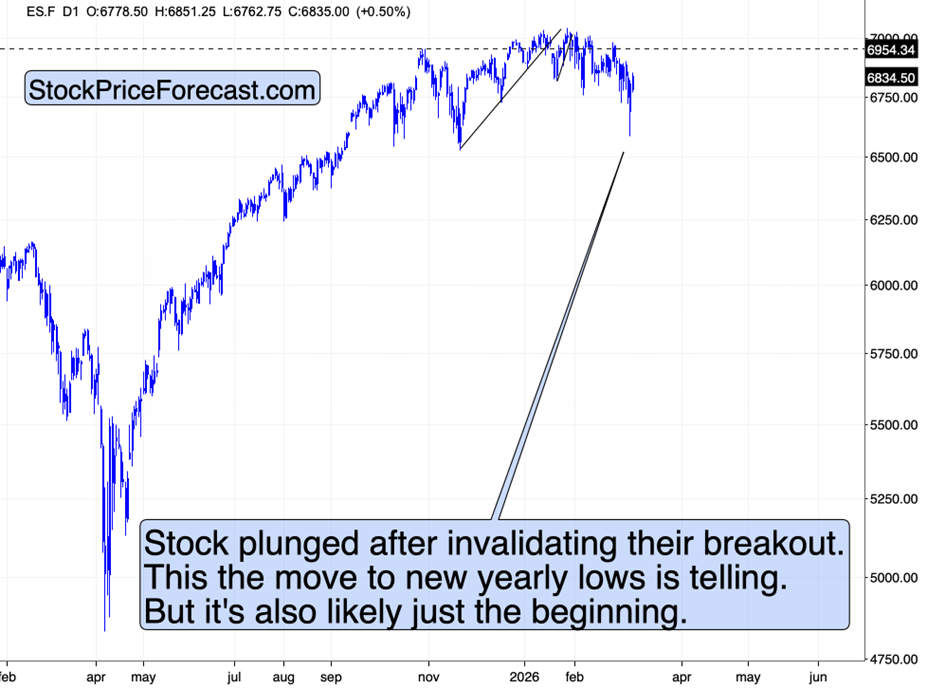
Finally, the stock market’s reversal is significant as a data point, but not as a trend change. As GAM Investments’ Paul Markham put it, the idea that this will be a sustained rally from here is “quite difficult to believe.”
Brent Oil Price Forecast
Every new Brent Oil analysis as it publishes, today's technical signal and key levels, live price — on one page.
See all Brent Oil forecastsUSD Index Prepares For 100-Level Assault
What matters now is what happens in the next 48-72 hours. If Trump’s words translate into an actual ceasefire and the Strait of Hormuz reopens, oil drops to $65-70, the USD gives back its gains, and the precious metals picture shifts… Or it simply continues with its post-2011 analogy – which would be more likely. I’m monitoring the situation.
But if the Strait stays closed and the fighting continues, which is the most likely scenario given the new hardline Supreme Leader and Iran’s stated position, then oil will re-approach $100, the USD will resume its move higher, stocks will very likely decline and the precious metals decline will continue.
If de-escalation is real, the safe-haven bid that has been propping gold up disappears, and miners fall with gold. If the war continues, oil-driven cost pressures crush mining margins while USD strength pressures gold from above.
Thank you for reading today’s analysis – I appreciate that you took the time to dig deeper and that you read the entire piece. If you’d like to get more (and extra details not available to 99% investors), I invite you to stay updated with our free analyses – sign up for our free gold newsletter now.
Thank you.
Przemyslaw K. Radomski, CFA
Founder
Golden Meadow®