
Oil News: Crude Drops as Risk Premium Evaporates
July WTI crude oil futures opened sharply lower Sunday night as traders rapidly stripped away a large piece of geopolitical pricing that had been supporting the market. The move was not driven by weak demand data, inventory numbers or a surprise economic report. Traders came into the weekend carrying a heavy supply fear trade. By Sunday night they were getting out of it.

The Story Changed Fast
The market did not wait for tankers to move. It did not wait for new barrels to appear. Crude reacted to what traders suddenly believed might happen next.
The weekend headlines changed the tone. Reports pointed toward possible progress between the United States and Iran and President Trump also suggested negotiations were moving forward. That immediately shifted trader attention away from supply disruption and toward the possibility of improving oil flows.
That reaction told the story.
For months the market had been carrying a sizeable risk premium because of the conflict surrounding Iran and the disruption around the Strait of Hormuz. A large amount of globally traded crude moves through that route every day. Traders had been pricing in the possibility of tighter supply, shipping problems and a longer disruption.
Sunday night the market started pricing in something different.
Brent Oil Price Forecast
Every new Brent Oil analysis as it publishes, today's technical signal and key levels, live price — on one page.
See all Brent Oil forecastsReality Still Has Catching Up To Do
A headline is not a barrel. Negotiations moving forward does not mean tankers are moving through the Strait of Hormuz tomorrow morning. Shipping routes that have been disrupted for three months do not normalize on a Sunday night. Insurance costs do not drop because Trump posted something constructive. Physical infrastructure does not repair itself because traders got optimistic.
The geopolitical premium that built up over weeks came out in hours. That part is real. But I’ve watched this exact cycle play out multiple times this year. Optimism pushes crude lower. Then one headline out of Tehran pulls it right back up. The market has not learned to hold its conviction on either side of this trade for more than a few sessions.
Fear Left the Trade
The run higher was built on supply fear and nothing else. Traders were paying up for protection against a shock that had not fully materialized. When prices get stretched that far on fear the reversal does not need much of a push. Sunday night it got one and the selling was fast.
Memorial Day liquidity made it worse. Fewer participants. Fewer resting orders underneath the market. Thin conditions do not create the move but they amplify it. The barrels have not actually come back yet. The market decided they might and traded it before the evidence arrived.
July WTI Crude Oil Technical Analysis
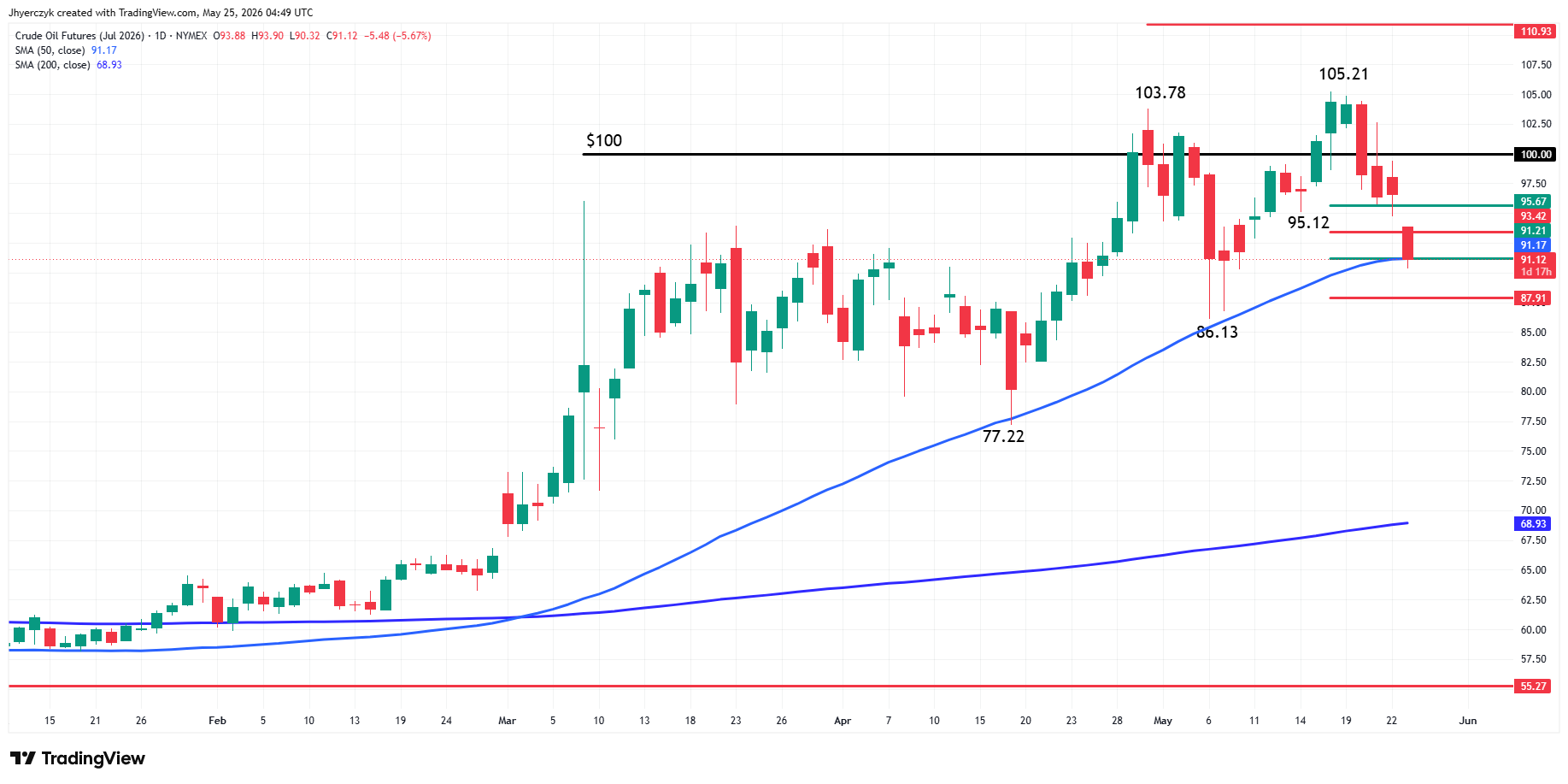
July WTI crude oil futures gapped lower on both the daily and weekly charts on Sunday’s opening. The move took the U.S. benchmark under a short-term retracement zone at $93.42 to $95.67, which is new resistance, and a minor bottom at $95.12. The sharp drop did not change the main trend to down, but it did shift momentum to the downside.
The market is now testing an important support cluster formed by the 50-day moving average at $91.17 and the intermediate 50% level at $91.09. Trader reaction to this area could set the tone this week.
A sustained move under $91.09 will indicate increased selling pressure with $87.91 the next target, followed by the main bottom at $86.13. Taking out this level will change the main trend to down and turn a buy the dip situation into a sell the rally situation.
A sustained move over $91.17 will signal the return of buyers. This could fuel an intraday short-covering rally with upside targets at $91.21, $95.67 and $100.
July Brent Crude Oil Technical Analysis
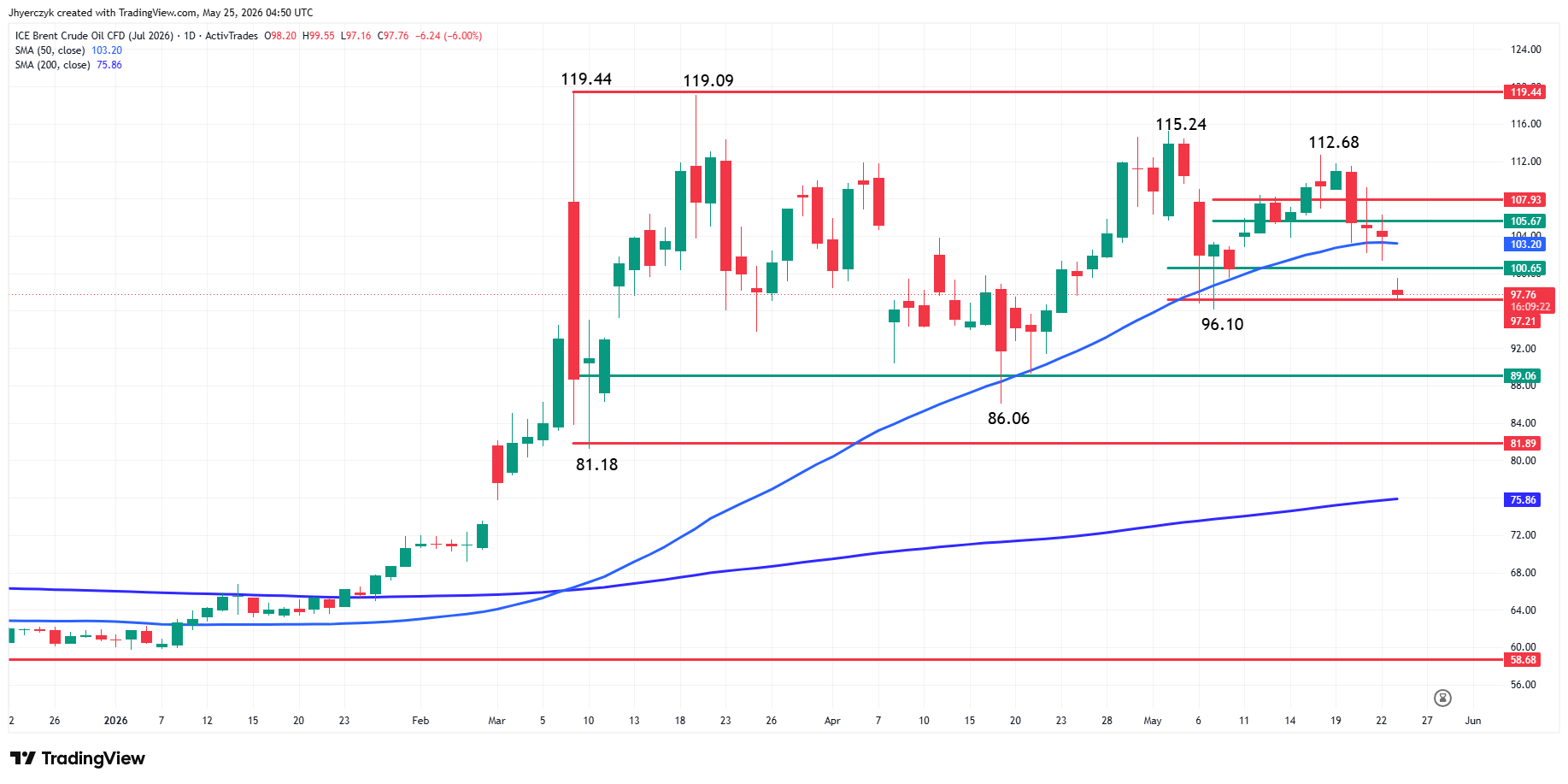
July Brent crude oil futures are trading sharply lower early Monday after gapping lower on both the daily and weekly charts. The big development is that it also moved below the 50-day moving average at $103.20, putting that level into resistance.
The market is currently testing an intermediate retracement zone at $100.65 to $97.21. Buyers could still come in on this break because the market is holding the main bottom at $96.10. If this fails, the main trend will turn down and traders will shift into sell the rally mode.
Watch the price action closely around $96.10 because this remains the trigger point for a downside acceleration with the next major target zone at $89.06 to $81.89.
What Traders Are Watching
Negotiations, Iran headlines and the condition of the Strait of Hormuz remain the unresolved drivers moving this market right now. The market has shifted from pricing panic to pricing progress and that changes the tone immediately. A continuation of positive headlines keeps pressure on crude. A breakdown in negotiations brings supply fears back quickly.
The technical picture now puts July WTI crude oil futures near a decision point around $91.09 and $91.17. That area is where buyers and sellers fight for control this week. The level I am watching is $91.09. That is where the trade starts changing. Everything else comes after that.
If you’d like to know more about how to trade crude oil, please visit our educational area.