Crude Oil Extends Gains as Iran Talks Stall, Military Buildup Escalates
April West Texas Intermediate crude oil futures are extending their gains on Thursday as U.S. and Iran officials tried to smooth out a few snags that led to a stall in the talks over Tehran’s nuclear program. Rattling traders, however, is the military buildup in the key oil-producing area by both sides.
The Strait of Hormuz Is the Real Risk—20% of Global Oil Flows Through It
The main concern for the crude oil market is that military activity will lead to a supply disruption if Iran decides to jam up shipping in the Strait of Hormuz. According to ANZ analysts, about 20% of the world’s oil consumption passes through the waterway.
If Iran is attacked by the U.S., it will try to use every tactic it can to gain the attention of the global powers, hoping it will put pressure on the U.S. to call off the attack. In my opinion, this will include jamming up the Strait of Hormuz with navy ships, commercial vessels and even mines. Iran will try to make it extremely difficult and dangerous for all the OPEC producers to get oil out of the region.
Wednesday’s 4% Jump Was Just the Beginning—More Spikes Coming
Wednesday’s 4% jump in crude oil markets was just a reaction to increased tensions. The market could add another 5% to 10% once the attack starts and likely another 10% if they successfully block the Strait of Hormuz. At that point, even if there is a ceasefire, the waterway could still be unnavigable due to debris and other large objects. These are the risks at stake now.
The Key Questions Traders Are Wrestling With Right Now
There is no question that this is bullish news, but the degree of bullishness will depend on a number of factors including: how long the military activity lasts? What regions inside Iran the U.S. attacks? They could hit military bases, oil facilities, nuclear sites. Can Iran successfully block the Strait of Hormuz to all tanker traffic and for how long? Then there is the possibility that Iran counter-attacks U.S. military bases around the world, or even U.S. domestic sites.
Brent Oil Price Forecast
Every new Brent Oil analysis as it publishes, today's technical signal and key levels, live price — on one page.
See all Brent Oil forecastsRemember Saddam Hussein Set His Own Oil Wells on Fire During Gulf War
These are the types of things that industry and hedge fund oil traders are considering at this time. They all impact oil to a certain degree, but I think the biggest concern is how long will these tensions or even a war last and who else will become involved? Will Iran drag allies China and Russia into this? Will Iran counter-attack Israel or facilities in Saudi Arabia, for instance? If you can recall the Iraq-Kuwait War in the 1990s, Iraqi leader Saddam Hussein, while under attack by the U.S., started firing SCUD missiles at Saudi Arabia and even set his own oil wells on fire.
Speculators Will Get Long, Shorts Will Cover—Another 10-20% Move Possible
The oil market is relatively calm at this time, in my opinion, but conditions could change really fast. Speculators will get long and shorts will be forced to cover aggressively, running the risk of another 10% to 20% spike in oil prices if a war were to start.
The Technical Picture: Momentum and Headlines Are Driving This Market Now
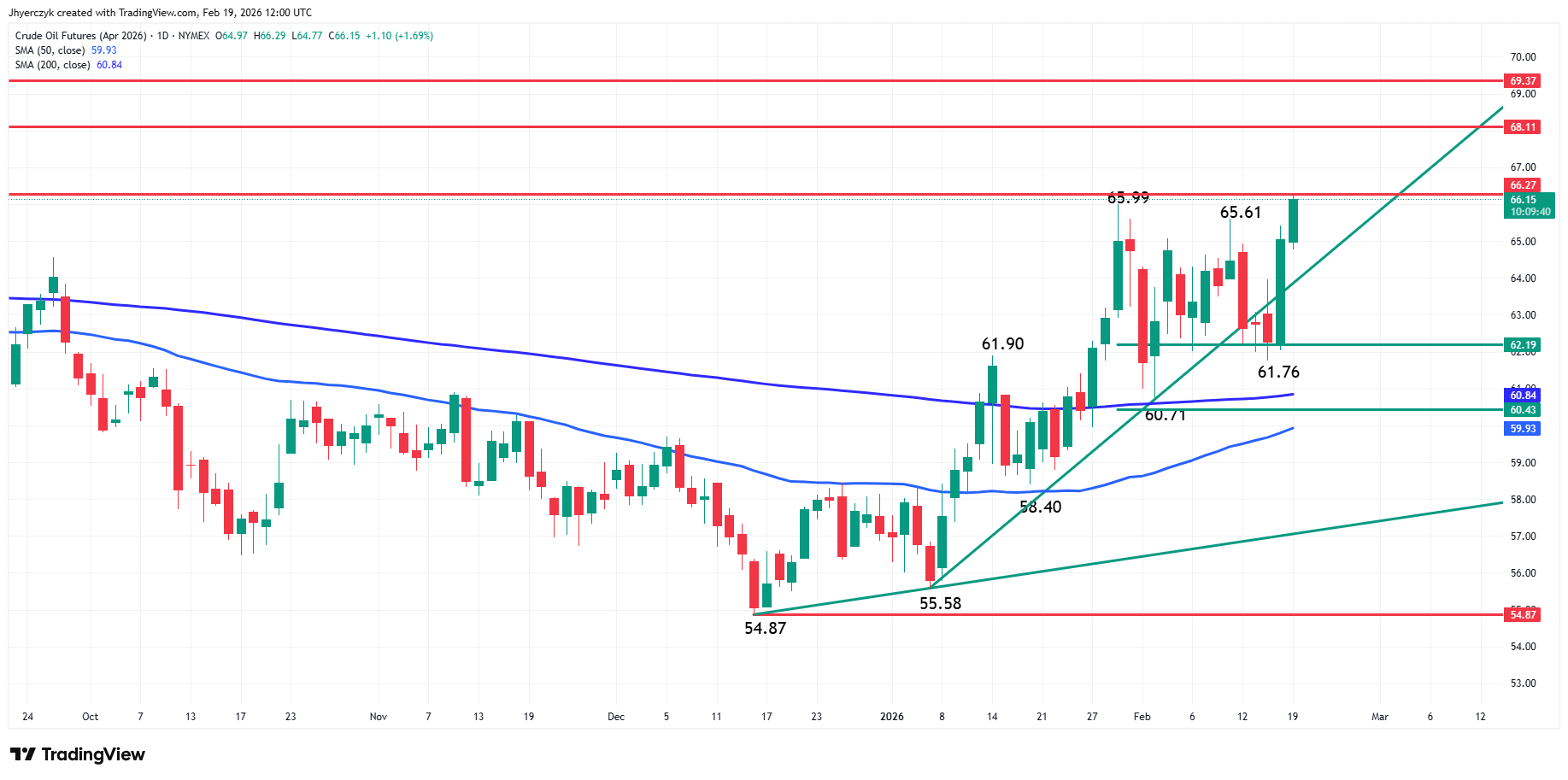
Technically, we’re now in a momentum and headline-driven market so we’re going to look at wider possibilities.
From the bottom up, the market is well supported by an uptrend line at $63.84 and the 200-day moving average at $60.84, followed by the 50-day moving average at $59.93.
Upside targets include former tops at $66.27, $68.11 and $69.37.
Don’t Expect $100+ Oil for Long—World Is Well-Supplied
Keep in mind that the world is well supplied with oil at this time and only 20% of global consumption flows through the Strait of Hormuz, so don’t start thinking about a prolonged period where crude oil is sitting above $90 or $100 a barrel.
In February 2022 when Russia invaded Ukraine, I saw oil futures prices spike to over $120 a barrel. Four years later, they are still fighting and prices were about half that at $60 just a month ago. Fundamentally, the main focus should be on whether the Strait of Hormuz gets blocked and for how long. I think that will determine how high prices go and for how long they sit at elevated levels.
More Information in our Economic Calendar.