


WTI Crude Oil Futures: War Premium Returns as Iran Talks Take Center Stage
West Texas Intermediate crude oil futures are higher on Tuesday as traders shifted their focus back to the possibility of a supply disruption in the Middle East after driving prices lower last week on concerns over high global supply.
Dip Buyers Step In With Conviction
Last week, we said that supply disruption fears have created a floor in the market, which is keeping traders in “buy the dip” mode. We’re seeing evidence of that today with a solid bounce from last Friday’s low at $62.14 to today’s high of $64.14.
This Is Not a Technical Bounce
I don’t think this is just a technical bounce either because the low at $62.14 isn’t coming from any strong technical region. It looks like headline buying, which supports my notion that the mere mention of talks between the United States and Iran, military activity in the region, or even the presence of additional US naval ships in the area is enough to attract buyers and encourage weak shorts to aggressively cover their positions.
I don’t think it was a value buy either because the value zone is right around the $60.83 to $59.59 area. So yes, I believe we’re looking at a fresh round of war premium buying.
Stability Over Momentum
We’ve seen the buying on the dip, but we haven’t seen any key technical resistance levels overcome, so the fresh buying is just providing stability to the market. This is helping to keep volatility down and allowing traders to assess the price action at a much slower pace instead of during a panic buying situation.
Brent Oil Price Forecast
Every new Brent Oil analysis as it publishes, today's technical signal and key levels, live price — on one page.
See all Brent Oil forecastsIran Talks Are Driving the Fundamental Story
Fundamentally, the talks between the US and Iran are the primary driver. Yes, we saw a brief sell-off last Thursday on demand concerns and worries about oversupply, and we may have seen some lightening of the war premium, but the market has absorbed that potentially bearish news and is back on track with the US and Iran relationship back at the forefront.
According to numerous news services, the two countries are scheduled to hold a second round of talks in Geneva today over Tehran’s nuclear program. Reuters suggests there is a little optimism in the air ahead of this meeting after President Trump said that Washington could make a deal with Tehran over the next month. Furthermore, there are reports that Iran’s foreign minister met with the head of the International Atomic Energy Agency, the UN nuclear watchdog, on Monday.
Key Levels to Watch
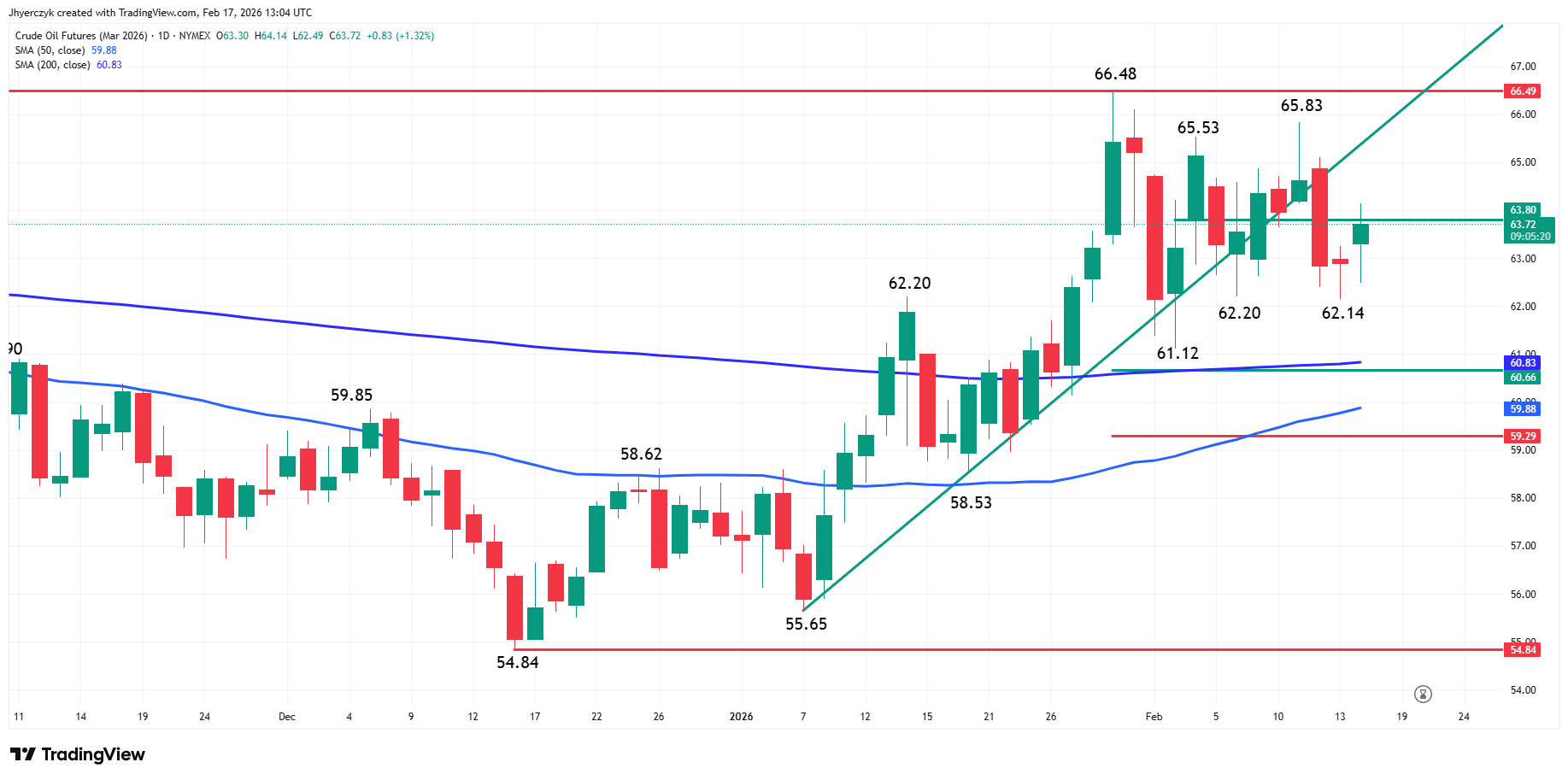
Technically, the major support cluster is being formed by the 200-day and 50-day moving averages at $60.83 and $59.88 respectively, and a retracement zone at $60.66 to $59.29.
Minor resistance is a pivot at $63.80, currently being tested. The first major upside target is a trend line at $65.41. This has provided support and guidance since the low on January 7. Recapturing this trend indicator opens the possibility of a breakout over $66.49.
The Risk Is Real If Talks Collapse
Looking ahead, the market is still being supported by the risk premium, but there is enough optimism about the upcoming meeting between the US and Iran to stall any major breakout rally. However, if the talks collapse there is the possibility of a sustained military campaign by the United States, and this could cause prices to jump $10 to $15 a barrel if it leads to the closure of the Strait of Hormuz.
More Information in our Economic Calendar.