



Oil prices continued to rise for the third consecutive session as the U.S.-Israeli conflict with Iran escalated and the risks of shipping through the Strait of Hormuz grew into fears of supply. Brent crude oil (BCO) is trading around $82 while WTI crude oil (CL) is trading around $73. As discussed earlier, the oil market is emerging with breakout patterns that indicate a quick move to $100. The escalation in the conflict will likely support the bullish trend in the oil market.
Strait of Hormuz Disruption Threatens Global Oil Supply
The Strait of Hormuz disruption is a direct threat to global energy flows. The conflict escalated as Israel increased strikes and Iran retaliated by hitting energy facilities and tankers. Iranian media reported that the strait is practically shut with threats to shoot at passing vessels.
Insurers have pulled a lot of coverage for ships. Tankers are avoiding the route. According to some reports, at least four vessels are damaged and around 150 ships are still grounded. This situation indicates an operational disruption.
On the other hand, the refined products also surged. Saudi Arabia closed its largest domestic refinery following a drone attack. When refining capacity is threatened, margins enlarge and fuel prices are higher than crude. That is adding inflation pressure and reinforces the bullish narrative.
These market developments support a strong bullish narrative for oil prices. If oil prices break the psychological $100 level, the next target will be $120-$150 if the conflict further escalates.
Brent Oil Price Forecast
Every new Brent Oil analysis as it publishes, today's technical signal and key levels, live price — on one page.
See all Brent Oil forecastsTechnical Outlook: Breakout Signals Point Toward $100
Weekly Breakout Confirms Structural Uptrend
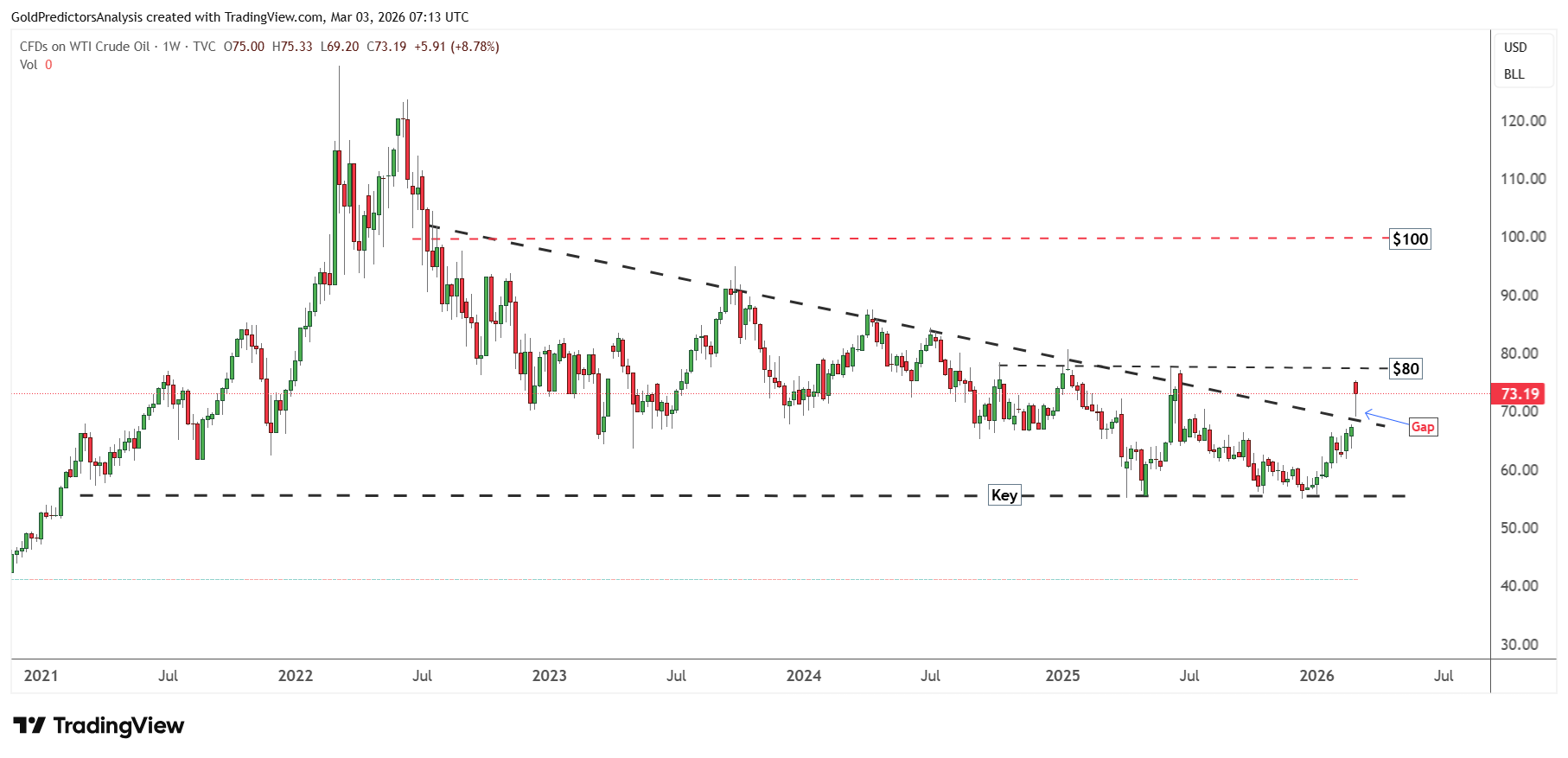
The WTI oil price has found a strong bottom at the long-term support of $55 and initiated a strong surge. After strong rebound from this support, the oil price has broken the descending trend line in the $68 area and opened higher with a big gap at $75.
This breakout from the $68 level in WTI oil is pushing the price to $80. However, the breakout from the triangle pattern indicates that the oil price will likely trade toward the $100 level.
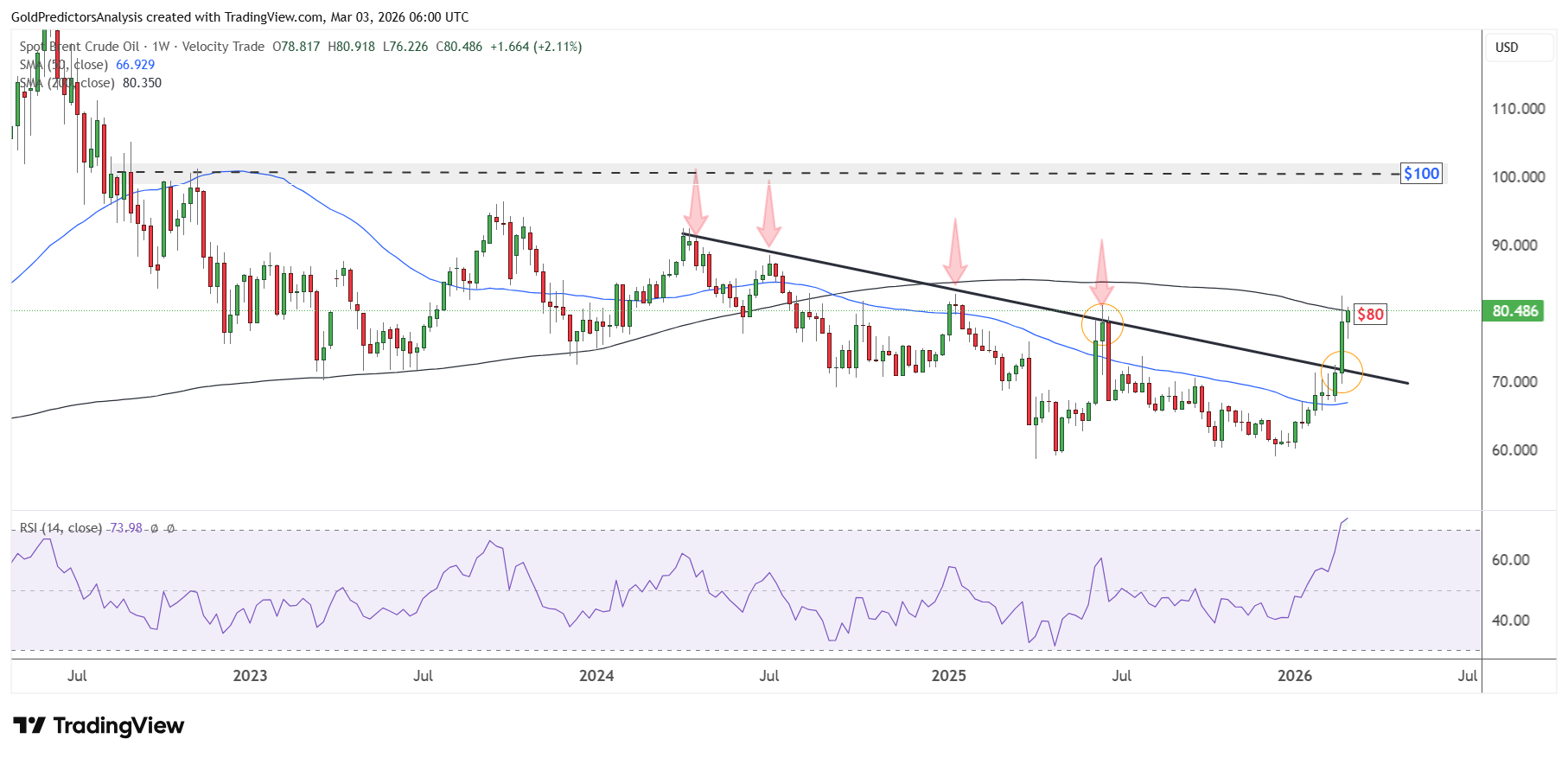
Brent Oil also shows strong bullish price action, as seen on the weekly chart below. The price has broken the descending trendline on the weekly chart at $72 and initiated a strong surge toward the 200-SMA.
A break above $80 in Brent Oil will indicate a strong surge toward $100. However, the RSI indicates that Brent Oil is approaching overbought levels. But the escalating crisis in the Middle East suggests that prices may continue to trend higher despite the overbought conditions.
Short-Term Momentum Accelerates Higher
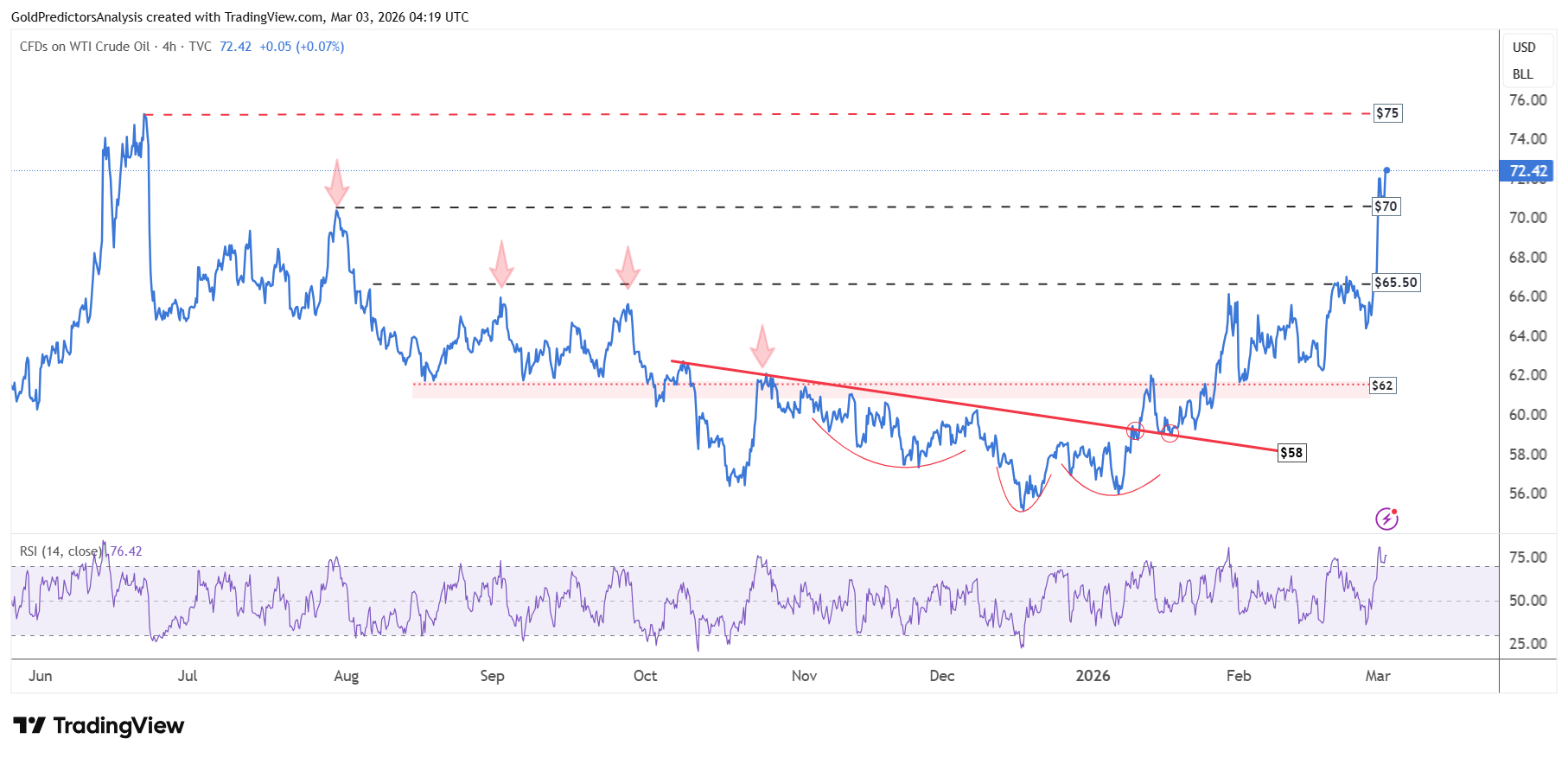
The short-term price action for the oil market is also strongly bullish, as seen on the 4-hour chart below. The 4-hour chart for WTI crude oil shows strong bullish developments above $55, as indicated by inverted head and shoulders pattern.
The breakout from $62 in WTI crude oil has taken the price to $70. However, the price has also broken $70 and is now moving toward $75 in the next few sessions. Based on this bullish price action, WTI crude oil will likely trade higher in the short term.
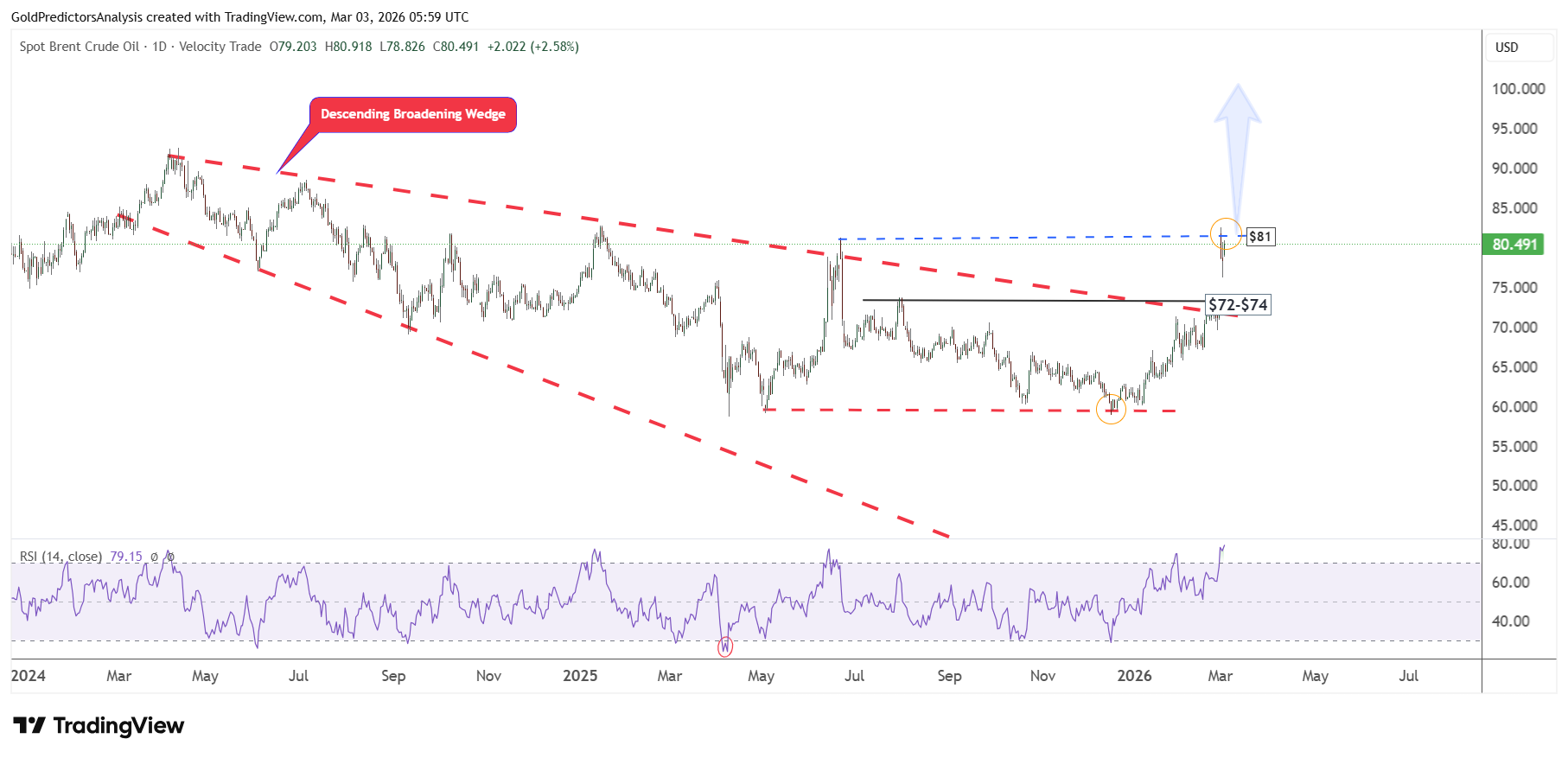
Similarly, the short-term price action in Brent crude oil is also strongly bullish. The price has broken the descending broadening wedge pattern, which has a minimum technical target of $92.50. However, due to escalating trade tensions, $92 will likely be broken, and the price will likely move toward the $100 psychological level.
The descending broadening wedge pattern is a bullish price pattern. A breakout from this pattern indicates that the bullish trend will continue.
Bottom Line
Oil prices remain in a healthy uptrend in the short term due to escalating tensions which may lead to supply disruptions. Any further attack on infrastructure or shipping can quickly drive prices higher.
The technical picture also favours fundamental developments. The emergence of bullish price action at long term support of $55 and breakout from the key level of $80 indicates a move to $100. However, if conflict persists prices may continue to rise towards $120-$150. Any hint of de-escalation could cool off the risk premium and cause volatility.
If you’d like to know more about how to trade crude oil, please visit our educational area.