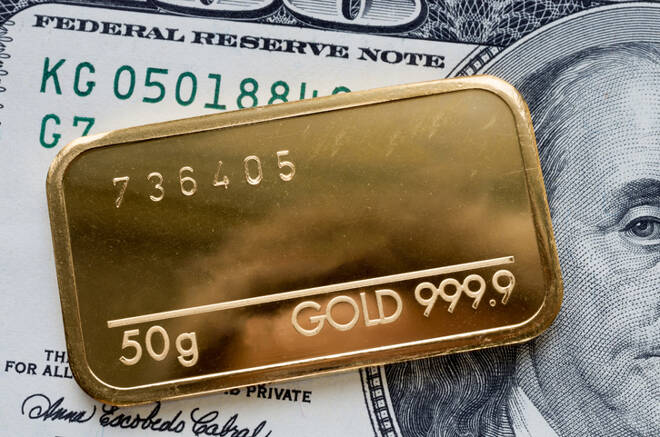
Gold futures are inching above the $1900.00 level for the first time since January 8, underpinned by steady-to-lower Treasury yields and a falling U.S.
Gold futures are inching above the $1900.00 level for the first time since January 8, underpinned by steady-to-lower Treasury yields and a falling U.S. Dollar amid growing inflation concerns after several Federal Reserve policymakers stood firm on their dovish stance over rates.
At 06:43 GMT, August Comex gold futures are trading $1908.20, up $7.70 or +0.41%.
There are no major reports on Wednesday so we could be looking at another cautious trade ahead of several U.S. economic reports on Thursday and the all-important Core Personal Consumption Expenditure Price Index (PCE), the Fed’s preferred gauge of inflation, on Friday. The latter is likely helping to put a bid under the gold market this week with investors looking for it to show a jump in inflation from 0.4% month-on-month to 0.6%.
In the absence of reports on Wednesday, traders will once again be looking toward Fed speakers for guidance. Since the last Fed meeting in late April and the release of the Fed minutes last week, Fed officials have been sounding a dovish tone with most strongly emphasizing that the jump in inflation is transitory, the economy is still fragile and the recovery too uneven for the Fed to start tapering its bond purchases or raising rates.
Federal Reserve Bank of Chicago President Charles Evans: The recent rise in U.S. inflation is unlikely to lead to the kind of undesirably high inflation that some notable economists have warned about, Evans said on Tuesday, reiterating his support for the Fed’s super-easy policy.
“I have not seen anything yet to persuade me to change my full support of our accommodative stance for monetary policy or our forward guidance about the path for policy,” Evans said in remarks prepared for delivery to a Bank of Japan conference.
San Francisco Federal Reserve Bank President Mary Daly: Federal Reserve policymakers are “talking about talking about” reducing their support for the economy, but for now policy is in a “very good place.”
“We haven’t seen substantial further progress just yet,” Daily said in an interview on CNBC, referring to the bar the Fed has set before it would begin to taper its $120 billion a month in asset purchases that is helping support the economy. “It’s too early to say the job is done.”
Federal Vice-Chair Richard Clarida: The U.S. central bank could curb any possible outbreak of inflation without throwing the economic recovery off track.
The Fed feels the current rise in prices will ease on its own as the economy reopens, but “in the risk case where these pressures are more persistent and they put our price stability mandate at risk, we will recognize that and through our communications and our tools I think we will be able to offset that in a way that would be supportive of maintaining economic recovery,” Clarida said on Yahoo Finance.
Everything has been coming up roses for gold bulls lately, but there is one negative in the news overnight that could catch the attention of these bullish traders. The Reserve Bank of New Zealand (RBNZ) projected a rate hike by September next year. However, policymakers did try to play down expectations by saying it would maintain its current stimulatory monetary settings until its inflation and employment targets are met.
With the news, the RBNZ becomes one of the first central banks in advanced economies to signal a rate hike.
For a look at all of today’s economic events, check out our economic calendar.
James Hyerczyk is a U.S. based seasoned technical analyst and educator with over 40 years of experience in market analysis and trading, specializing in chart patterns and price movement. He is the author of two books on technical analysis and has a background in both futures and stock markets.