


July Natural Gas Drops 4% on Supply Glut and Weak Exports
July Nymex Natural Gas settled at $3.021 on Friday, down 13.5 cents or 4.28%. Prices failed for a second session to break through the $3.387 to $3.396 resistance zone and the sellers took over. U.S. inventories are still 5.7% above the five-year average. Production hit 110.4 bcf per day. LNG export flows dropped 5.8% from last week on seasonal maintenance.
The weather forecasts are still bullish but the supply side is not cooperating. Buyers keep bidding passively on dips. They are not chasing. That is why this market gave back 4% on a Friday.
Supplies Keep the Pressure On
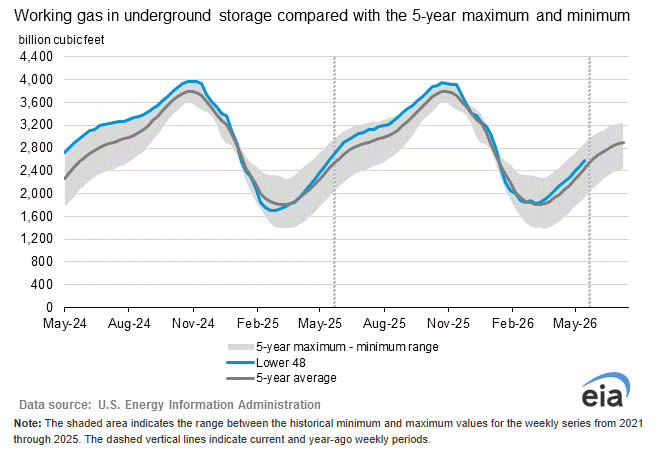
The builds keep coming in below average and the market does not care. The Energy Information Administration reported 95 bcf for the week ending May 29. Expectations were 99 bcf. The five-year average was 101 bcf. That is three consecutive weeks of lighter injections and July Nymex Natural Gas still dropped 4% on Friday. When below-average builds cannot hold prices up, the supply overhang is doing more work than the injection numbers.
Total inventories are 5.7% above the five-year seasonal average. That is the number the bears keep pointing to. The builds have been light but the cushion above average is still there and production is not slowing down.
Lower-48 dry gas production hit 110.4 bcf per day on Friday according to BloombergNEF. That is 1.7% above year-ago levels and running near records. The Energy Information Administration raised its 2026 production forecast to 110.61 bcf per day. Baker Hughes reported the rig count dipped by one to 124 last week, down from the 2.5-year high of 134 rigs earlier this year but nowhere near the 94-rig low from September 2024. Producers are not pulling back. The gas keeps coming and the market knows it.
Natural Gas Price Forecast
Every new Natural Gas analysis as it publishes, today's technical signal and key levels, live price — on one page.
See all Natural Gas forecastsLNG Export Flows Drop on Maintenance
Estimated net flows to U.S. LNG export terminals averaged 17.2 bcf per day on Friday. That is down 5.8% from the prior week and sitting near the lowest level in more than two weeks. Seasonal maintenance at terminal facilities pulled export demand lower and left more gas available for the domestic market.
The Strait of Hormuz is still restricted. Qatar’s Ras Laffan Industrial City is still running below capacity with roughly 17% of export capacity offline. Those disruptions are keeping global LNG demand pointed at U.S. cargoes over the medium term. But right now the maintenance cycle is cutting into the flows and the timing is bad. Supply is heavy domestically and the export pull that was supporting prices just got weaker at exactly the wrong moment.
European storage is 41% full as of June 3. The five-year average for this time of year is 56%. That gap means European buyers need to rebuild inventories before winter and U.S. LNG cargoes are the most reliable source. Once the maintenance cycle ends and export flows normalize, that demand comes back. The question is whether it comes back fast enough to stop the selling.
Weather Supports Demand but Not Enough Yet
Commodity Weather Group shifted models warmer with above-average temperatures expected across the Midwest and Northeast through June 14. The Edison Electric Institute reported U.S. electricity output climbed 6.4% year-over-year for the week ending May 30. Power generation over the past 52 weeks is running 2.18% above year-ago levels.
The heat is building but overall Lower-48 gas demand hit 70.6 bcf per day on Friday. That is down 2% from the same period last year. Power burn is expected to ramp as the heat settles in but right now demand is running below year-ago levels and that gives the bears another number to lean on.
The summer cooling season is still early. If the above-normal temperatures hold through late June and into July, demand catches up. It just has not caught up yet and Friday’s 4% drop shows the market is not willing to wait.
Daily July Natural Gas Technical Analysis
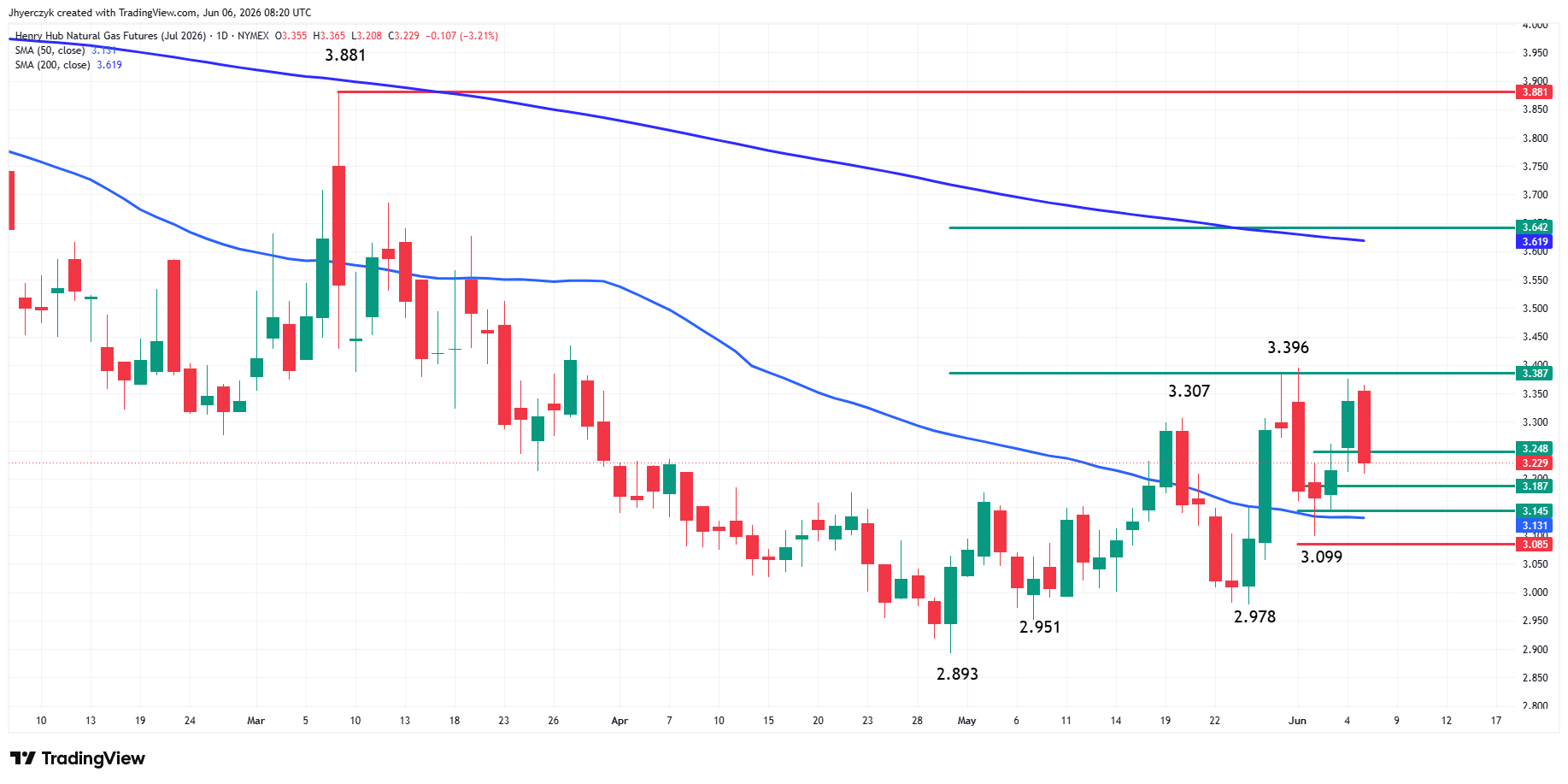
July Natural Gas futures settled lower on Friday after failing for a second session to take out the key 50% level at $3.387 and the main top at $3.396.
The main trend is up according to the daily swing chart. A trade through $3.396 will signal a resumption of the uptrend. A move through $3.099 will change the main trend to down.
The market is also trading on the strong side of the 50-day moving average at $3.131, providing additional support, while supporting the uptrend.
Minor support is a series of 50% levels at $3.248, $3.187 and $3.145.
As long as the 50-day moving average and the main bottom at $3.099 remain intact, traders will be in buy the dip mode. These two price levels are your exits if wrong. If the current rally attempt fails, then look for buyers to try to reestablish support and start a new uptrend. Even if the trend turns down, it’s hard to get short at current levels with an elongated support base formed.
What to Watch
Supply is winning the argument right now. Production at 110.4 bcf per day keeps pushing gas into a market that is already sitting 5.7% above the five-year storage average. LNG export flows dropped 5.8% on maintenance and left more gas onshore. Overall demand at 70.6 bcf per day is running 2% below last year. The weather forecasts are bullish but the numbers on the ground are not backing them up yet.
The medium-term setup looks nothing like the short-term. European storage is sitting at 41% against a five-year average of 56% and that gap has to close before winter. Those cargoes are coming from U.S. terminals. The Strait of Hormuz is still restricted. Qatar’s Ras Laffan is still running 17% below export capacity. Once the maintenance cycle at U.S. terminals wraps up and export flows get back above 18 bcf per day, the domestic surplus starts draining faster than the bears expect.
The $3.387 to $3.396 resistance zone rejected the market for a second session. The 50-day moving average at $3.131 and the main bottom at $3.099 are the key support levels. As long as both hold, buyers stay in the dip-buying mode. A break below $3.099 changes the trend but the support base underneath is deep enough to limit the downside.
More Information in our Economic Calendar.