


On March 18, the Federal Reserve held rates at 3.50–3.75% and released a dot plot signaling only one rate cut for the remainder of 2026. Silver, which had been trading around $80–82 . As of March 20 it is trading near $68 — down from its March 10 high of $88.80.
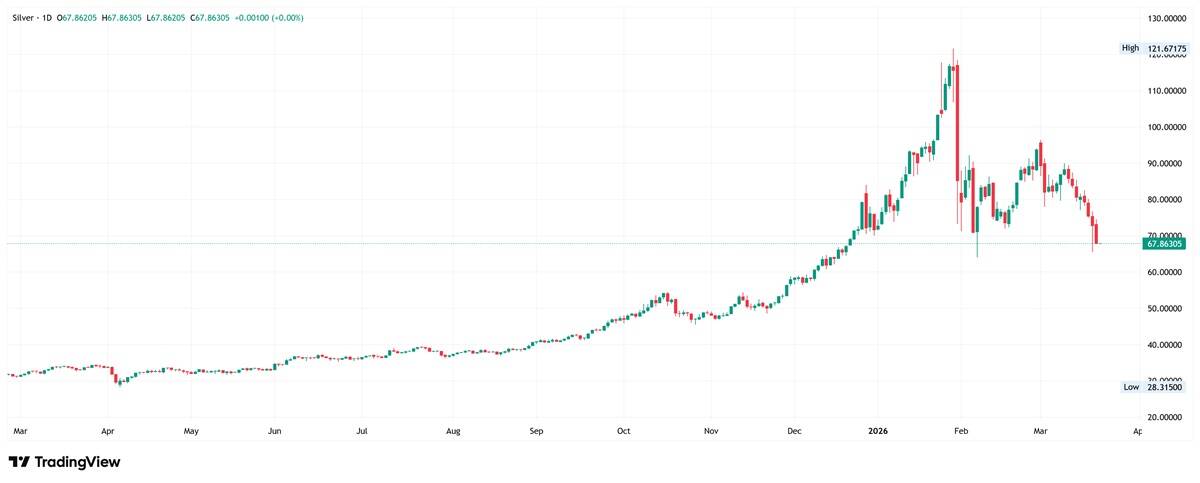
I want to put that decline in context, because it illustrates exactly the dynamic I covered in this week’s premium Silver Catalyst issue. The dollar-silver relationship has a well-documented inverse correlation. When the Fed signals fewer cuts, the dollar strengthens. When the dollar strengthens, investment demand for silver retreats. The move from $88 to $68 is not a mystery — it is the mechanism working as described.
What it is not is a change in the fundamental picture. Silver fell from $96 to the mid-$80s on dollar strength, and the structural deficit did not reduce by a single ounce. In January-February correction took silver from $121.64 to $64.14, and COMEX inventory kept draining regardless of price. The pattern is consistent: the dollar creates the dip; the fundamentals determine what comes after it.
The Dollar and Why This Is Not 2022
The hawkish dot plot produced exactly the short-term headwind I flagged before the meeting: fewer expected rate cuts, stronger dollar, silver investment demand hit hard. This is worth understanding precisely, because the same forces that create the dip also reveal its limits.
The inverse correlation between the Dollar Index and silver prices runs between –0.6 and –0.8 over multi-decade periods. The mechanism operates through five simultaneous channels: currency translation effects for non-US buyers, repricing of real assets in a stronger-dollar environment, opportunity cost (fewer expected cuts means the zero-yield case for silver weakens at the margin), algorithmic amplification (many systems are explicitly programmed to sell silver when DXY rises above certain thresholds), and export competitiveness dynamics.
These channels explain virtually all of the current selloff. But what a rising dollar does not do:
- Reduce the solar industry’s need for silver
- Change the geology causing Fresnillo to cut production 9%
- Replenish COMEX registered inventory
- Push back India’s April 1 SEBI reform date
- Stop industrial delivery demand at COMEX
The 2022 episode is the clearest modern case study. The Dollar Index reached 20-year highs. Silver ETP holdings declined by approximately 117.4 Moz, one of the largest annual outflows on record (Silver Institute). Silver fell from around $26 to below $18. And the market still ran a roughly 237 Moz structural deficit (Silver Institute, World Silver Survey 2023) because industrial buying never stopped. The floor got lower before the recovery began.
The difference between now and 2022 is structural severity. In 2022, COMEX registered inventory was above 300 million ounces. Today it stands at 78.95 Moz — a 67% decline from the April 2020 peak, based on historical CME warehouse data. In 2022, there was no sixth consecutive structural deficit. There was no India SEBI reform opening nearly $1 trillion in mutual fund assets to silver allocation. And there was no Section 301 investigation targeting 25% of global mine supply.
The dollar-driven pullback has a well-understood cause and a historical precedent. The precedent ends with the fundamentals reasserting.
Silver Price Forecast
Every new Silver analysis as it publishes, today's technical signal and key levels, live price — on one page.
See all Silver forecastsCOMEX Registered Inventory at 78.95 Moz: The Floor Beneath the Price
While markets focus on the Fed’s dot plot, the physical market beneath the price has quietly reached a stress level with no precedent in exchange history.
The CME Silver Stocks Report for March 12, 2026, reviewed directly from the official CME file, shows:
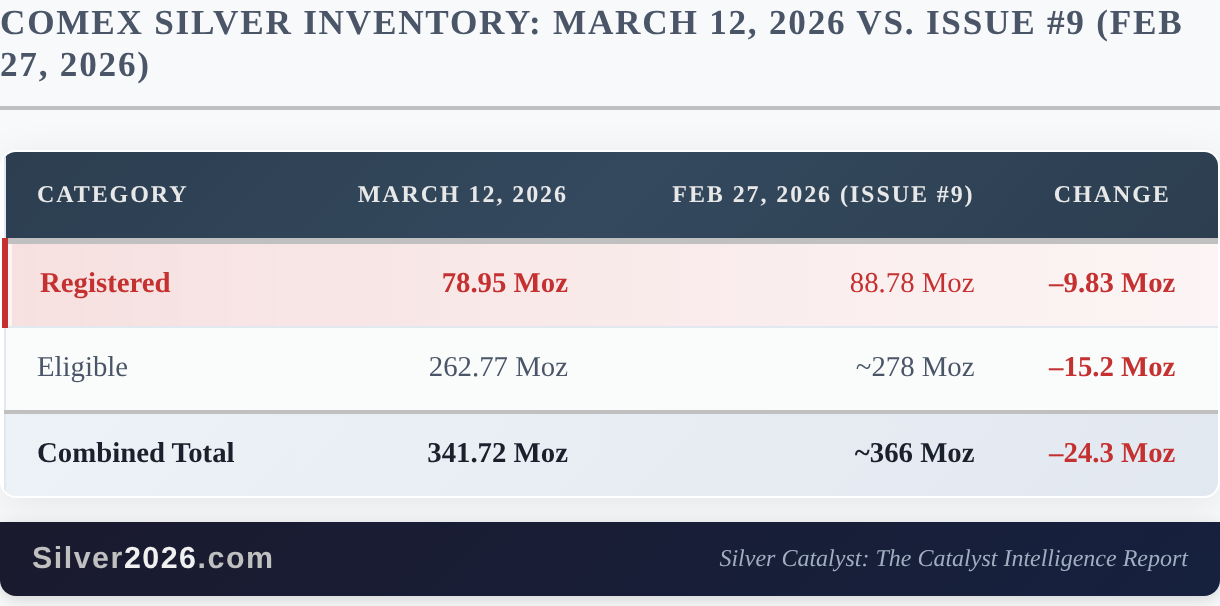
Registered silver is the metal actually available for delivery against futures contracts. It represents the physical cushion supporting COMEX price discovery. At 78.95 Moz and declining at approximately 22–23 Moz per month, a simple depletion model suggests roughly 74 trading days before the registered pool would reach zero at current pace — a model output, not a forecast, but the trajectory is meaningful regardless.
According to GoldSilver.ai‘s COMEX monitoring dashboard, which derives analytical metrics from CME’s published data, the COMEX Stress Index stands at 84 out of 100 as of March 12, near its all-time high. The same dashboard models a coverage ratio of 13.7% — the ratio of registered inventory to open interest — and estimates paper leverage at 7.3 times deliverable metal. These are third-party derived metrics, not official CME statistics, but they are calculated from the exchange’s own daily warehouse reports.
The April 2026 delivery cycle is already building. As of March 13, 9.9 Moz in potential April delivery demand represents 12.6% of registered inventory — before April First Notice Day. The March cycle began with 52.63 Moz in standing delivery demand against 88.78 Moz registered (59.3%), a ratio that would have been considered a full-blown crisis in any prior cycle.
Here is the critical point: lower silver prices do not reduce delivery demand from industrial users and commercial hedgers. They reduce investment demand. Industrial delivery demand is determined by production schedules, contractual requirements, and end-use needs — none of which are sensitive to whether silver is at $68 or $83. A price decline driven by investment outflows does not relieve the COMEX delivery pressure. If anything, it can accelerate physical accumulation by opportunistic buyers, as happened in January 2026 when Turkey imported a record 273 tonnes in a single month.
At 78.95 Moz registered and falling, COMEX is operating with minimal margin for error. The investment selloff creates the price decline. The physical market creates the floor.
The University of Zurich Study: When Academia Validates the Thesis
One of the more overlooked developments of the past week occurred on March 11, two days before the PCE data that triggered the latest dollar-driven correction. Researchers at the University of Zurich — Prof. Thorsten Hens and Alvin Amstein, commissioned by Bank von Roll — published a peer-reviewed study examining precious metals allocation across multiple portfolio models.
The study’s key finding on silver: “Silver in particular is likely to benefit from the energy transition.”
This sentence, in a peer-reviewed paper from a top-10 European research university, matters disproportionately to its length. Here is why.
Bank price targets and commodity desk reports circulate within financial institutions but rarely drive formal allocation decisions. Peer-reviewed academic research operates differently. It is cited in investment policy statements, endowment allocation guidelines, and eventually investment mandates. When a finance department at a research university publishes peer-reviewed work making the case for precious metals exposure — and specifically naming silver as a beneficiary of the energy transition — it creates the intellectual infrastructure that institutional allocators need to justify positions to their investment committees.
Most institutional investors who are not currently holding silver are not avoiding it because of a bearish view. They are avoiding it because their investment policy statements don’t permit it, or because the internal justification threshold has not been met. Academic validation from a credible source lowers that threshold. It doesn’t create demand this week. It creates the conditions for demand to be authorised over the next several quarters.
The timing is notable. The Zurich study was published 21 days before India’s SEBI mutual fund reform takes effect on April 1 — the date on which nearly $1 trillion in Indian mutual fund assets gains formal permission to allocate to precious metals for the first time. Three separate institutional demand signals — academic validation, SEBI reform, and the BHP-Wheaton streaming deal closure — are converging in the same 30-day April window.
The academic case for silver allocation is no longer confined to independent analysts or commodities desks. It has crossed into peer-reviewed research. In the institutional money management world, that is a different category of imprimatur entirely.
What This Means
Silver at $68 on March 20 is lower than it was when I published Issue #10 three days ago. The hawkish dot plot delivered exactly the near-term headwind I described. That part of the analysis was straightforward — and it played out as expected.
What has not changed: 78.95 Moz of COMEX registered inventory, draining at 22–23 Moz per month. A sixth consecutive structural deficit of 67 Moz, projected by the Silver Institute. India’s April 1 deadline. The University of Zurich study. The Section 301 investigation targeting Mexico’s 200 Moz of annual production. The eVTOL program approvals adding a new category of silver demand.
The dollar move from $80 to $68 is the investment demand channel contracting on hawkish Fed signalling. As I’ve been tracking throughout 2026, that channel has reversed before — and faster than most expect — when the structural forces become too visible to ignore.
The 2022 case study didn’t end at $18. It ended at $30 by early 2023, then $50 by late 2024, then $121 in January 2026. The dollar creates the dip. The fundamentals determine what comes after it.
The full Silver Catalyst Issue #10 contains 3 more Deep Dives not covered in either free article: the complete stagflation data picture (GDP 0.7%, Core PCE 3.1%, February jobs –92,000) and what it means for the Fed’s impossible position, the Section 301 trade investigation targeting Mexico and the supply disruption scenarios it creates, and the FAA eVTOL pilot program approval and what it means for a new high-intensity category of silver demand. If you want the complete framework as these catalysts continue to unfold, I encourage you to get “Silver Rising” with complimentary 2-week access to the Silver Catalyst newsletter.
Thank you.
The Silver Engineer