



June WTI Posts One of Its Sharpest Weekly Declines as Peace Headlines Flush the Risk Premium
June WTI crude oil futures and Spot Brent crude oil both closed sharply lower last week after peace headlines between the U.S. and Iran triggered a wave of long liquidation that the market had been building toward for weeks. The Strait of Hormuz is still restricted. Iran has not accepted anything. But the speed of the selloff told me everything I needed to know about how crowded the bullish trade had become.

The Trade That Defined the Week
A 14-point memorandum of understanding surfaced midweek and June WTI crude oil did not wait for confirmation. It collapsed. Spot Brent crude fell back below $100 a barrel inside the same session. I’ve watched crowded trades come apart before and that is exactly what this was. Weeks of positioning built around Strait of Hormuz restrictions, military escalation risk and supply disruptions came out in a matter of sessions. The exits do not open gradually when a trade that crowded starts moving against you. Everyone hits the door at once.
Project Freedom and the Trap It Created
Trump announced Project Freedom midweek, a military escort operation moving commercial vessels through the Strait of Hormuz. The market read it two ways simultaneously and that created the confusion. On one side, escorted ships moving through the Strait means supply can flow and that is bearish crude. On the other side, U.S. warships running tanker escorts through Iranian-controlled waters is not a de-escalation. That is a confrontation waiting to happen. One vessel made it through and crude pulled back. I understood the knee-jerk reaction. I did not buy the conclusion. One escorted ship is not normalized shipping. Commercial traffic stabilizes when vessels move freely without a naval convoy and that is not what happened last week.
The Inventory Data Nobody Cared About
The American Petroleum Institute reported a large draw in crude inventories with additional declines in gasoline and distillates. That is a bullish report on any normal week. Last week it landed and traders barely moved. When a peace headline is running the tape this completely, the American Petroleum Institute does not get a vote. The draw was real. The numbers supported higher prices. They just could not compete with the noise coming out of the diplomatic track and the market made that clear fast.
Iran Has Not Said Yes
Iran confirmed it was reviewing the 14-point proposal. It did not accept it. Officials made clear that negotiations could not move forward under threats or military pressure. Trump followed that by warning that military action was still on the table if talks broke down. That sequence brought traders back to reality fast. The geopolitical risk did not go away last week. It took a few sessions off. The Strait of Hormuz does not need to be fully shut to keep a floor under this market. The threat of disruption is enough to keep tanker operators rerouting, insurance costs climbing and physical delivery timelines stretching out. Every additional day of uncertainty is a cost that gets passed through the global supply chain one way or another.
Brent Oil Price Forecast
Every new Brent Oil analysis as it publishes, today's technical signal and key levels, live price — on one page.
See all Brent Oil forecastsThe Selling Evolved as the Week Went On
Early in the decline the move looked like straightforward long liquidation. Traders who had been heavily positioned on the bull side took the peace headline as a reason to reduce exposure and they did it quickly. By the end of the week the character of the selling had changed. Short sellers were pressing the move harder and rebound attempts were struggling to find traction. The market felt heavier going into the weekend than it did coming out of Monday. But buyers never completely walked away either. Every significant pullback still attracted dip buying because one negative headline out of Tehran puts the risk premium right back in. That kept the short side from getting too aggressive about pressing lower.
Oil and the Fed Are Still Connected
High crude prices do not stay contained. They move through transportation costs, manufacturing costs and shipping costs and the Federal Reserve is watching all of it. As long as June WTI crude oil stays elevated, inflation stays alive and the Fed has less room to justify a rate cut. Last week reinforced that connection instead of breaking it. The peace headline sent crude lower and for a few sessions the inflation picture looked a little more manageable. Then Iran did not say yes and the picture clouded right back up. A deal that sends June WTI crude oil sustainably below $90 changes the Fed calculus fast. Nothing that happened last week confirmed that deal is coming.
Technical Outlook
June WTI Crude Oil Futures
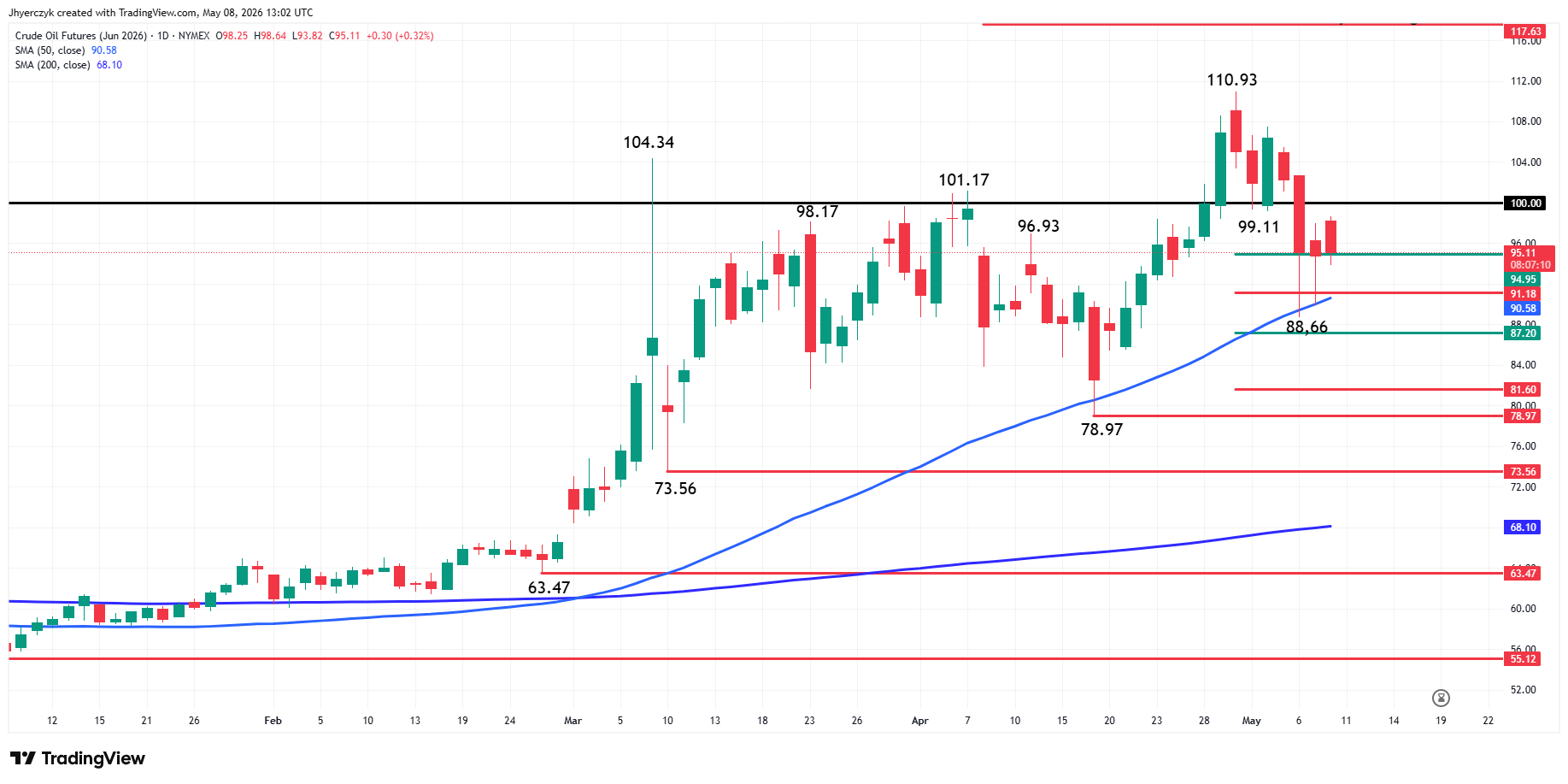
June WTI crude oil futures closed lower last week while posting a volatile trading session. The sharp sell-off from $110.93 stopped at $88.66. The move made $110.93 a new minor top. A trade through this level will signal a resumption of the uptrend with $117.63 to $119.48.
Key retracement zone support is at $94.95 to $91.18 and $83.02 to $76.44. The major support according to the swing chart is the main bottom at $78.97 and the 52-week moving average at $67.06.
The new minor range is $110.93 to $88.66. Its 50% level at $99.80 is the major pivot this week.
Trader reaction to $99.80 is likely to set the tone this week. A sustained move over $99.80 will signal the presence of buyers. If this creates enough upside momentum, buyers could drive the market to $110.93 and possibly beyond.
A sustained move under $99.80 will indicate the presence of sellers with potential downside targets at $94.95 to $91.18 and $83.02 to $76.44.
Buyers have been coming in on dips, so I think we should respect this pattern until it breaks, which will be difficult because potential support drops all the way to $67.06 this week.
Spot Brent Crude Oil
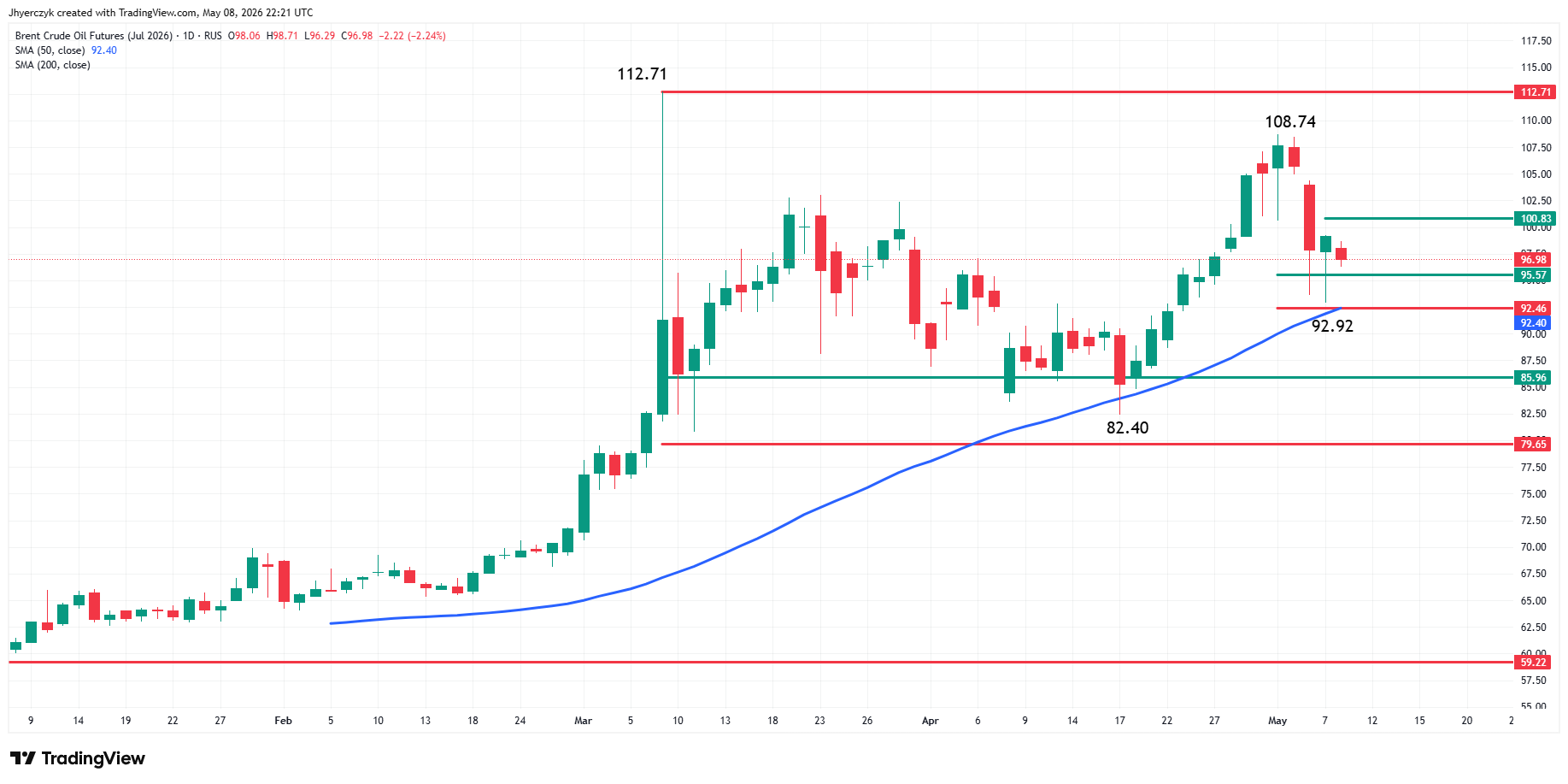
Spot Brent crude oil finished lower last week. The short-term swing is $87.32 to $120.54. Its retracement zone at $104.19 to $100.01 is support. It essentially stopped the selling at $99.77 last week.
The new minor range is $120.54 to $99.77. Its 50% level or pivot is $110.16.
The long-term range is $58.98 to $120.54. Its support zone is $89.76 to $82.50.
The 52-week moving average is $74.61.
Given the current uptrend, any one of these support areas could attract new buyers if tested.
The key level on the upside is the pivot at $110.16. Trader reaction to this price will set the tone this week.
A sustained move over $110.16 will set a bullish tone with $120.54 a potential target. A sustained move under $110.16 will signal the presence of sellers. This opens the door for a retest of $103.93 to $100.01. Taking out $99.77 will indicate the selling pressure is getting stronger with $89.76 to $82.50 the next potential target.
Keep an eye on $110.16 all week. Expect heightened volatility.
Weekly Outlook
The $99.80 pivot on June WTI crude oil is the level that sets the tone this week. Hold above it and the buyers who have been coming in on dips stay in control with $110.93 back on the radar. Lose it and $94.95 to $91.18 becomes the first area to watch followed by $83.02 to $76.44. On Spot Brent crude oil the $110.16 pivot is the equivalent level. Trader reaction there sets the Brent tone the same way $99.80 sets the WTI tone.
The negotiation headlines are going to keep driving session to session moves. One positive statement out of Tehran and the shorts cover fast. One negative statement and the longs that survived last week’s selloff start reducing again. Until there is a signed agreement or a clear breakdown in talks, this market trades on headlines and the chart levels are the guardrails not the drivers.
If you’d like to know more about how to trade crude oil, please visit our educational area.


