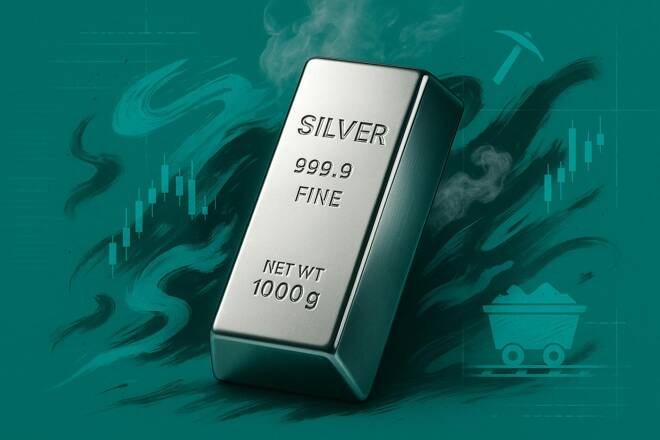
Spot Silver (XAG/USD) closed lower on Wednesday after taking out Monday’s low at $70.52. The plunge to $70.07 took place without much fanfare despite the thin holiday trade. End-of-day profit-taking likely triggered a rebound to $71.64 into the close.
On Wednesday, XAG/USD settled at $71.64, down $4.60 or -6.04%.
Wednesday’s trade confirmed Monday’s closing price reversal top, setting up the possibility of a further decline. My swing chart defines the upswing as $45.53 to $84.03, making its 50% to 61.8% retracement zone at $64.79 to $60.25 the primary target zone.
When traders talked throughout the year about “buying dips”, they seemed to pounce on the small, low-volatility $3.00 to $6.00 swings the market was giving them. However, facing a higher-volatility $20.00 to $24.00 “dip”, I’m curious to see how aggressive they’ll be, because volatility creates a lot of fear for traders.
The fundamentals are still bullish, but the price to trade them has gotten more expensive. Not only is the price of silver substantially higher than it was just 30 days ago, but it also costs more money to trade because of higher margin requirements.
Over the weekend, following an extremely volatile trade on Friday, December 26, the CME Group announced it will raise margins on precious metals. Not satisfied, they did it again for a second time in a week. According to a statement from the CME, margins for gold, silver, platinum and palladium contracts will rise after Wednesday’s close. The decision was made based on a review of “market volatility to ensure adequate collateral coverage,” CME said.
Having lived through the Hunt Brothers’ attempted corner of the silver market in 1979–1980 and personally witnessed what a margin hike can do to small speculators, prices are going lower over the near-term until the market can absorb the move.
To trade silver successfully, one has to know the players. Not everyone who trades silver sees it as a long-term hold. We have producers in the market, we have industrial demand, we have hedge funds and commodity funds, to name a few. When it gets too expensive to hold a futures contract, the buyers will liquidate.
Some do it in an orderly fashion if they can afford to. But it’s the overleveraged trader that can fuel the volatility. He’s the one that won’t budge when prices are going lower because he feels he has enough profit on paper to withstand the heat. You also have the trader who likes to average down, hoping for that wicked retracement rally that gets him back to breakeven.
None of this changes the fact that we’re looking at increasing industrial demand for silver in 2025 as well as a deficit. However, the rules of the game have been altered and we’re no longer in a “set it and forget it” market. Now traders have to be more savvy. It’s no longer a momentum trade with aggressive buyers taking out offers and small speculators chasing the market higher. Now traders have to use a little more finesse.
Given the bullish fundamentals, I still favor the upside but I’m switching my entry strategy from taking offers to buying value. I don’t see value at current price levels. In fact, I believe dead cat bounces are likely to be sold. But I do like the retracement zone at $64.79 to $60.25 for an initial entry in the new year. And if that doesn’t work, I have the 50-day moving average at $56.73 to lean on.
I know my assessment is not going to be popular with the Silver Bugs, but to them I quote H.G. Wells, who said something like “Adapt or perish.” In market terms, it translates to “adjust your trading strategy when conditions change—because the market doesn’t care how well something worked last cycle.”
More Information in our Economic Calendar.
James Hyerczyk is a U.S. based seasoned technical analyst and educator with over 40 years of experience in market analysis and trading, specializing in chart patterns and price movement. He is the author of two books on technical analysis and has a background in both futures and stock markets.