Silver hit $121.67 on January 29. By the intraday low on March 19, it was trading at $66–68 — a 44–46% decline from the all-time high, compressed into less than eight weeks. If you positioned in silver throughout 2025 and watched that number, I understand the discomfort.
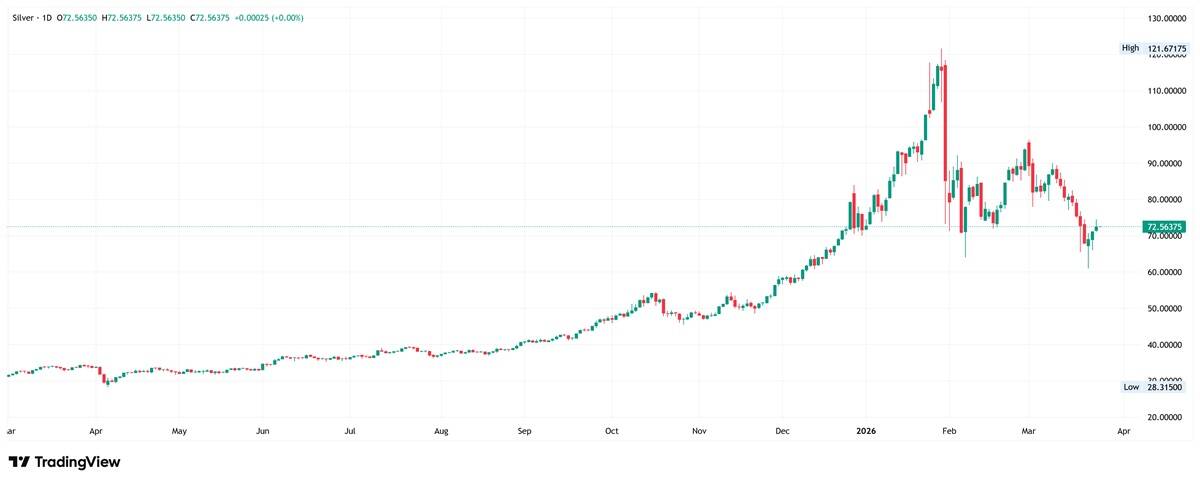
But there is a version of this week’s events that the price chart simply cannot show. The price chart shows paper contracts repricing in response to a hawkish Federal Reserve hold, a Strait of Hormuz disruption, and a dollar surge. What it does not show is what was happening simultaneously inside the COMEX physical delivery system, in Turkish vaults, and in Micron’s Q2 earnings call. Those three data points — each confirmed, each independent of the others — describe a physical market that got tighter during the same week the paper price collapsed.
In a previous article, I covered the stagflation trap, the Section 301 investigation targeting Mexico’s 200 Moz annual output, and the geological guidance cuts from Fresnillo and First Majestic. Those structural forces have not reversed. They have been joined by new ones.

Inside COMEX on March 19: An Unusual Concentration in the Delivery System
The most important data point from this week did not appear in a price chart or a news headline. It appeared in a CME Group delivery report.
On March 19 — the same session that silver flash-crashed to its intraday low — the CME’s own publicly available Metals Issues and Stops MTD Report recorded a striking concentration inside the COMEX delivery system. According to analysis derived from that primary document and independently confirmed by two separate Substack researchers, the CME’s house account (the clearinghouse itself) absorbed 114 out of 138 delivery notices on March 19. That is 82% of a single day’s entire delivery flow going through one account: the exchange itself, rather than independent counterparties.
To put that number in context: through March 20, approximately 43.4 Moz had already been delivered in the March 2026 COMEX contract — one of the largest delivery months on record — against a registered pool of 79.20 Moz. The delivery cycle was historic in scale. The 82% house account concentration occurred at its most stressed point.
There are two legitimate ways to read this. The more routine reading: the clearing house acted as a temporary counterparty in the normal management of an unusually compressed cycle, absorbing notices that would subsequently be rematched. The more significant reading: the shorts could not deliver, and the exchange stepped in to prevent visible settlement failure. The CME has not commented publicly, and the data alone cannot distinguish between the two. What is not in dispute is that an 82% concentration on the most volatile session of the year is rare — and directionally consistent with the delivery stress that prior issues have been documenting for months.
The paper price and the physical delivery system moved in opposite directions on March 19. Paper sold off sharply. Physical delivery demand did not ease. A paper price crash and a record delivery cycle running simultaneously, on the same day, is the kind of divergence that the delivery data makes visible even when the price chart does not.
This is Catalyst #2: COMEX Inventory Depletion Creating Delivery Crisis from “Silver Rising” at what may be its highest activation point in this cycle.
Silver Price Forecast
Every new Silver analysis as it publishes, today's technical signal and key levels, live price — on one page.
See all Silver forecastsTurkey Imported 20.3 Moz in Two Months. That Is Not a Rounding Error
A subscriber asked whether Turkish silver imports are real and whether they affect the supply-demand balance. The answer to both questions is yes — and the data, when examined carefully, is one of the more significant physical demand developments in the global silver market right now.
Borsa İstanbul (BIST) is the sole exchange entity in Türkiye authorized to handle precious metals imports. Under Turkish law, all standard unprocessed silver can only be imported by CBRT-authorized BIST members and must be delivered to the exchange within three working days. BIST’s import data is therefore not a sample or an estimate: it is the complete official record of every kilogram of silver that legally enters Türkiye.
The physical import data — not trading volume, but actual metal crossing the border — reads as follows:
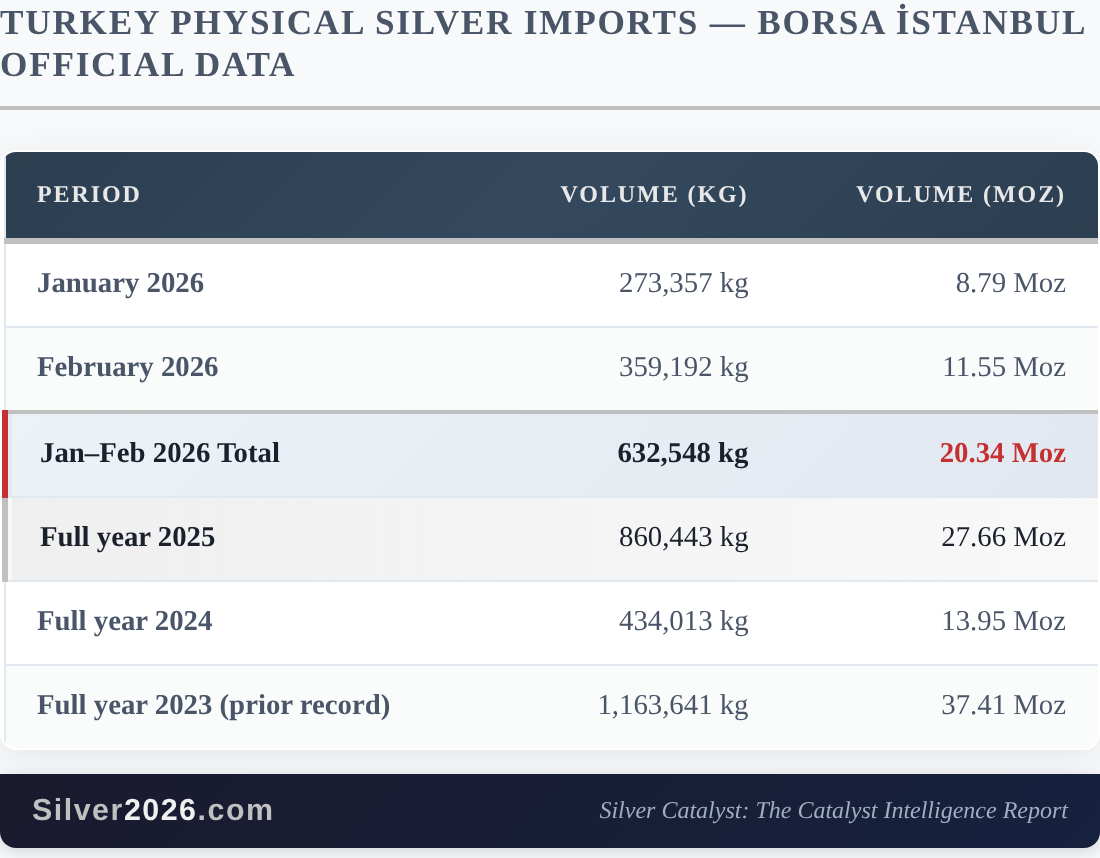
Three observations matter here. First, February was larger than January: 11.55 Moz versus 8.79 Moz. This is an accelerating pattern, not a one-month spike. Second, the two-month total equals 73.5% of Turkey’s entire 2025 annual import volume, in 60 days. Third, the trading-to-import ratio runs at approximately 1.12× — near parity. In speculative markets, trading volume typically runs 5–10× physical flows. Near-parity here strongly suggests genuine physical accumulation, not paper turnover.
The drivers are locally identifiable: Turkey’s gold import restrictions redirect precious metals investment toward silver; persistent lira depreciation makes hard assets structurally attractive; and silver at $70–80 is accessible to retail investors priced out of gold. These factors remain intact regardless of what the FOMC does or what oil prices do.
But the most consequential question is sourcing. Based on OEC bilateral trade data for 2024, Switzerland accounted for approximately 46% of Turkey’s silver import value. Switzerland hosts the world’s largest concentration of LBMA-accredited refiners — Argor-Heraeus, PAMP, Metalor, Valcambi. If that sourcing pattern is holding at 2026 volumes, Turkey is drawing from the same LBMA good delivery pool that European institutional allocators access. The Silver Institute’s projected 67 Moz global deficit figure is almost certainly not yet reflecting this scale of Turkish demand — the Silver Institute’s models are compiled annually, and January–February 2026 data would not have been incorporated.
To put it in physical terms: 20.34 Moz equals approximately 26% of COMEX total registered inventory (79.20 Moz), absorbed by a single country in sixty days. At even half the current annualized pace, Turkey’s demand alone would approach the entire projected 2026 structural deficit. That metal is coming from somewhere. It is not being created; it is being redirected.
This activates Catalyst #100: Currency Crisis Contagion Driving Emerging Market Silver Demand from “Silver Rising” at a level we have not previously seen confirmed with this level of precision.
Micron’s Q2 Results: The AI Memory Supercycle Is Not a Projection Anymore
On March 18 — the same day as the FOMC decision — Micron Technology reported Q2 FY2026 results that Wall Street described as the strongest in the company’s history. Revenue nearly tripled year-over-year. Non-GAAP gross margins reached 74.9%. High Bandwidth Memory (HBM) capacity is 100% sold out through the remainder of 2026. The company committed to $25 billion in capital expenditure for the year. Server memory module prices (DDR4/DDR5 configurations) have risen approximately 180% since October 2025, from $250 to $700 per module.
This is not a forecast being updated. This is a confirmation event.
The silver connection runs through the packaging architecture that makes HBM possible. Advanced semiconductor packaging — specifically the CoWoS (Chip-on-Wafer-on-Substrate) and HBM stacking processes that Micron and TSMC depend on — requires silver-loaded conductive inks, pastes, and interconnects throughout the die-attach and thermal management layers. The Silver Institute’s December 2025 “Next Generation Metal” report confirms that AI server clusters carry approximately 2–3× the silver content of traditional data centers, applied in chip attachment, thermal interface materials, and heat dissipation systems. SMM industry analysis estimates global semiconductor packaging silver consumption at approximately 38–48 Moz annually, with advanced AI packaging identified as the fastest-growing sub-segment.
The transition from conventional DDR memory to HBM requires a fundamentally different packaging architecture that is more silver-intensive per die. Every new AI accelerator chip, every new data center rack, every new HBM memory module is incrementally more silver-intensive than what it replaces. Micron’s sold-out HBM and $25 billion capex plan are not a quarter-to-quarter correction. They are evidence of a structural expansion of the semiconductor manufacturing base that will compound silver demand through 2030 regardless of what happens to silver’s investment bid in any given week.
Deloitte projects the semiconductor industry growing 26% in 2026, with North America growing 34%. TrendForce projects memory revenue reaching $551.6 billion this year — more than double the entire foundry market. These are not fringe forecasts; they are consensus estimates from major institutional research organizations.
When the largest memory manufacturer in the world sells out its entire next-generation production at record margins and commits to $25 billion in new capacity, the AI demand signal is confirmed, not projected. This demand does not pause during FOMC meetings, and it does not negotiate with the Federal Reserve.
This confirms Catalyst #34: Semiconductor Market Growing to $2.06 Trillion by 2032 from “Silver Rising” at maximum activation.
What This Means
Three developments. Three categories. Three independent confirmation signals.
Inside the COMEX delivery system, the most volatile session of the year produced an 82% concentration of delivery notices through the exchange’s own house account — simultaneous with one of the largest delivery cycles in COMEX history. Inside Turkish vaults, 20.34 Moz of physical silver moved across the border in sixty days, sourced in part from the same LBMA refining pool that supplies European institutional allocators. Inside Micron’s earnings call, the AI memory supercycle produced the strongest quarterly results in the company’s history, confirming that semiconductor silver demand is structural and accelerating.
None of these three developments responds to the FOMC meeting. None of them is relieved by a dollar rally. None of them is captured in the current spot price of $71–74, still recovering from the week’s lows.
The Silver Institute projects the sixth consecutive structural deficit at 67 Moz for 2026. That figure was compiled before January and February’s Turkish import data became fully visible. The cumulative deficit since 2021 approaches 800+ Moz — equivalent to nearly one full year of global mine production drawn from above-ground stocks. The physical pool that supplies COMEX delivery, LBMA settlement, and emerging market demand is not being replenished by mine supply; it is being drawn down by all three simultaneously.
The full Silver Catalyst Issue #11 contains additional Deep Dives: the double shock of the FOMC hawkish hold and the Hormuz disruption, analyzed through the 1970s Phase 1/Phase 2 framework that explains both the correction and what history predicts follows; the Section 301 formal investigation timeline and the 21-day countdown to the comment period deadline; the hidden defense and aerospace silver demand layer that no government agency publishes; and LONGi’s copper substitution move and what peer-reviewed research says about the structural supply gap through 2030. If you want the complete picture — including the full Catalyst Dashboard, institutional price forecasts, and the convergence analysis tying Turkey, Mexico, and COMEX into a single structural narrative — you can get it by accessing Silver Rising with complimentary 2-week Silver Catalyst access.
Thank you.
The Silver Engineer