


Chip Rally Lifts Futures
S&P 500 futures edged up 0.26% early Tuesday. Nasdaq 100 futures firmed 0.55%. Dow Jones Industrial Average futures ticked higher by 62 points, up 0.12%. Semiconductor stocks are driving the action again. The same names that got sold last week are catching bids this week. Asia confirmed the move overnight with South Korea’s Kospi leading the charge. The bounce is real. Whether it holds is the question.
Monday’s regular session told the same story. The S&P 500 added 0.3%. The Nasdaq Composite gained 0.86%. The Dow Jones Industrial Average lost 80.77 points, down 0.16%. Chips carried everything. The rest of the market sat out. A rally led by one sector bouncing off a liquidation event is not broad buying. It is one trade working.
Daily June E-mini S&P 500 Index Futures Technical Analysis
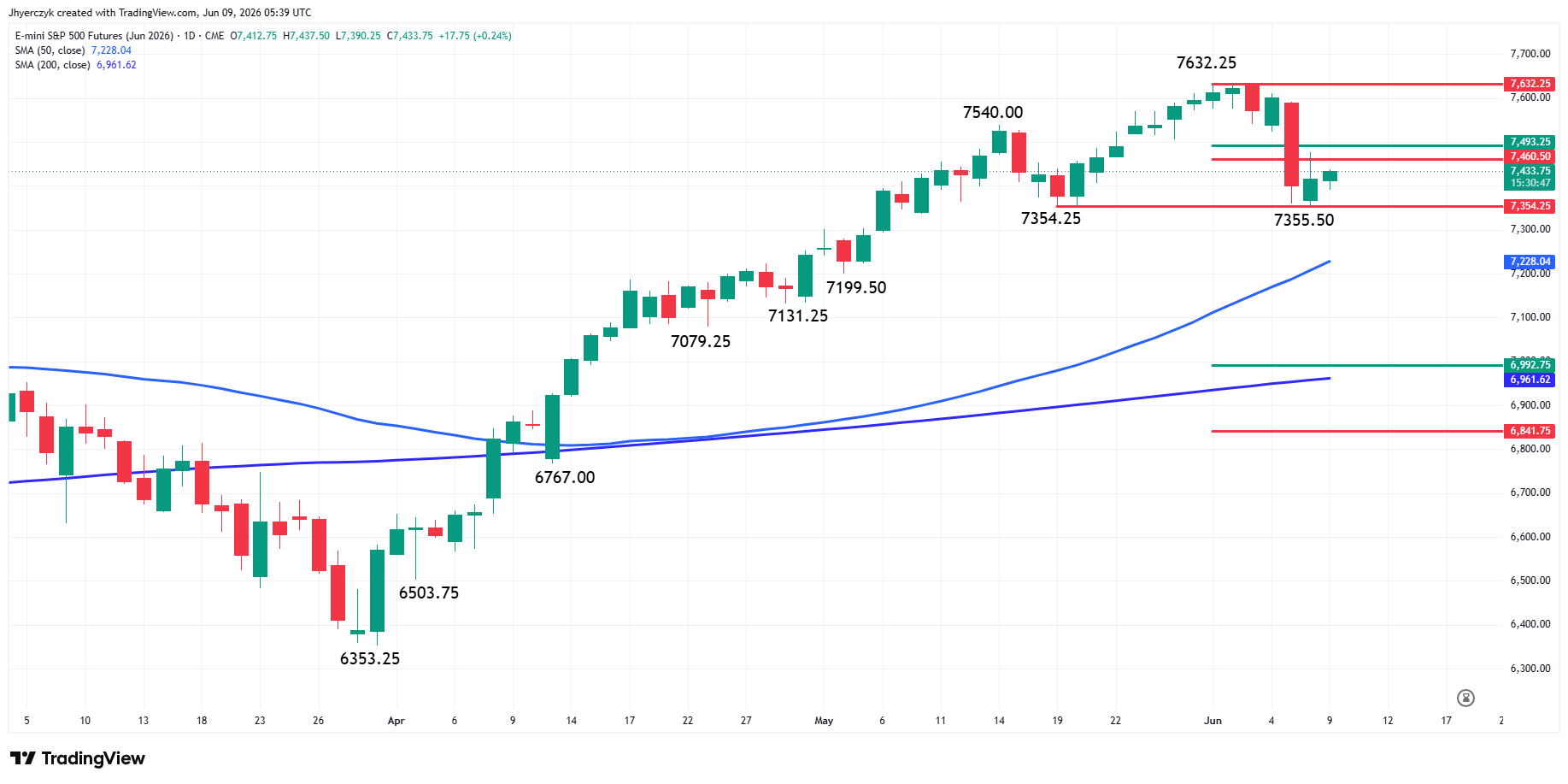
June E-mini S&P 500 Index futures are edging higher on Tuesday after a successful test of the 7354.25 main bottom the previous session. A trade through this level will change the main trend to down.
On the upside, minor resistance is a retracement zone at 7460.50 to 7493.25. Overtaking this area will shift momentum to the upside and put the record high at 7632.25 back on the radar.
I have two concerns. The first is whether a bearish secondary lower top forms on the current retracement or whether bulls can retake control for a test of the record high. The second is what is going to happen if 7354.25 fails and the main trend changes to down. Will the selling extend into the 50-day moving average at 7228.12? If so, will there be a technical bounce or will we see an acceleration into the long-term retracement zone at 6992.75 to 6841.75 and the 200-day moving average at 6961.63?
We’re in a period of heightened volatility so two-sided trading is highly likely. In summary, watch trader reaction to 7460.50 to 7493.25 to see if there is follow-through to the upside, and watch for a breakdown under 7354.25 with a sharp break to 6992.75 to 6841.75 a possibility.
Dow Jones Price Forecast
Every new Dow Jones analysis as it publishes, today's technical signal and key levels, live price — on one page.
See all Dow Jones forecastsHow Long Does the Chip Bounce Last?
Brian Kersmanc, portfolio manager at GQG Partners, went on CNBC’s “Closing Bell: Overtime” Monday and asked the question nobody in this market wants to answer. “What the issue is on a longer-term basis is sustainability,” Kersmanc said. “So, how much further does this sustain on a longer-term basis?”
He made the point that matters. Semiconductor products trade like commodities. Pricing cycles hit them the same way. Memory chip prices surged as much as fifteen times over the past year in some corners of the market. Kersmanc compared that to crude oil running from $60 a barrel to $900 a barrel. Asked the room whether investors would still be chasing energy stocks at that multiple. The answer is obvious. Nobody chases a commodity at fifteen times its starting price and expects the cycle to hold.
The artificial intelligence spending thesis is intact. Nobody is arguing that. The argument is whether the stocks already reflect every dollar of it. Every rally in chip names from here runs into that question.
Kospi Surges 7% as Asia Confirms the Bounce
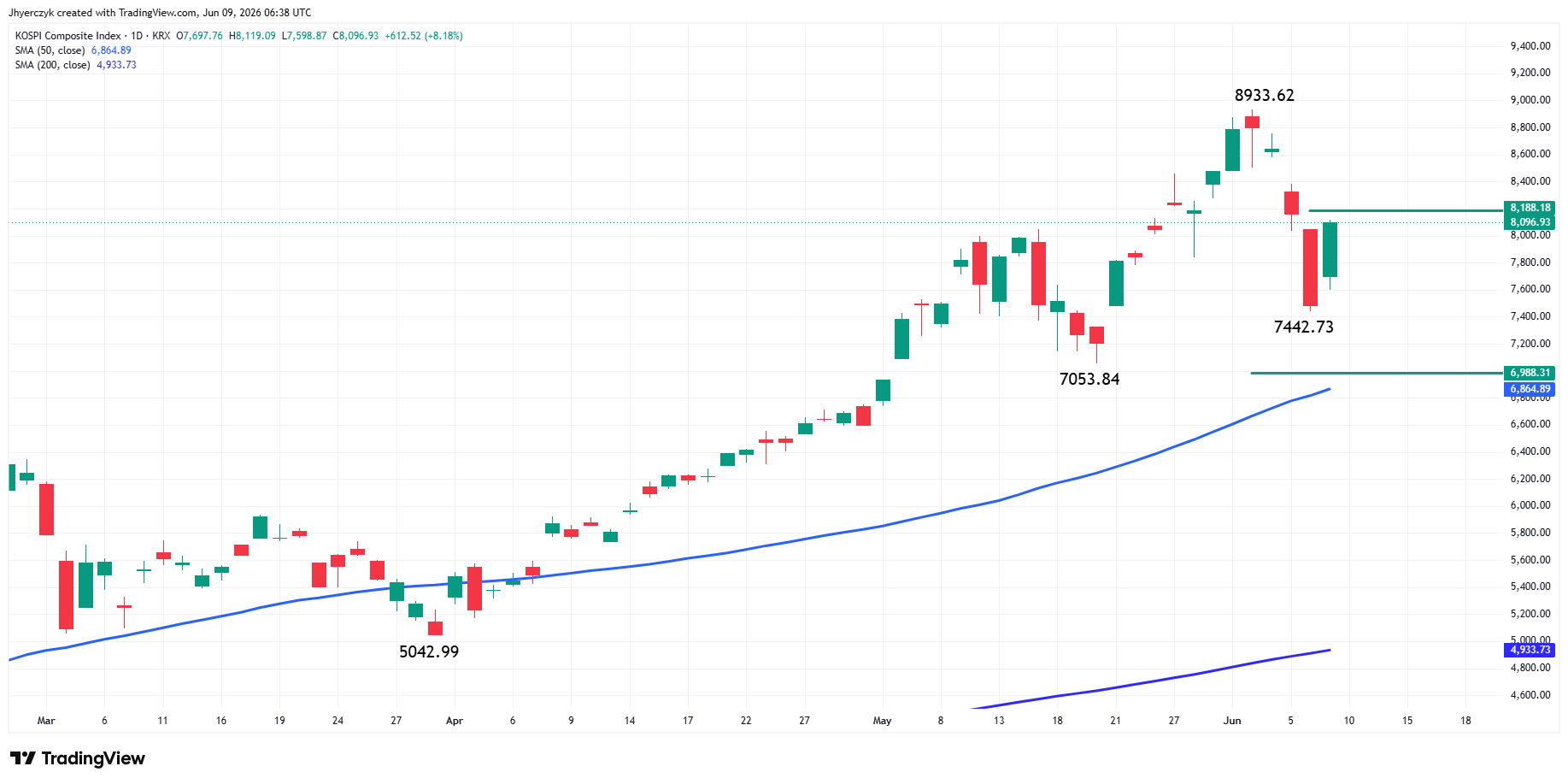
South Korea’s Kospi surged 7% on Tuesday. Reversed Monday’s entire loss and then some. Memory chip producers led. SK Hynix jumped 6.44%. Samsung Electronics advanced 3.38%. Seoul Semiconductor ripped more than 12%. The semiconductor side of the Korean market bought the dip with both hands.
Japan followed the same script. The Nikkei 225 climbed more than 2%. Tokyo Electron popped 5.65%. Advantest picked up 1.51%. Renesas Electronics rose 2.54%. Equipment makers caught the same bid as the chip producers.
Not everything participated. SoftBank Group fell another 2%, extending recent losses. Hong Kong’s Hang Seng Index traded flat. Australia’s S&P/ASX 200 slipped 0.13%. Mainland China’s CSI 300 was the only other bright spot, up 0.94%. The bounce is concentrated in chip names across the entire region. Everything else was mixed at best.
Andrew Jackson, equity strategist at ORTUS Advisors, said the brief rotation into defensive sectors may not last. He expects volatility to stay elevated through the week. SpaceX is expected to price its initial public offering Thursday with trading starting Friday. That event alone pulls capital out of existing positions as institutional accounts reserve cash for allocations. More selling pressure that has nothing to do with fundamentals.
Iran’s Ceasefire Has Conditions Attached
Iran stopped striking Israel on Monday. Then warned the attacks restart if Israeli military operations continue in Lebanon. Israeli Prime Minister Benjamin Netanyahu said the confrontation with Iran and Hezbollah was “not yet over.” The Israel Defense Forces conducted what they called a large-scale strike on strategic defense systems the same day. The weekend missile attack from Iran is still fresh.
President Donald Trump posted on Truth Social that both sides were seeking an immediate ceasefire. Iran’s foreign ministry responded by repeating the same condition. Operations expand in Lebanon, strikes resume. The diplomats are talking about peace. The military is conducting strikes. Every headline out of this region moves crude oil. Crude oil moves equity futures. The ceasefire is not priced as resolution. It is priced as a pause that could break at any moment.
China Export Growth Crushed Expectations
China’s exports rose 19.4% in May compared with the same period last year. The Street expected 15%. April came in at 14.1%. The acceleration caught economists off guard. Shipments to the United States jumped 35.4% year-over-year. That is the strongest growth rate since March 2021. The tariff overhang that weighed on Chinese exports for years is fading from the numbers.
Shena Yue, senior economist at Oxford Economics, pointed to high-tech products as the driver. Electric vehicles. Batteries. Solar products. Artificial intelligence-related technology. The categories growing fastest are the same ones tied directly to the semiconductor buildout. One more data point supporting the chip trade even as portfolio managers question the valuations publicly on television.
Can Tuesday’s Data Move the Market?
United Natural Foods, J.M. Smucker, Designer Brands, and Lands’ End all report before the bell. Consumer-facing names. None of them move the indexes alone. Together they fill in the spending picture at a time when every data point feeds directly into the Federal Reserve debate.
The economic calendar carries more weight. April wholesale inventories. May existing home sales. The National Federation of Independent Business Small Business Optimism Index. Weak numbers feed the rate cut argument. Strong numbers keep the Federal Reserve locked in place. The data lands on a market that needs a reason to pick a direction and has not found one yet.
What to Watch
The chip bounce is the story but it is running on momentum, not conviction. South Korea confirmed it overnight. The question is whether U.S. buyers follow through or use the strength to sell into. SpaceX pricing Thursday pulls capital to the sideline. The ceasefire is a crude oil catalyst sitting one headline away from escalation. Any spike in crude oil hits growth stock multiples first. The Federal Reserve is not moving until the labor market cools and the latest employment data says it is not cooling.
The way I see it, the June E-mini S&P 500 Index futures need to clear the 7460.50 to 7493.25 resistance zone to put the record high at 7632.25 back in play. Below 7354.25 the main trend flips to down and the 50-day moving average at 7228.12 becomes the first target. Two-sided trading is the setup until one side breaks. Tuesday’s data and the ceasefire headlines decide which side gets tested first.
More Information in our Economic Calendar.