Stocks Slide as Oil Tops $110 and War Fears Grip the Market
The major U.S. stock indices are lower at the mid-session on Friday. Worried investors are dumping shares due to the ongoing war between the U.S., Israel, and Iran. At the same time, oil prices rose above $110 per barrel because of supply concerns. These issues are making investors nervous, leading them to pare long stock positions and to avoid riskier investments.
At 16:41 GMT, the blue chip Dow Jones Industrial Average is trading 45,433.62, down 526.49 or -1.15%. The benchmark S&P 500 Index is at 6,407.41, down 69.75 or -1.08% and the tech-heavy Nasdaq Composite is trading 21,078.513, down 329.568 or -1.54%.
War Uncertainty Is the Only Story That Matters Right Now
Plain and simple, the uncertainty about the war is keeping investors cautious. And when they are worried, the easiest thing to do is sell to protect their accounts and to perhaps, get their heads straight, due to the everchanging outlook for the war. Even as President Trump tried to calm investors by delaying actions against Iran’s energy facilities, the markets did not react positively. Meanwhile, Iran is showing little interest in negotiating a peace deal, and there are reports the U.S. may send additional troops to the Middle East.
One Month In and the Strait of Hormuz Is Still Closed
One month after the start of the war, the Strait of Hormuz, a key oil shipping route, is closed, raising concerns about global energy supply. I think a lot of investors believe like me that securing the Strait should have been top priority on day one. Now we sit, nearly 30 days later, with so much uncertainty that investors are having a hard time predicting what will happen next. That includes professionals. If they can’t find a strategy to hedge away the risk, then the only way they can get protection is to sell stocks.
Inflation Fears Are Back and Rate Hike Talk Is Growing
Fear of inflation is also a factor weighing on the stock market on Friday. Higher oil prices and increased import costs are raising concerns about inflation. The price rise across the U.S. economy has some experts thinking the Federal Reserve might raise interest rates instead of cutting them.
Talk of inflation and rate hikes has opened the door to a growing chance of a recession, meaning the economy could slow down. Meanwhile, a report today showed consumer confidence is dropping, and that is also creating more worries. Together, these factors are putting more pressure on financial markets that shows up clearly on the daily S&P 500 Index (SPX) chart.
Dow Jones Price Forecast
Every new Dow Jones analysis as it publishes, today's technical signal and key levels, live price — on one page.
See all Dow Jones forecastsTechnical Outlook
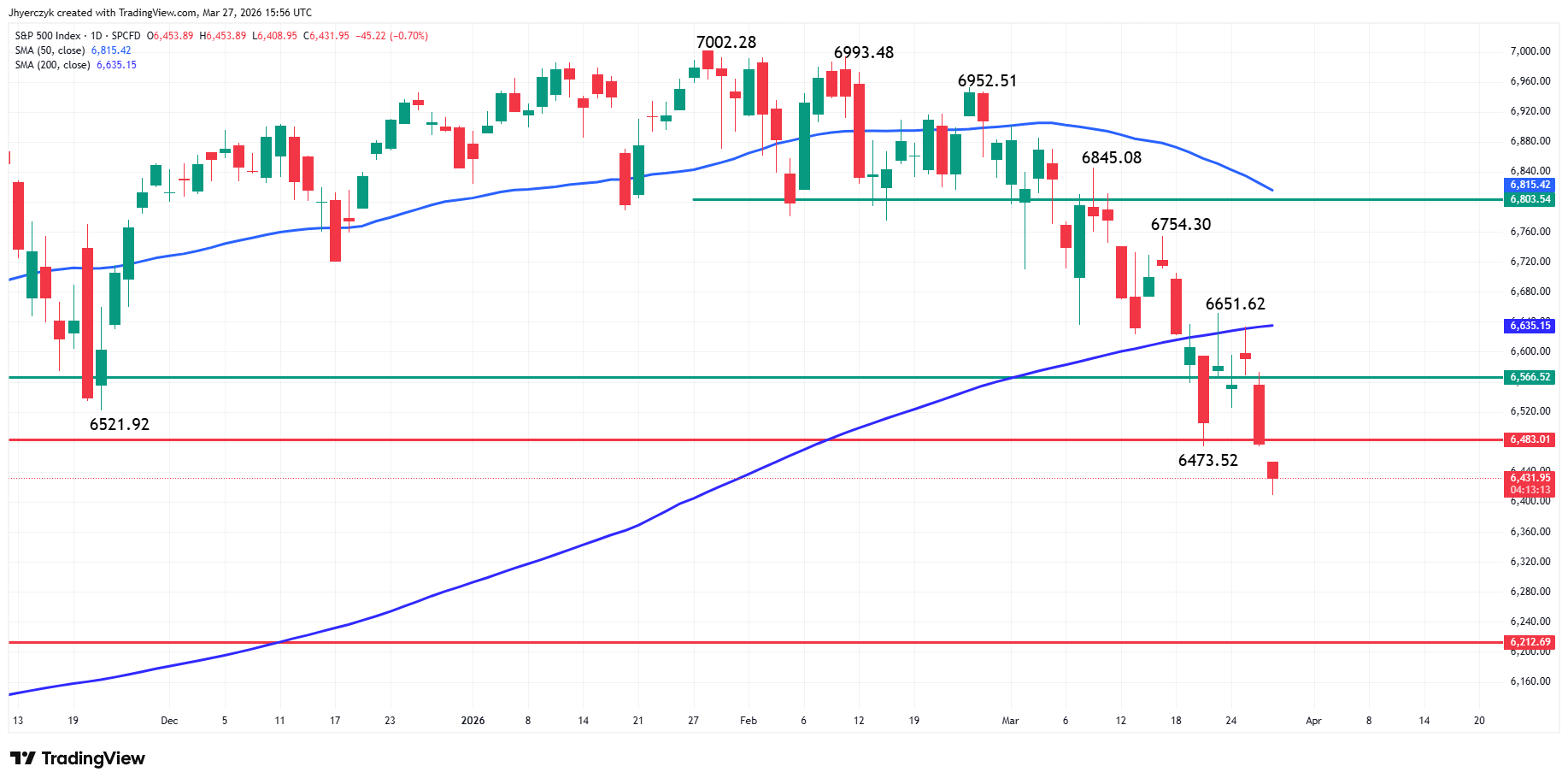
Technically, the SPX trend is down. The opening gap lower took out last Friday’s swing bottom at 6473.52, reaffirming the downtrend. Since it also crossed to the weak side of a major long-term support level at 6483.01, it opened the door to a possible acceleration to the downside with 6212.69 the next likely downside target.
On the upside, resistance is lined up like a ladder. First, buyers have to recover 6483.01. If this creates enough upside momentum then the 50% level at 6566.52 will become the next rung. However, with traders clearly in sell the rally mode, the key indicator to watch for resistance and a possible shift in sentiment is the 50-week moving average at 6635.05.
More Information in our Economic Calendar.