Advertisement
Advertisement
SpaceX’s Historic IPO Opens a New Chapter for Mega-Cap Growth Stocks
Published: Jun 15, 2026, 14:55 GMT+00:00
Live PriceTesla, Inc. Common Stock
$359.13
+0.04%
The long-awaited public debut of SpaceX has become one of the most significant events in modern market history.
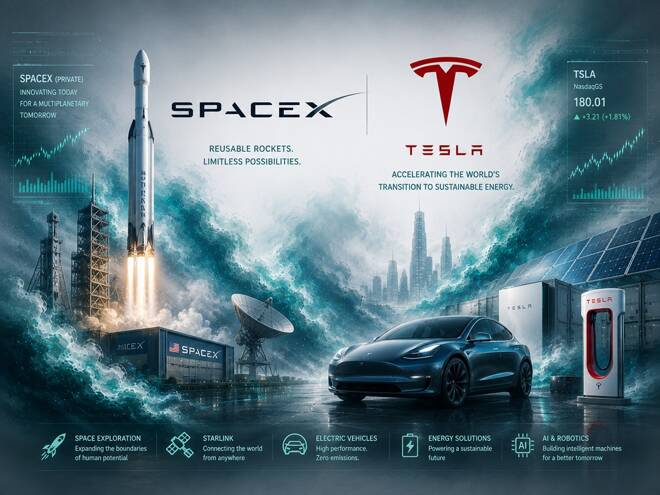
Trading under the ticker SPCX, the aerospace company finished its first trading session nearly 20% above its initial public offering price, immediately joining the ranks of the world’s most valuable publicly traded companies.
SpaceX Launches Into Public Markets With Record-Breaking Momentum
With a market capitalization surpassing $2 trillion, SpaceX now sits alongside the dominant technology leaders that have shaped the past decade of market performance. The listing also marks another milestone for Elon Musk, whose combined holdings in SpaceX and Tesla have pushed his personal fortune into unprecedented territory.
Yet the significance of this IPO extends far beyond the company’s first-day gains. For investors, the listing represents a major test of market appetite for high-growth businesses that prioritize long-term expansion over near-term profitability. It may also provide a roadmap for a new generation of public offerings, particularly from the artificial intelligence sector.
The enthusiasm surrounding SpaceX reflects investor confidence in the company’s long-term vision rather than its current earnings profile. Since its founding in 2002, SpaceX has accumulated substantial losses while investing heavily in launch systems, satellite infrastructure and next-generation space technologies. However, management argues that years of investment are beginning to generate meaningful returns.
A key pillar of that strategy is Starlink, the company’s satellite internet network, which has become a significant source of recurring revenue and cash flow. The proceeds raised through the IPO are expected to accelerate an ambitious expansion plan that includes a dramatic increase in satellite deployment and the development of space-based computing infrastructure.
Investors are effectively betting that SpaceX can evolve from a successful aerospace company into a foundational provider of global communications and computing services. This vision helps explain why the market has been willing to assign such a lofty valuation despite the company’s limited profitability.
Retail investors also played a major role in the stock’s debut. Individual traders accounted for an unusually large share of demand, reinforcing the strong retail participation that has become a defining feature of modern financial markets. The combination of a globally recognized brand, Elon Musk’s reputation and the scarcity of publicly traded space-related investments created conditions for exceptional first-day demand.
Why Volatility Could Remain Elevated
While the IPO’s success has generated excitement, investors should also prepare for significant volatility in the weeks and months ahead. Historically, many high-profile listings experience sharp price swings after their initial surge. Early enthusiasm often collides with the realities of valuation, profit expectations and changing market sentiment.
SpaceX may be particularly vulnerable to these dynamics because only a relatively small portion of its total shares is currently available for public trading. This limited public float can magnify price movements as buyers and sellers compete for a constrained supply of shares. Even small changes in investor sentiment can therefore lead to outsized market reactions.
Another factor likely to influence trading activity is the company’s expected inclusion in major stock market indices. Given its enormous size, SpaceX is poised to become a meaningful component of widely followed benchmarks. As index providers add the stock, passive investment vehicles such as exchange-traded funds and index funds will be required to purchase shares regardless of valuation.
These mandatory purchases could create additional upward pressure on the stock price in the short term. However, such flows are technical rather than fundamental, meaning they may not necessarily reflect changes in the company’s underlying business performance.
For retail investors, this distinction is important. Strong demand from index funds can support a stock temporarily, but long-term returns ultimately depend on revenue growth, profitability and operational execution.
What the SpaceX IPO Means for OpenAI and Anthropic
Perhaps the most important consequence of the SpaceX listing is what it signals for the broader IPO market. For several years, high interest rates and economic uncertainty limited the number of large technology companies willing to go public. The strong reception received by SpaceX suggests that investor appetite for disruptive growth stories remains intact, particularly when companies operate in sectors viewed as transformational.
This development is likely to be closely watched by OpenAI and Anthropic, two of the most anticipated future listings in the artificial intelligence industry. Unlike SpaceX, these companies are positioned at the center of the generative AI boom and benefit from rapidly expanding commercial adoption. Their revenue growth trajectories may therefore appear more immediately attractive to investors seeking exposure to artificial intelligence.
However, the comparison is not entirely straightforward. SpaceX enters public markets with more than a decade of investor familiarity with Elon Musk as the leader of a publicly traded company. Many investors who generated substantial returns from Tesla are willing to extend a similar degree of trust to his latest venture.
OpenAI and Anthropic do not yet possess that same public-market track record. As a result, investors may place greater emphasis on governance structures, management execution and the path toward sustainable profitability. This difference could lead to even greater volatility once these companies eventually begin trading.
Can Fundamentals Catch Up With Valuations?
The success of the SpaceX IPO highlights a familiar pattern in financial markets. During periods of optimism, investors often focus on future opportunities rather than current earnings. SpaceX, OpenAI and Anthropic all share a common characteristic: they operate in industries with enormous potential but require extraordinary levels of capital investment. As a result, profitability remains elusive despite rapid revenue growth.
For now, investors appear comfortable funding these long-term ambitions. The belief is that today’s losses represent investments in infrastructure that could eventually support dominant market positions. Nevertheless, history suggests that enthusiasm alone cannot sustain valuations indefinitely. Public companies ultimately face scrutiny from shareholders who expect measurable progress toward profitability and cash generation.
Research on high-growth listings has consistently shown that companies trading at extreme revenue multiples often struggle to justify those valuations over time. While some become transformative market leaders, many eventually face significant repricing as investors reassess expectations. The challenge for SpaceX—and potentially for future AI listings—will be demonstrating that revenue growth can eventually translate into durable earnings power.
Conclusion
The SpaceX IPO could be more than a successful market debut; it may mark the beginning of a new phase for global equity markets. Its record valuation, extraordinary investor demand and rapid ascent into the mega-cap universe have reopened discussions about how much investors are willing to pay for long-term innovation. The listing also provides an early indication of how public markets may respond to the next generation of AI giants. If SpaceX has reopened the door for transformative growth companies, OpenAI and Anthropic could be the next major beneficiaries.
For investors, however, the lesson remains unchanged. Exciting narratives can drive valuations higher in the short term, but long-term shareholder returns ultimately depend on execution. The coming years will reveal whether these ambitious companies can transform extraordinary expectations into equally extraordinary financial results.
Sources: Reuters, CNBC, The Wall Street Journal
About the Author
Carolane De Palmascontributor
Carolane's work spans a broad range of topics, from macroeconomic trends and trading strategies in FX and cryptocurrencies to sector-specific insights and commentary on trending markets. Her analyses have been featured by brokers and financial media outlets across Europe. Carolane currently serves as a Market Analyst at ActivTrades.