Oil inventories are falling. Fuel reserves are thinning. Fertilizer supply chains are under pressure. Freight routes remain vulnerable. Food inflation risk is quietly rebuilding. And at the centre of it all sits the Strait of Hormuz – one of the world’s most important energy arteries and now the pressure point that could determine whether this remains a temporary disruption or becomes the biggest Commodity squeeze in modern history.
For traders, the message is clear: this is no longer a market waiting for confirmation. It is a market racing against time.
“The mistake traders make during supply shocks is assuming they will have time to react,” says Lars Hansen, Head of Research at The Gold & Silver Club. “In Commodities, the most violent repricing usually happens before the mainstream consensus accepts the crisis is real.”
Inventories Are the Market’s Hidden Alarm Bell
The world does not need to run out of Oil for the system to break.
That is the critical point many traders miss. Commodity markets rely on operational stockpiles – the minimum levels required to keep pipelines, refineries, storage terminals, shipping networks and industrial supply chains functioning properly. Once inventories fall toward those stress levels, prices can become disorderly long before supply physically reaches zero.
That is why the current drawdown matters.
If the Strait of Hormuz remains restricted into June, the market may be forced to confront a reality it has so far tried to dismiss: spare capacity is not unlimited, strategic reserves are not infinite and the global economy cannot easily replace disrupted Persian Gulf supply.
“This is not just about barrels on a spreadsheet,” Hansen says. “It is about the minimum volume required to keep the global energy system moving. Once that cushion disappears, price becomes secondary to access.”
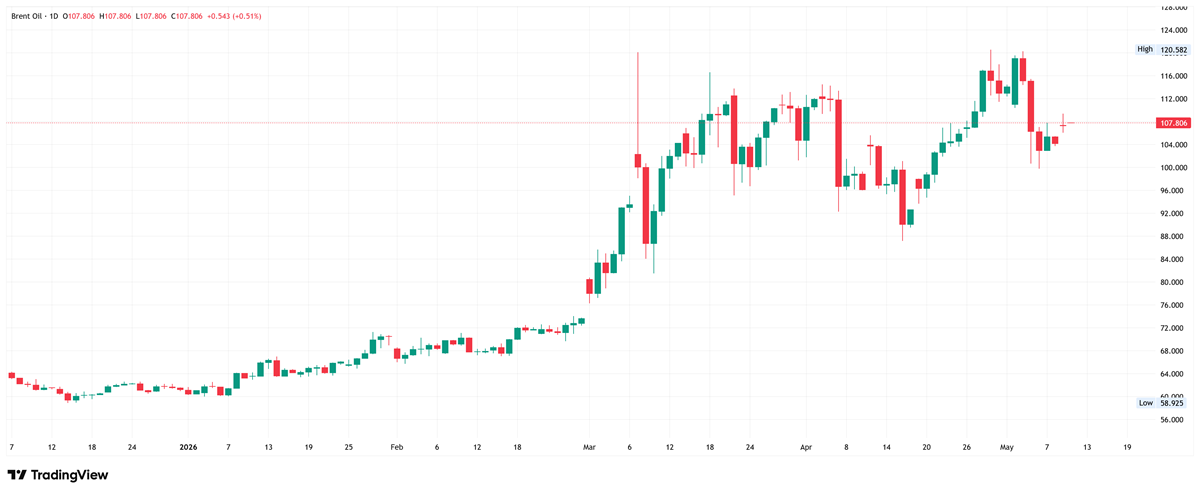
Brent Oil Price Forecast
Every new Brent Oil analysis as it publishes, today's technical signal and key levels, live price — on one page.
See all Brent Oil forecastsThe Shock Will Not Stop at Oil
The greatest danger is that traders continue treating this as a Crude Oil story.
It is not.
Oil is the first domino. Diesel, Gasoline, Jet Fuel, Petrochemicals, Shipping, Aviation, Manufacturing, Food Production and Mining all sit downstream from Energy. When Energy tightens, the entire cost structure of the global economy begins to change.
A prolonged Strait of Hormuz disruption could quickly feed into Fertilizer markets, where higher input costs threaten farmers just as climate volatility and food security concerns are already rising. That is where the next inflation shock may emerge – not suddenly, but silently, before appearing in consumer data when it is already too late to position.
“Energy scarcity can become food scarcity through a chain reaction most markets underestimate,” Hansen says. “Fuel costs rise, Fertilizer costs rise, farming margins compress and eventually the consumer pays the price.”
That is why Agricultural Commodities may become one of the market’s most explosive blind spots. Wheat, Corn, Soybean, Coffee, Cocoa and Sugar are no longer quiet secondary trades. They are becoming strategic inflation hedges.
Scarcity Is Becoming the New Supercycle
The most powerful Commodity bull markets are not born from optimism. They are born from scarcity.
That scarcity is now spreading across the global economy. Governments are stockpiling resources. Export controls are increasing. Trade routes are being weaponized. Energy security has become national security. Food security has become political security. Metals security has become industrial security.
Oil, Gold, Silver, Copper, Natural Gas, Uranium and Agricultural Commodities are no longer simply raw materials. They are hard assets in a world where supply is harder to secure, more expensive to move and increasingly controlled by geopolitics rather than free markets.
“The next great Commodity move may not come from demand alone,” Hansen says. “It may come from panic over availability. When buyers realize supply cannot be sourced easily at any price, the market changes completely.”
The Race Against Time Has Begun
This is how generational Commodity opportunities often begin: slowly, quietly and then suddenly.
In 2008, many traders missed the opportunity because they were paralysed by fear. In 2020, many missed the inflation trade because they waited for perfect certainty. Today, the same mistake may be forming again.
The market is still behaving as though this crisis can be contained, negotiated away or absorbed by existing stockpiles. But if inventories continue to tighten and Hormuz remains constrained, capital may be forced to chase Oil, Gold, Silver, Copper, Natural Gas and Agricultural Commodities with increasing urgency.
At The Gold & Silver Club, our view is clear: this is not the moment to wait passively for the headlines to confirm what physical markets are already signaling.
The race against time has already begun.
And the biggest Commodity squeeze in modern history may already be underway.
In markets that reward speed and punish hesitation, this is not an opportunity traders can afford to watch from the sidelines. The only question now is whether you will position yourself before the greatest Commodity wealth transfer in history accelerates – or risk being left behind.