Dollar Climbs to One-Week High as Year-End Position Squaring Fuels Rally
The U.S. Dollar is edging higher against a basket of major currencies early Wednesday after showing little reaction to yesterday’s release of the Fed’s December minutes. The greenback has been steadily climbing since reaching a multi-month low at 97.749 on December 24, reaching a one-week high at 98.311 earlier today.
Technically, the main trend is down according to the swing chart and the moving averages, so we’re looking at a counter-trend trade likely tied to end-of-the-year position squaring.
At 05:16 GMT, DXY is trading 98.312, up 0.095 or +0.10%.
Counter-Trend Rally Tests Critical Retracement Zone at 98.307
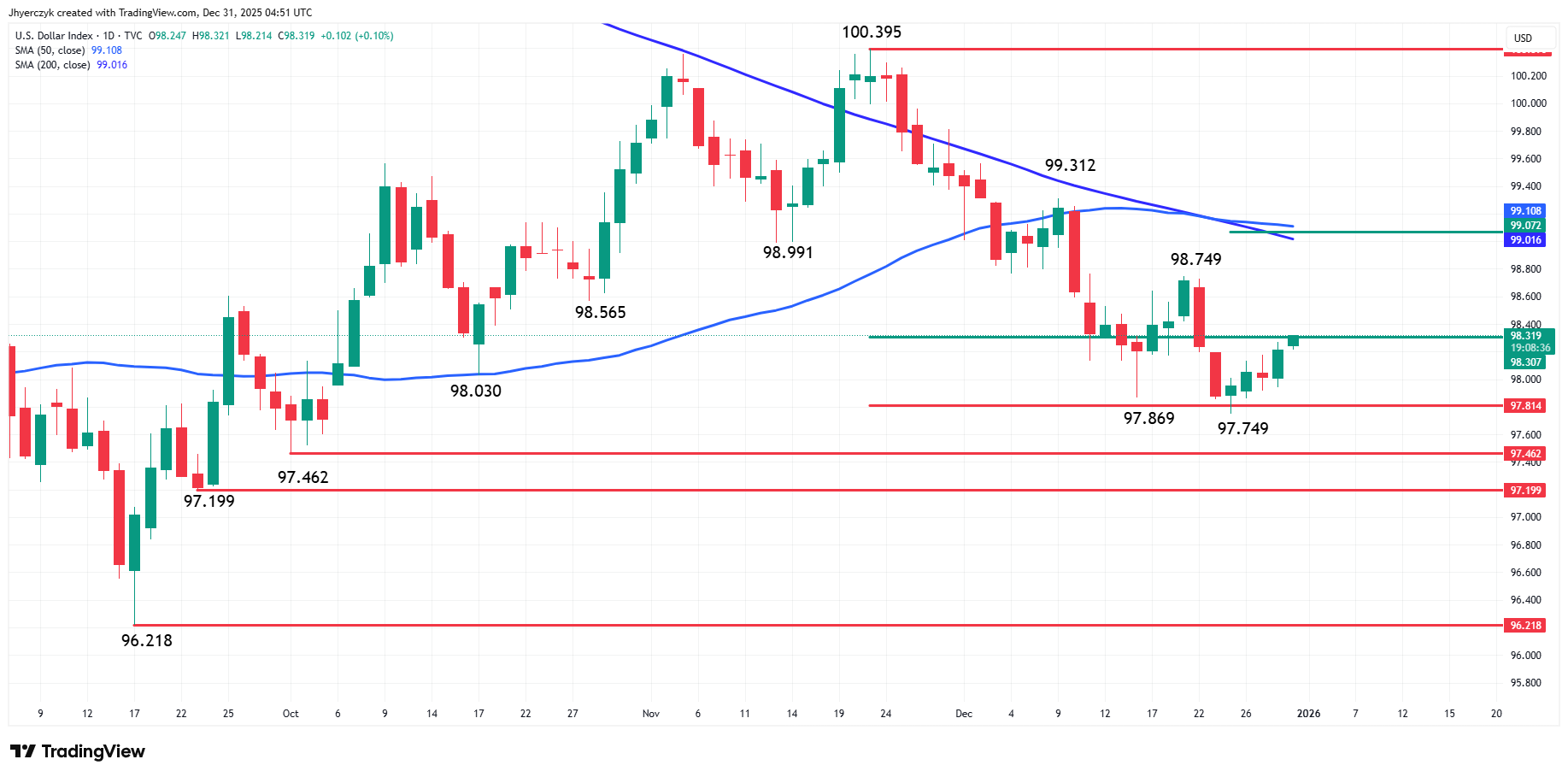
The long-term range from September 17 at 96.218 to November 21 at 100.395 has created a retracement zone at 97.814 to 98.307. The index has been building a support base inside this zone for three weeks. This base-building process is contributing to the slight shift in upside momentum the last five trading sessions.
Overcoming the 50% level at 98.326 today could give the index room to run over the near-term with the main top at 98.749 the first target.
On the downside, support is 97.814 to 97.749. If it fails then look for the selling to possibly extend into former bottoms at 97.462 and 97.199.
With the 200-day moving average at 99.016 and the 50-day moving average at 99.108, the index is clearly in a downtrend. Trading well below these moving averages at 98.312 suggests continued weakness and reflects market expectations for at least two rate cuts by the Federal Reserve in 2026.
However, the Fed minutes tell a different story. The deep division among policymakers suggests those rate cuts are far from certain. This divergence between market pricing and Fed uncertainty may be encouraging some weaker bears to cover their short positions.
EUR/USD Price Forecast
Every new EUR/USD analysis as it publishes, today's technical signal and key levels, live price — on one page.
See all EUR/USD forecastsRising Yields Lift Dollar as Fed Minutes Reveal Deeper Division Than Expected
Yields, which have a huge influence on the direction of the dollar, moved higher on Tuesday, following the release of the minutes. This move may have put a bid under the dollar index.
The minutes from the central bank’s highly divisive meeting on December 9-10 showed a vote to cut rates again appeared to be closer than previously thought. The Fed’s 25 basis point rate cut dropped the benchmark to 3.50%-3.75%.
“Most participants judged that further downward adjustments to the target range for the federal funds rate would likely be appropriate if inflation declined over time as expected,” the document stated.
Jobs vs. Inflation Debate Sets Stage for Volatile First Quarter of 2026
The major issue heading into 2026 will involve the Non-Farm Payrolls report and the Consumer Price Index (CPI) report. Some policymakers argued for the rate cut to prevent a further loss of jobs. Others said rates were at the appropriate level and any further cuts risk stoking inflation.
Fed Likely to Hold Steady Through March as Data Dictates Direction
In my opinion, the Fed is going to remain flexible until about April when it will probably have enough information on the jobs market and inflation to make an informed decision. This means no rate cut in January and March, which gives the dollar a little room to breathe before the downtrend begins again.
More Information in our Economic Calendar.