



Dollar Gaps Lower, Tests September Lows
The U.S. Dollar gapped lower on the opening on Monday and stayed there all session, posting a tight range defined by 97.333 to 96.806. The early weakness suggests the selling was likely a follow-through move related to last Friday’s extreme plunge. Today’s selling took out the 97.199 main bottom with the low of the session hitting the worst price since September 17.
The lack of follow-through to the downside after the initial thrust suggests the market may be oversold—not for technical reasons but for fundamental reasons with some of the major players perhaps moving to the sidelines ahead of the start of the Federal Reserve meeting on Tuesday.
At 20:20 GMT, DXY is trading 97.011, down 0.445 or -0.46%.

Aggressive European and Asian Sellers Drive Weakness
The dollar is currently being controlled by aggressive sellers from Europe and Asia, in my opinion. It seems to have lost its typical relationship with Treasury yields. This is understandable because even the Treasuries at times look like they’ve lost their bearings.
With Treasuries, we’ve recently seen yields move higher while the Fed chatted up interest rate cuts. Stock market investors are betting on at least two rate cuts, but Treasury yields don’t seem to be reflecting that idea yet. In the meantime, yields are getting manipulated by some selling out of Europe in reaction to President Trump’s activities. We’re not going to call it “Sell America” trading at this time because I don’t think we saw it last week, maybe one day, when stocks, bonds and the dollar all fell, but after that day, trading returned to normal.
Technical Breakdown Continues November Trend
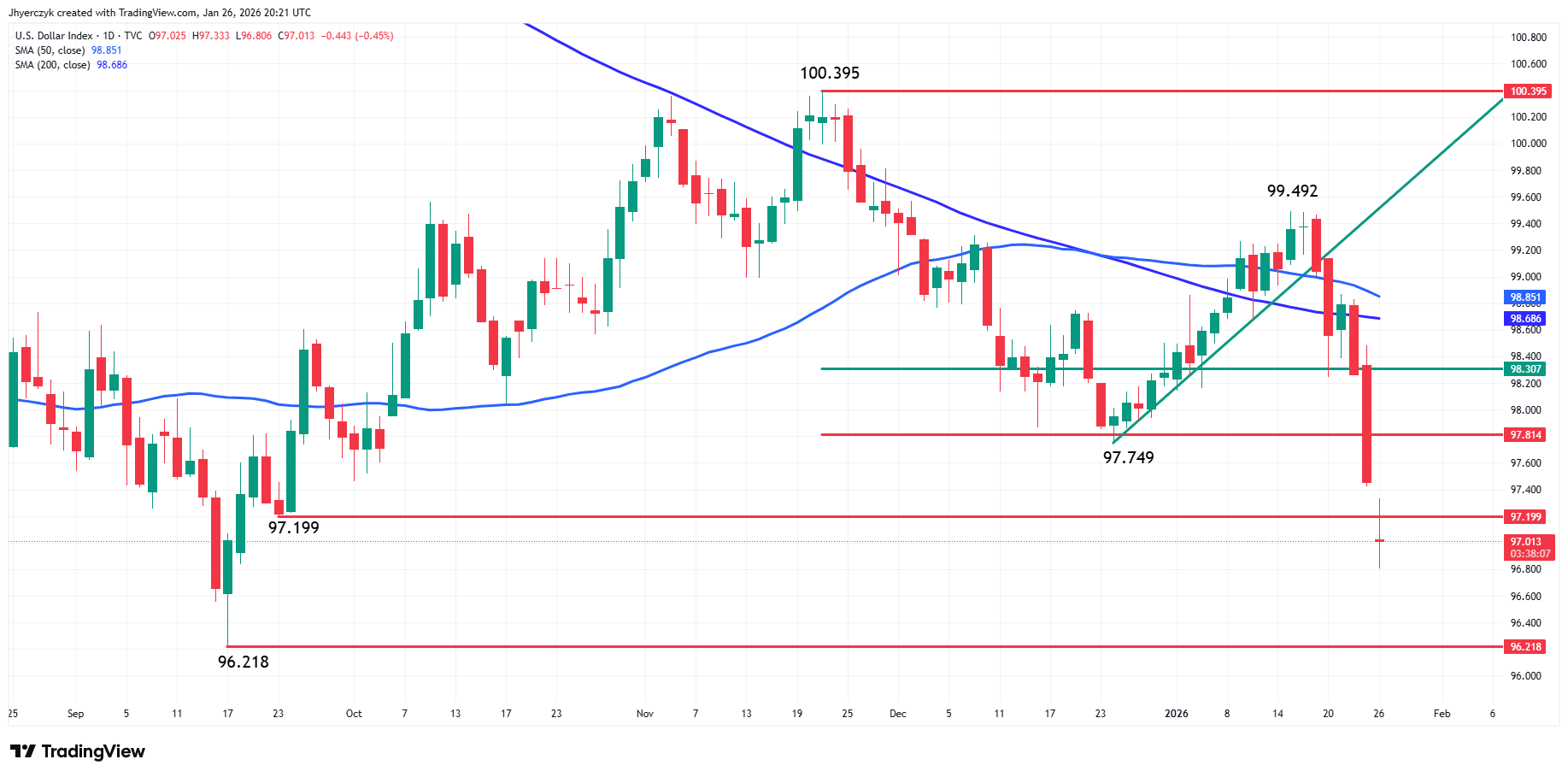
The size of the break last week in the dollar was likely a continuation of the selling that began on November 21 at 100.395. This move was interrupted by the bottom on December 24 at 97.749 and the subsequent short-covering rally to 99.492 on January 15. In hindsight, I don’t know why I didn’t realize the shorting opportunity that rally was creating earlier in the month.
With the major players like central banks and financial institutions, committed to a weaker U.S. Dollar and the Fed likely to cut rates twice in 2026, it’s probably best to play the dollar from the short-side, which means be patient for rallies to sell. Like any asset that has an inventory, however, you’re going to have to be prepared for some quarterly short-covering rally that shakes out the weaker shorts and gives the big money time to re-enter at more favorable positions.
EUR/USD Price Forecast
Every new EUR/USD analysis as it publishes, today's technical signal and key levels, live price — on one page.
See all EUR/USD forecastsCentral Banks Signaling: Short the Rallies
Until the global central banks send out the all clear signal, the best bet will be to short the big rallies.
Key Levels: 97.199 Pivot in Focus Ahead of Fed
Technically, it looks as if the former bottom at 97.199 may become a pivot this week, stronger up above it to perhaps 97.749 if we get the momentum and weaker under the pivot for a shot at the September bottom at 96.218.
My experience in trading the dollar index tells me that those big single bar breaks are more liquidation moves rather than new shorts, which is probably why we get the periodic short-covering rallies. With the Fed coming up on Wednesday, don’t be surprised if DXY straddles 97.199 until the market gets direction from Powell after the Fed rate announcement.
More Information in our Economic Calendar.


