


Market Overview
The broad-based US dollar managed to stop its previous session’s decline and gained some ground during the early European trading session. As of now, the US Dollar Index (DXY), which tracks the value of the dollar against a basket of six major currencies, is trading slightly bullish at 97.10.
Despite these gains, many factors are putting downward pressure on the dollar. However, the concerns over Federal Reserve independence, as well as the threat of a looming government shutdown, leave negative impact on the dollar and caps gain in the DXY.
Apart from this, traders seems cautious to place any strong position ahead of the upcoming US ADP Employment Change and Consumer Confidence reports.
Fed Uncertainty Weighs on the Dollar
Markets are worried about the independence of the Federal Reserve. US President Donald Trump recently said he will soon announce his choice for the next Fed chair, who will take over from Jerome Powell when his term ends in May. Thereby, the betting markets are pointing to BlackRock executive Rick Rieder as the likely candidate.
Experts say the choice of the next Fed chair could have a huge impact on US monetary policy. “It’s not possible to view the actions of the next Fed chair as separate from the economic environment or their ability to influence other FOMC (Federal Open Market Committee) participants,” said Tim Duy, chief U.S. economist with SGH Macro Advisors.
Investors are worried that a new Fed chair could change policies in a way that weakens the US dollar. This uncertainty has put extra pressure on the dollar.
Government Shutdown Fears Add Pressure on the Dollar
Besides the uncertainty around the Fed, the possibility of a US government shutdown is also putting pressure on the dollar. Congress has to approve funding by January 30, but Senate Majority Leader Chuck Schumer’s pushback on Homeland Security money has made a shutdown more likely.
GBP/USD Price Forecast
Every new GBP/USD analysis as it publishes, today's technical signal and key levels, live price — on one page.
See all GBP/USD forecastsUS Dollar Index Forecast: DXY Breaks Triangle Support as Bearish Bias Strengthens
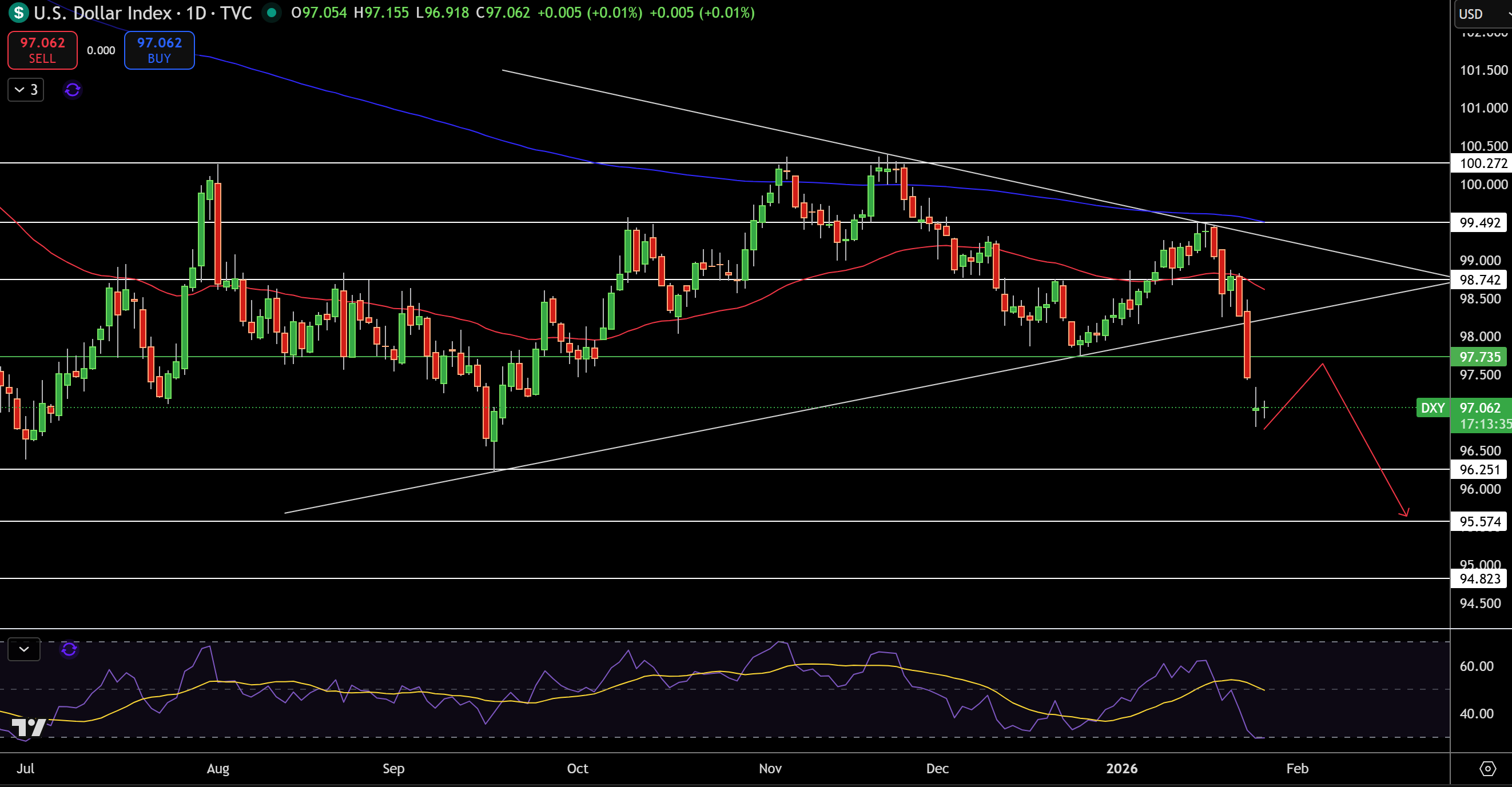
The US Dollar Index is trading around $97.05 after closing below the symmetrical triangle support that held since October. This move came after a strong bearish candle, showing the market is accepting lower prices below the rising trendline.
The price is now under the 50-day moving average, and the 200-day average near $99.40 is still trending down, which supports a bearish outlook. The old support at $97.70 is now acting as resistance.
The RSI has dropped below 40, suggesting bearish momentum is building. With the triangle pattern breaking lower, the next support levels are at $96.25 and $95.60.
Trade idea: Consider selling if the price rallies toward $97.70, with a target of $95.60 and a stop above $98.30.
GBP/USD Price Forecast: Consolidates Near $1.37 After Sharp Breakout Rally
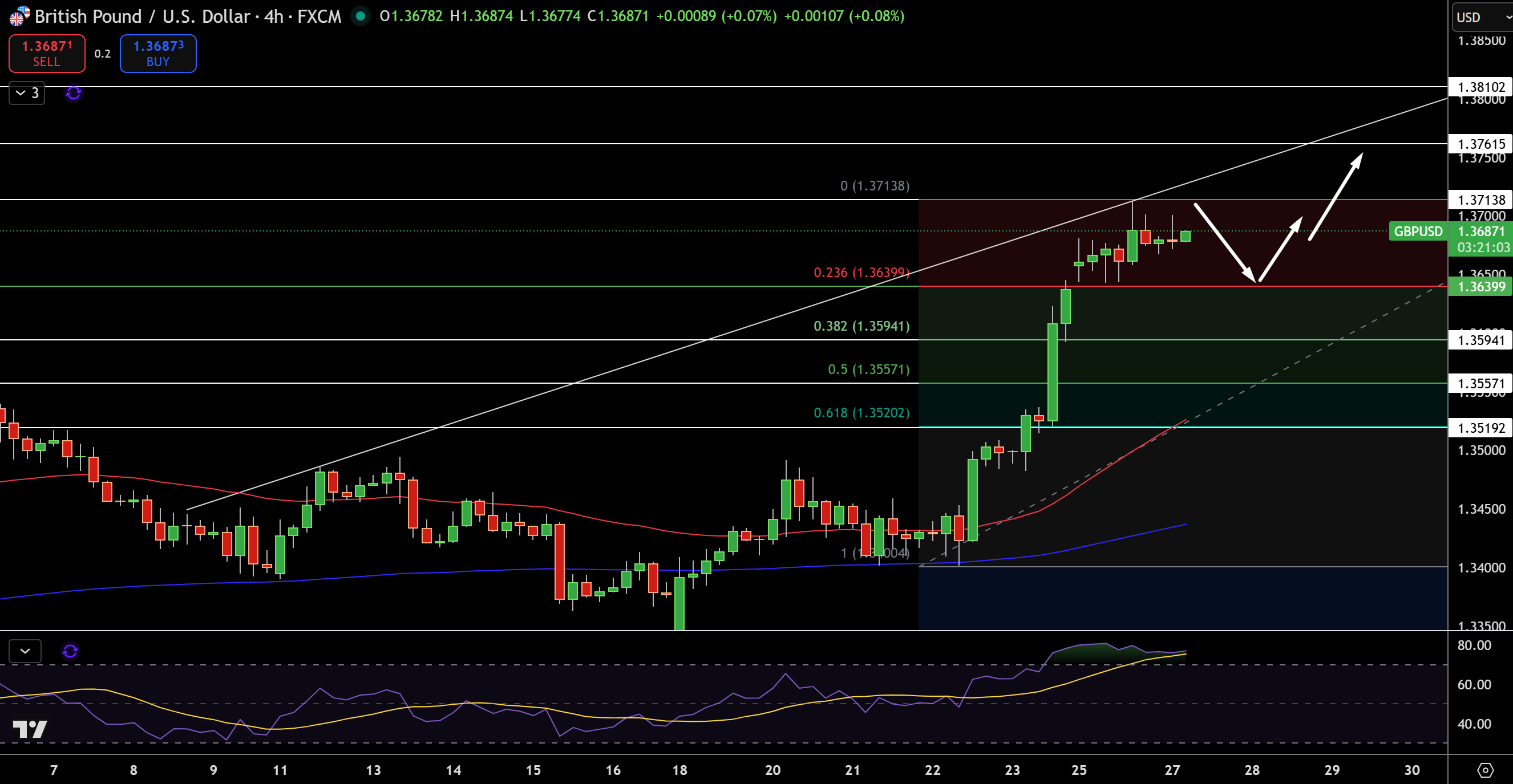
GBP/USD is trading around $1.3690 after a strong rally from the $1.3400 level on the 4-hour chart. Recent candles have small bodies and short wicks near the highs, which suggests the market is consolidating. The price is still above the rising trendline and inside a bullish channel, pointing to the potential for higher highs.
A Fibonacci retracement from $1.3404 to $1.3714 shows first support at $1.3640 (0.236) and $1.3594 (0.382). The 50-EMA has moved up quickly and crossed above the 200-EMA, which confirms the trend is gaining strength. The RSI is above 60, showing that bullish momentum is holding. Resistance is at $1.3715 and then $1.3810.
Trade idea: Consider buying near $1.3640, with a target of $1.3780 and a stop below $1.3590.
EUR/USD Price Forecast: Holds Above $1.1860 as Bullish Structure Consolidates
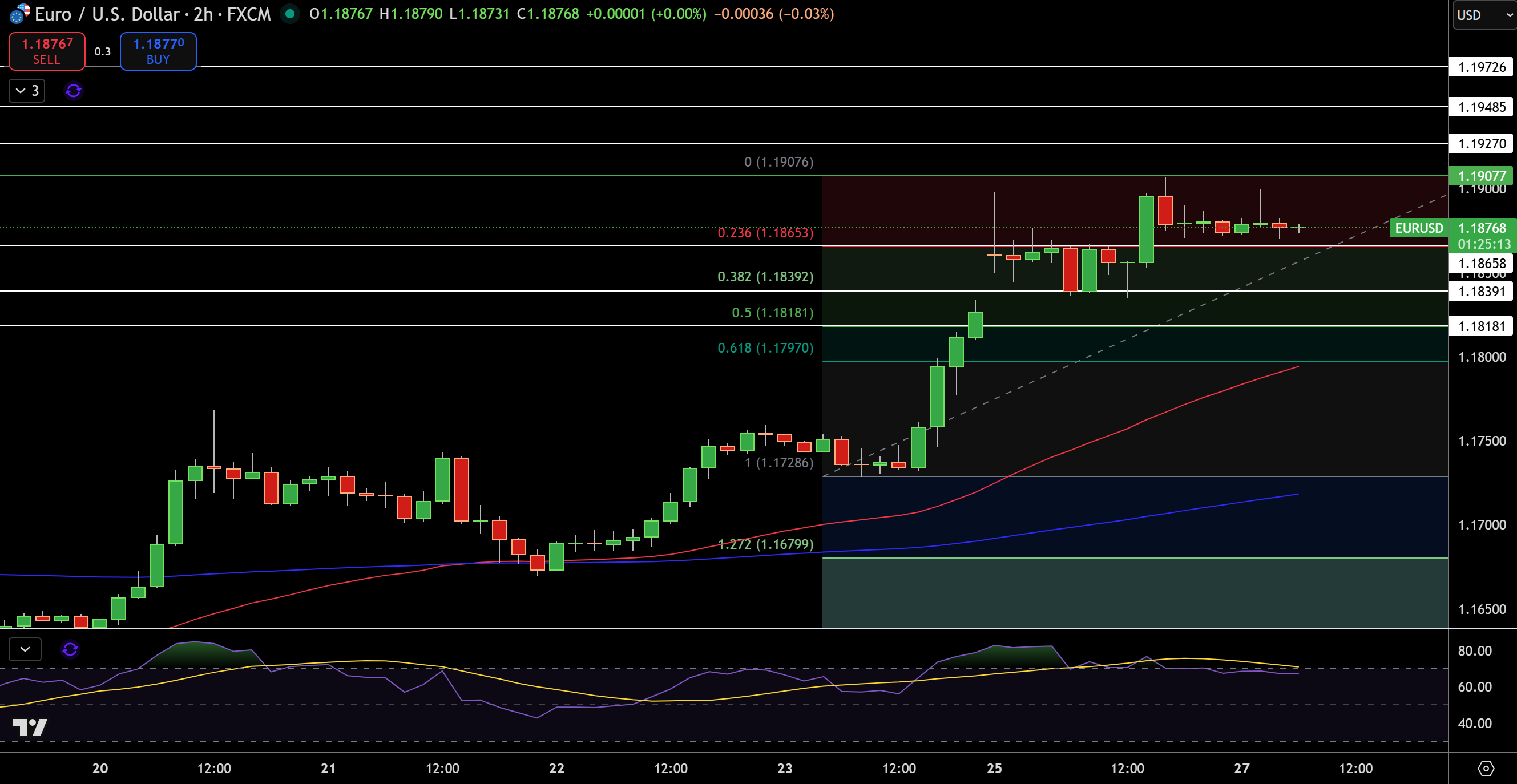
EUR/USD is trading around $1.1870 after failing to break above the $1.1907 high on the 2-hour chart. Recent candles are small with mixed wicks, which suggests the market is consolidating. The price is still above the rising trendline and remains within the upward channel that began near $1.1679.
Fibonacci retracement from $1.1679 to $1.1907 shows that $1.1865 (0.236) and $1.1839 (0.382) are important support levels, and both have held so far. The 50-EMA is still above the 200-EMA, so the trend remains up. The RSI is steady just above 50, showing balanced momentum. Resistance is at $1.1907 and then $1.1948.
Trade idea: Consider buying around $1.1840, with a target of $1.1910 and a stop loss below $1.1800.