
Mainland China’s CSI 300 and SSE Composite Index eye new 2026 highs on Tuesday, February 10, as Beijing shifts from credit controls to stimulus.
A robust Chinese economy, defying the impact of US tariffs on external demand, sent Mainland indices to 2026 highs in mid-January. Upbeat data had tempered previous expectations of further monetary and fiscal policy support from Beijing, initially weighing on demand for Chinese stocks.
However, recent announcements from Beijing have lifted sentiment, with the CSI 300 and SSE Composite looking at three-month winning streaks.
Expectations of further policy support and upbeat Chinese economic data affirm the bullish medium-term outlook for Mainland and Hong Kong-listed stocks.
Below, I will explore the key drivers behind recent gains, the medium-term (3-6 months) market outlook, and the key technical levels traders should watch.

Beijing Eyes the Auto Sector for Domestic Demand
This week, China’s Ministry of Commerce held a forum with Chinese automakers, aiming to boost domestic demand. The Ministry of Commerce will reportedly optimize auto trade-in schemes, with existing and new policies. These measures aim to boost demand for autos, which are likely to be key to China’s domestic consumption, one leg of its dual economy.
Last week, Brian Tycangco, editor at Stansberry Research, remarked on auto sales trends and the potential impact of expiring subsidies, stating:
“Over the past five years, China’s NEV sales went from 1.3m units (2020) to 16.5m units (2025). That’s a 66% CAGR, which is unheard of in the modern history of the automotive industry. NEV penetration by the end of 2025 reached 52.3% – more than half of all new cars sold in China are battery-powered or assisted (PHEV). Growth like this cannot be sustained without going through some period of correction or consolidation, especially when subsidies expire, raising the cost for customers.”
Commenting on the significance of the automotive industry and outlook, Tycangco added:
“Although it shouldn’t be surprising for growth to flatten (or even go slightly negative) in the coming months, the NEV industry is a top priority for development for Beijing.”
Tycangco listed several efforts to boost demand, including renewed consumer subsidies for new/first-time NEV buyers and increased efforts from Beijing to open new export markets for Chinese NEVs.
For context, Chinese EVs reportedly account for around 65% of global sales. These trends underscore the price advantages Chinese automakers have over their Western peers.
Hong Kong Hang Seng Price Forecast
Every new Hong Kong Hang Seng analysis as it publishes, today's technical signal and key levels, live price — on one page.
See all Hong Kong Hang Seng forecastsUS-China Relations in Focus
While Beijing targets the domestic auto market, US-China relations remain key to market risk sentiment. Improving relations and easing restrictions on Chinese goods would boost demand for Mainland China-listed stocks, supporting a bullish medium-term outlook.
Overnight, US Treasury Secretary Scott Bessent shared details of US Treasury staff visiting China, stating:
“Last week, senior US Treasury staff visited China to strengthen channels of communication and advance the dialogue between our nations. During their visit, our teams discussed preparation for the next high-level meeting on US-China trade between myself and Vice Premier He Lifeng. We look forward to continued constructive engagement between both sides, and to maintain our positive forward momentum over the coming weeks as we approach our next face-to-face engagement.”
Scott Bessent’s comments underscored a marked shift from the US administration’s efforts to target global demand for Chinese goods and impede China’s advancements in chips and AI.
Last week, news broke that major US tech companies, including ACER, Asus, Dell, and Hewlett-Packard, are considering a switch to Chinese memory chips. China’s ability to cost-effectively mass-produce contrasts with an ongoing global memory chip supply crunch that Chinese manufacturers can address. This development reinforces the need for the US administration to improve relations with Beijing. Improved relations would ensure US manufacturers can access China’s supply chain.
Key Downside Risks to the Bullish Outlook
Despite the bullish sentiment, downside risks could derail the positive outlook. These include:
- US-China trade tensions escalate.
- Global tariffs impact demand for Chinese goods.
- Beijing delays monetary and fiscal policy measures.
- External demand for Chinese goods drops sharply.
- Domestic demand slumps.
- Chinese housing market deteriorates further.
These factors would likely push the Hang Seng Index and the CSI 300 below their 50-day EMAs. EMA breaches would signal bearish trend reversals.
However, China’s continued progress in AI, self-reliance in chip manufacturing, and private sector activity affirm a constructive short- to medium-term bias for Mainland China indices.
Moreover, economists remain optimistic that Beijing can drive domestic consumption through new subsidies and lower borrowing rates. Hopes also linger that policymakers can stabilize the housing market.
CSI 300 Technical Outlook: Resistance Levels in Focus
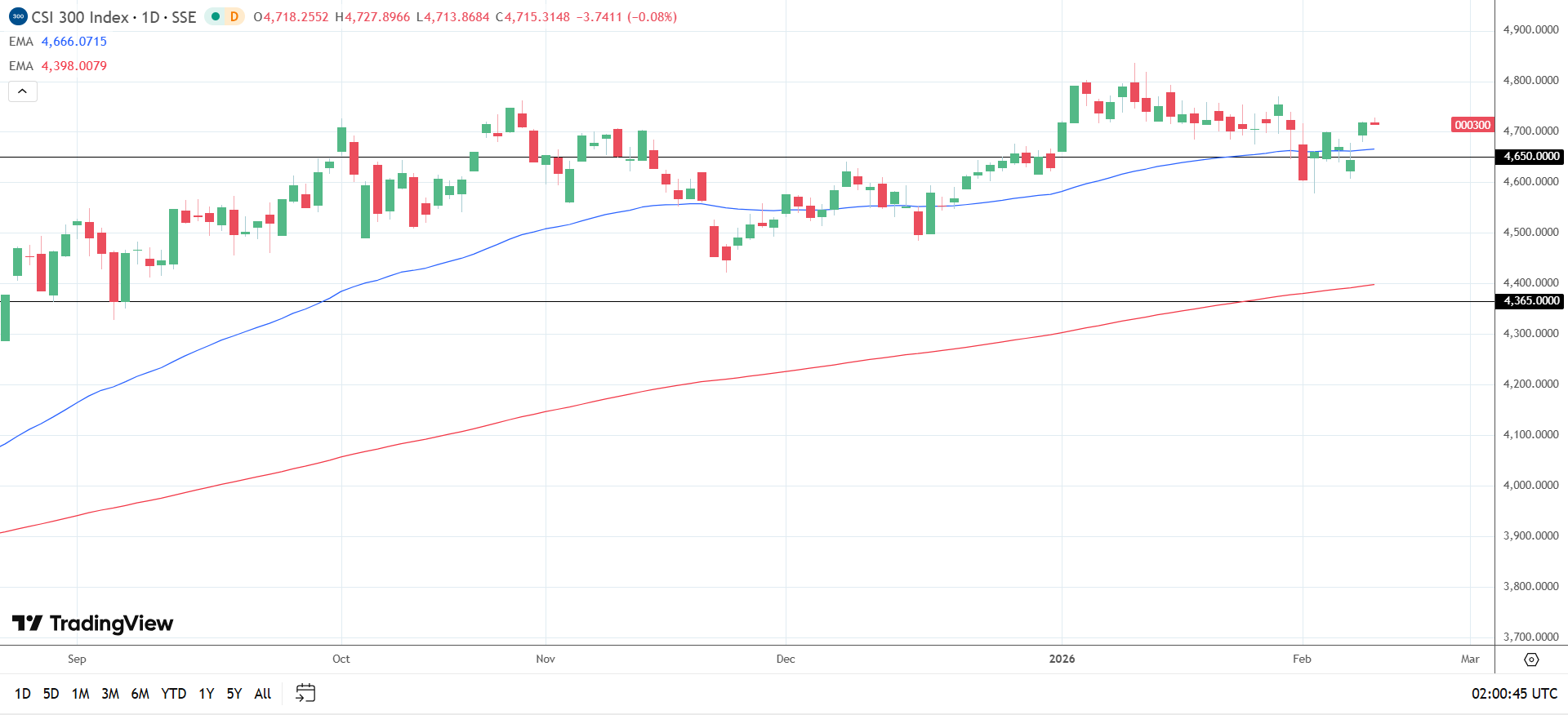
Chart technicals and market fundamentals remained aligned in early trading on Tuesday, February 10. Viewing the daily chart, the CSI 300 trades above its 50-day and 200-day EMAs. The EMA positions indicate a bullish bias.
A breakout above the 4,750 resistance level would bring the January 13 high of 4,837 into play. A sustained move through 4,837 would pave the way toward 5,000. Crucially, holding above the 50-day EMA after this week’s breakout reinforces the bullish trend.
Hang Seng Index: Bullish Outlook Intact
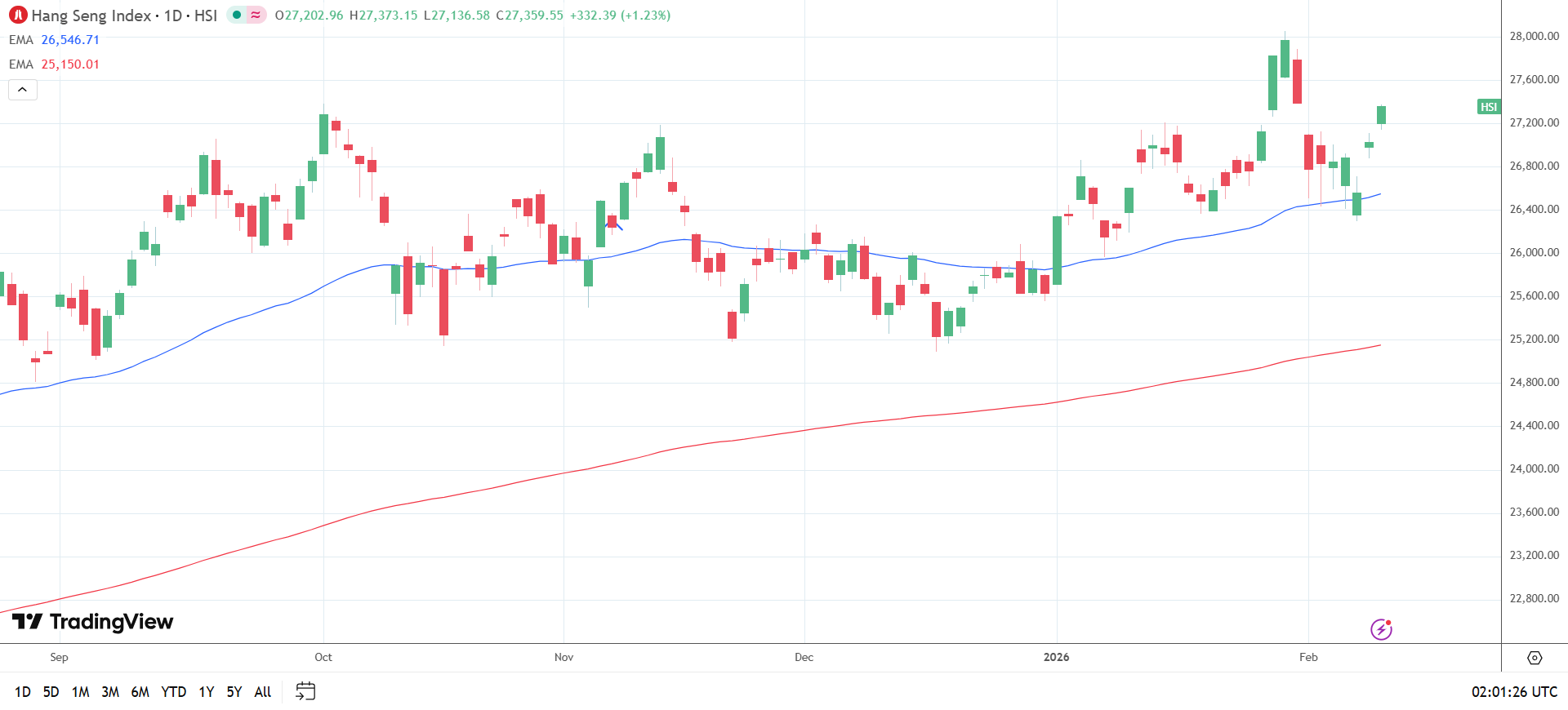
The Hang Seng Index’s outlook aligns with the CSI 300, with the Index trading above its 50-day and 200-day EMAs. These EMAs signal bullish momentum, also aligning with favorable fundamentals.
A break above 27,500 would bring the January high of 28,056 into play. A sustained move through 28,056 would enable the bulls to target 30,000 for the first time since 2021.
Conclusion:
To summarize, the short- and medium-term outlook remains constructive. Beijing’s ongoing policy support, AI advancements, and strong external demand are tailwinds for Mainland China and Hong Kong-listed stocks.
However, global trade developments, China’s housing market, private sector activity, and consumer price trends are likely critical for domestic consumption. Nevertheless, meaningful policy measures targeting domestic consumption would likely drive the CSI 300 to its 2021 all-time high of 5,931.
Discover strategies to navigate this week’s market trends here.