



The European Union is pushing even stricter sanctions against Russian oil. It will make the first attempt to serve third country ports namely Kulevi (Georgia) and Karimun (Indonesia). These ports have been assisting Russia in exporting oil despite restrictions. Their blocking can narrow the choice of Russia, and it can tighten oil supply in the world.
The sanctions package consists of the new bans on Russian refineries with the addition of Bashneft and major plants of Rosneft to the list. Although this does not directly affect Rosneft, the move indicates the increasing pressure. This may interfere with the oil streams of Russia particularly in case of total prohibition of maritime services. The traders can begin to price in supply shock.
The EU has a broader strategy in metal-related import bans and tech export controls for such countries as Kyrgyzstan. It tries to seal loopholes and evade sanctions. If these actions are effective, they may further tighten Russian revenues and diminish routes of oil trade in Asia.
These developments may have an upward pressure on oil prices. The eventual passage of these measures and Russian retaliation will likely be monitored by markets. The threat of supply is growing, and geopolitical tensions are in the spotlight.
Crude Oil Technical Analysis
Oil Daily Chart – Price Consolidation
The short-term outlook for the WTI crude oil (CL) price remains uncertain, as price consolidates between $66 and $6, as shown by the daily chart below. These consolidations are highlighted by the red-highlighted region above the 200-day SMA. A break above $66 will take the prices toward $69, where price may start to weaken again.
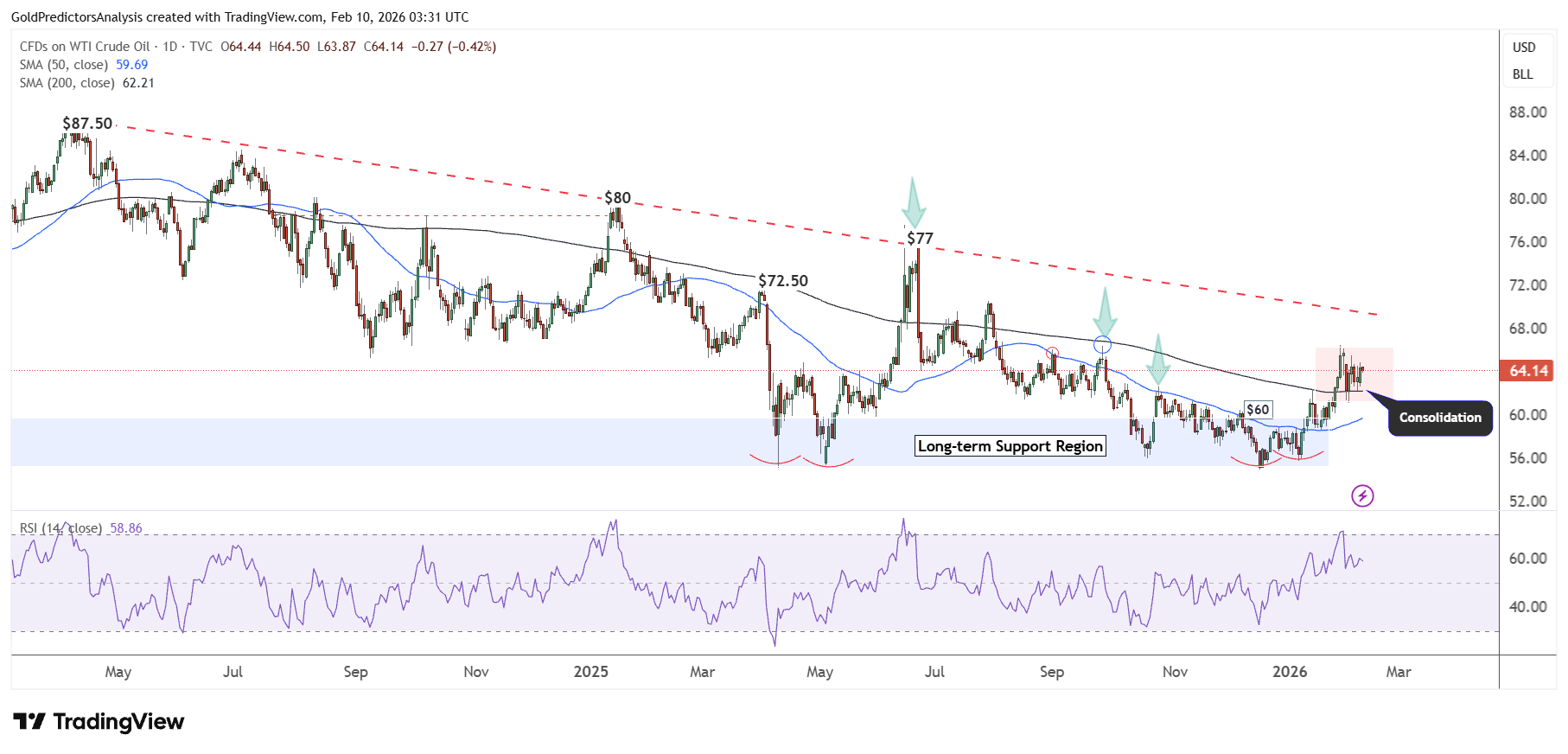
However, a break below $62 will indicate further downside towards $55.
As long as the price remains between these levels, the uncertainty is likely to persist. However, the consolidation above 200-day SMA indicates that the price will likely continue higher in the short term.
WTI Crude Oil Price Forecast
Every new WTI Crude Oil analysis as it publishes, today's technical signal and key levels, live price — on one page.
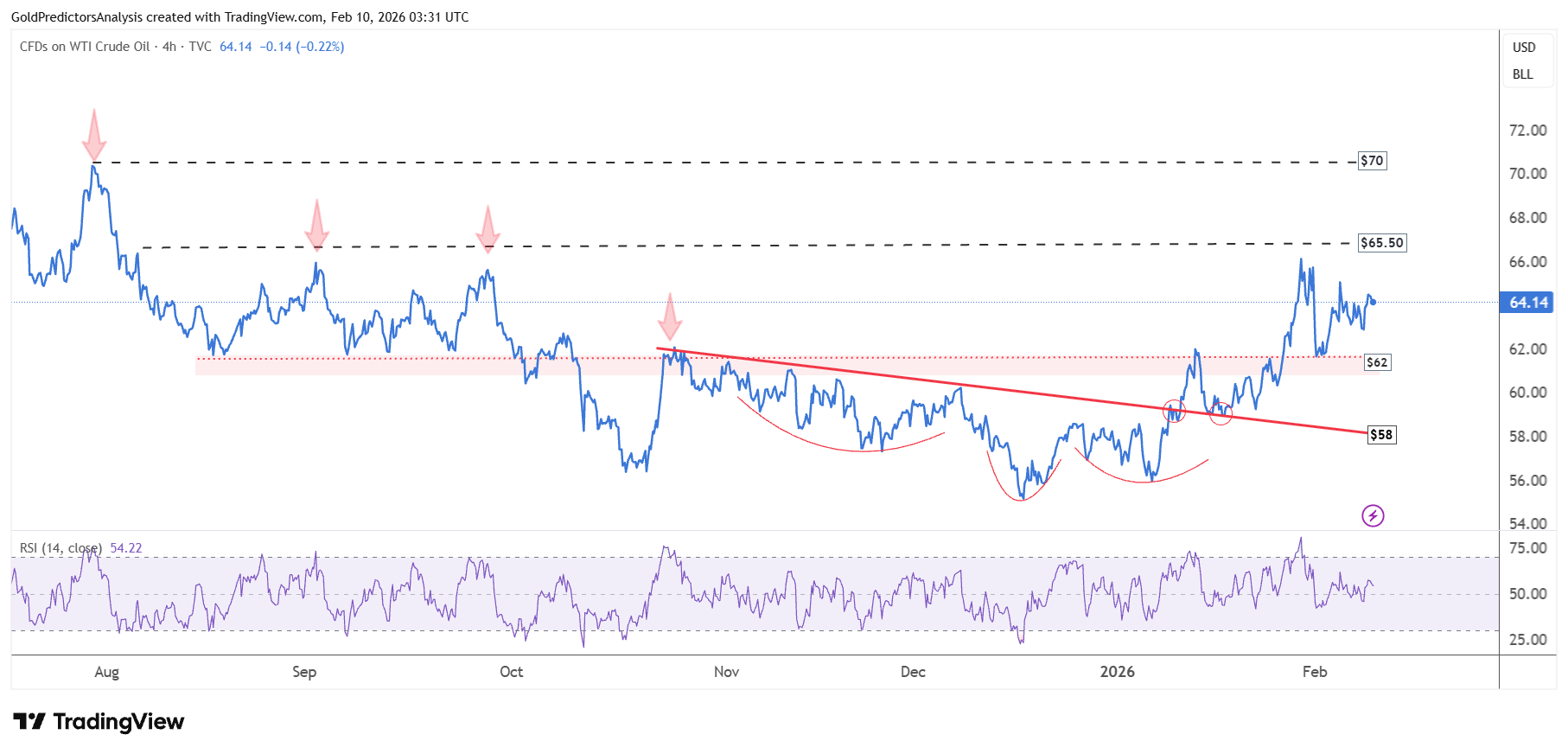
See all WTI Crude Oil forecastsOil 4-Hours Chart – Price Consolidation
The 4-hour chart for WTI crude oil shows uncertainty between $62 to $65.50.
However, the formation of bullish price action below $58 indicates that the short-term direction for oil may be higher.
A break above $66 will take the price towards $70. However, a break below $61 will take the price back toward $58. The RSI on the 4-hour chart also consolidates in a neutral zone which indicates uncertainty in the short term.
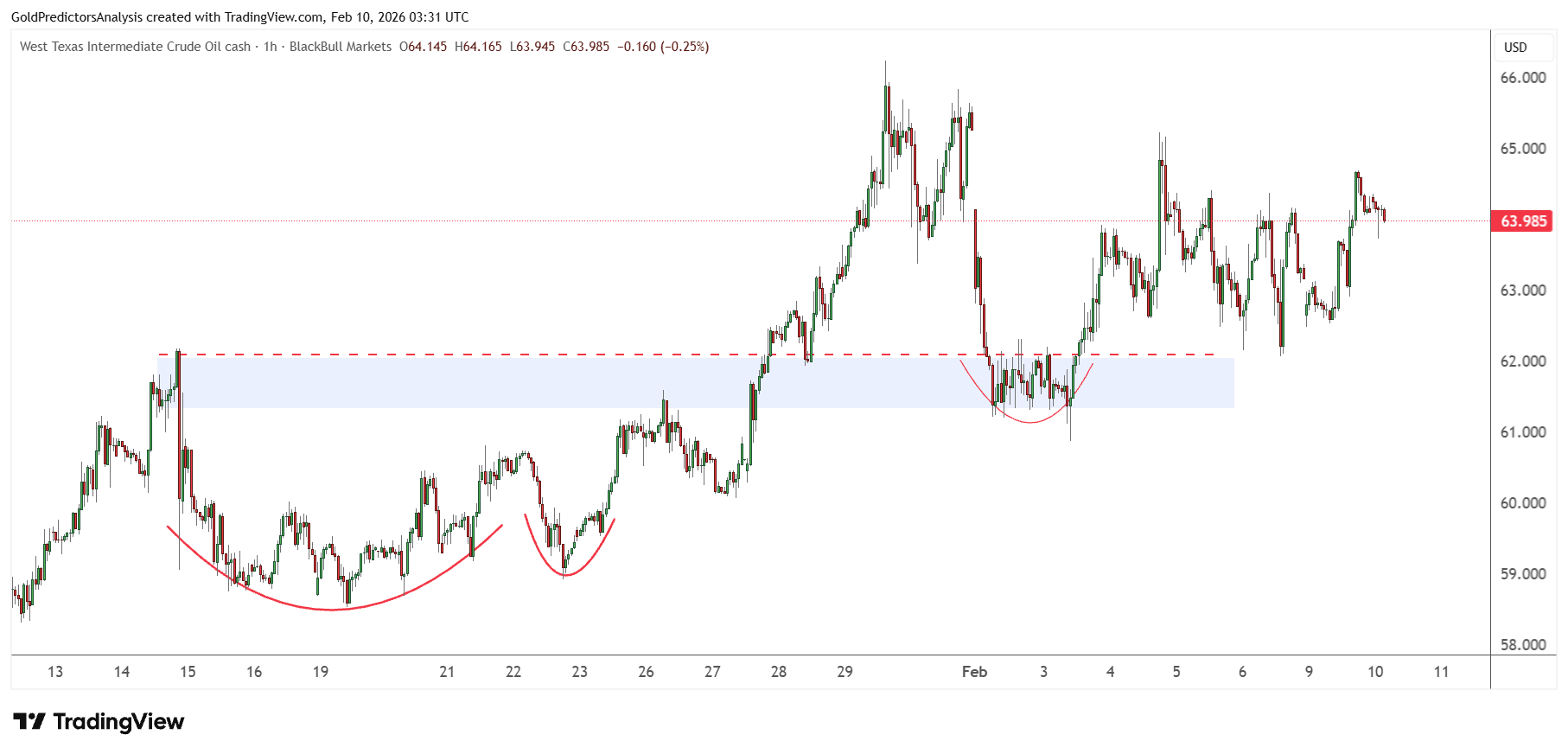
The constructive price action is observed on the hourly chart which shows consolidation above $60. A break above $66 will take the prices to higher levels.
However, a break below $61 will invalidate the short-term positive price action and take prices lower.
Final Words
Oil prices are trapped between levels due to geopolitical pressure. The EU’s proposed sanctions on third-party ports and Russian refineries could cause supply shocks and increase prices. But oil charts show consolidation with WTI crude oil still stuck between $61 and $66. Traders are waiting for a breakout. A break above $66 could bring a rally to $70. However, a break below $61 could drag prices lower.
If you’d like to know more about what drives oil prices, please visit our educational area.