
US stock futures edged lower in the Asian market session on Tuesday, February 10, partially reversing gains from the previous session. Market focus turned to the upcoming US economic data and the next wave of corporate earnings, leaving traders in a cautious mood.
Meanwhile, the Nikkei 225, the Hang Seng Index, and Mainland China’s indices posted strong gains. The contrasting trends underscored the significance of today’s US session.
Despite the morning pullback, rising bets on an H1 2026 Fed rate cut support a medium-term outlook for US stock futures.
Below, I’ll outline the key market drivers, the medium-term outlook, and the technical levels traders should watch.

US Administration Warns of Slower Job Growth
Overnight, White House economic advisor Kevin Hassett reportedly warned that US labor market data could be weaker in the near-term, testing sentiment ahead of this week’s delayed US jobs report. While Hassett attributed the likelihood of softer data to increased productivity and immigration policy, last week’s reaction to US labor market data underscored market sensitivity to jobs data.
Hassett’s view would align with the US administration’s positive economic outlook. Nevertheless, a weaker labor market may curb consumer spending and cool economic momentum, given that private consumption accounts for around 65% of US GDP.
Notably, last week’s JOLTs job openings indicated weaker labor demand. The drop in job openings challenged views that immigration policies could create labor market shortages, which typically lifts wages. Weaker labor demand could dampen wage growth, slow consumer spending, and dampen demand-driven inflation. These scenarios would indicate a more dovish Fed policy stance, affirming the bullish medium-term outlook for US stock futures.
Dow Jones Price Forecast
Every new Dow Jones analysis as it publishes, today's technical signal and key levels, live price — on one page.
See all Dow Jones forecastsUS Retail Sales and Earnings in Focus
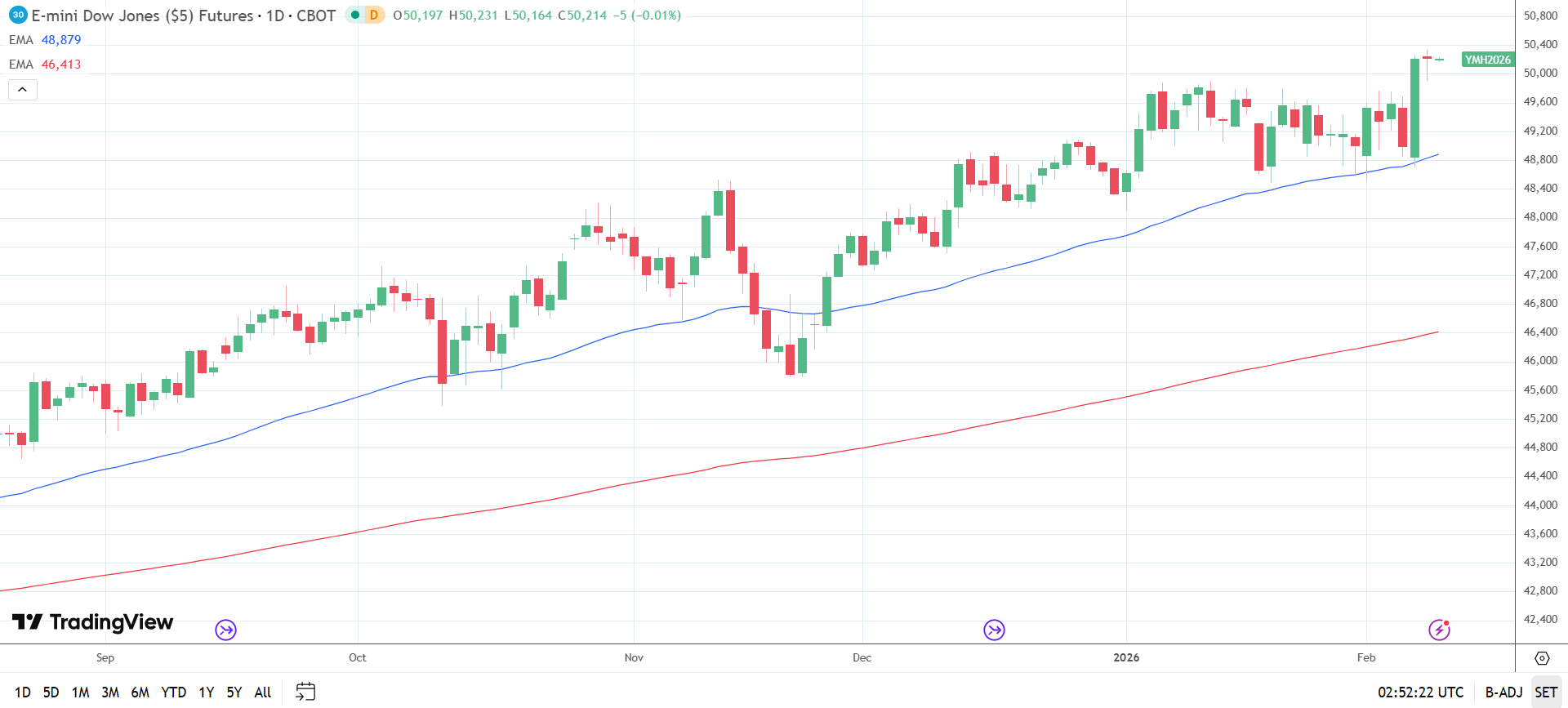
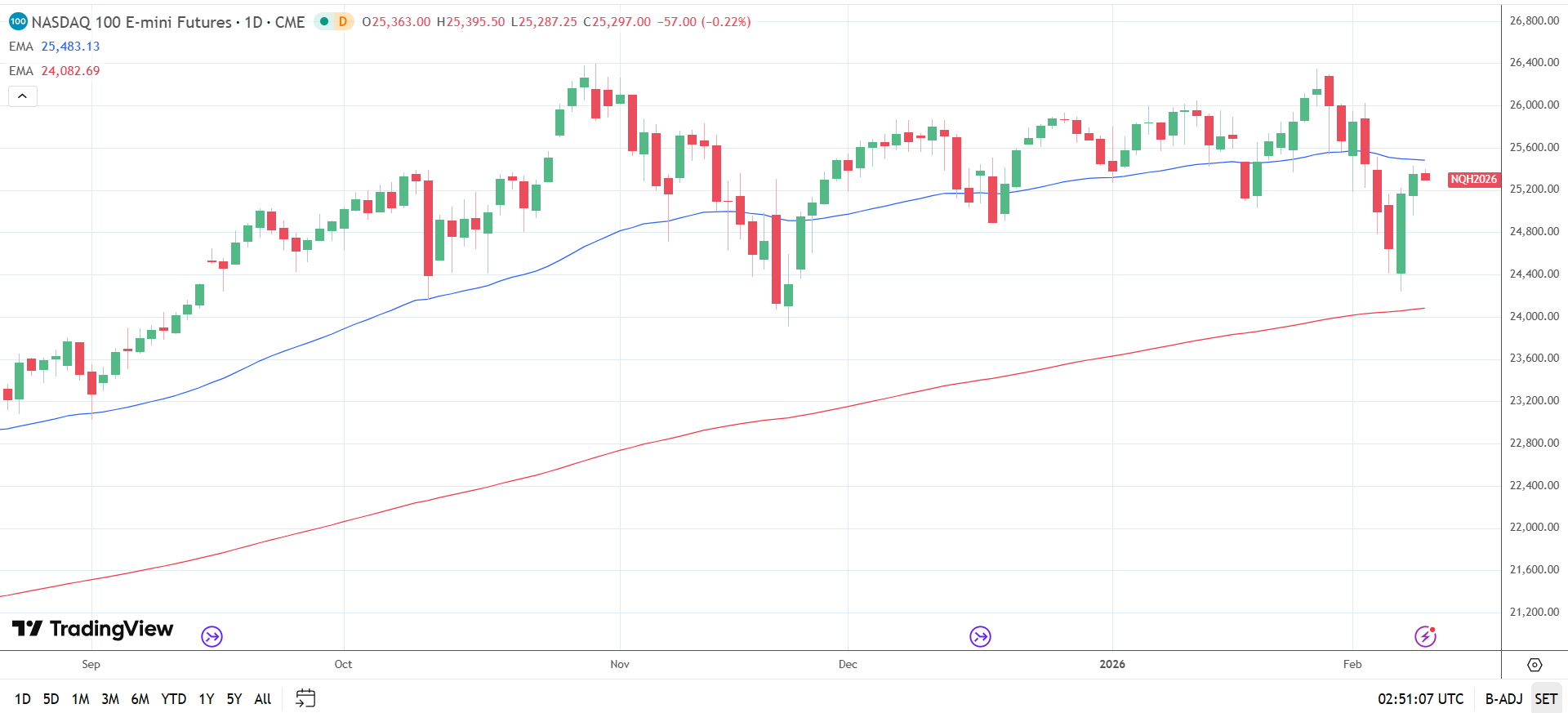
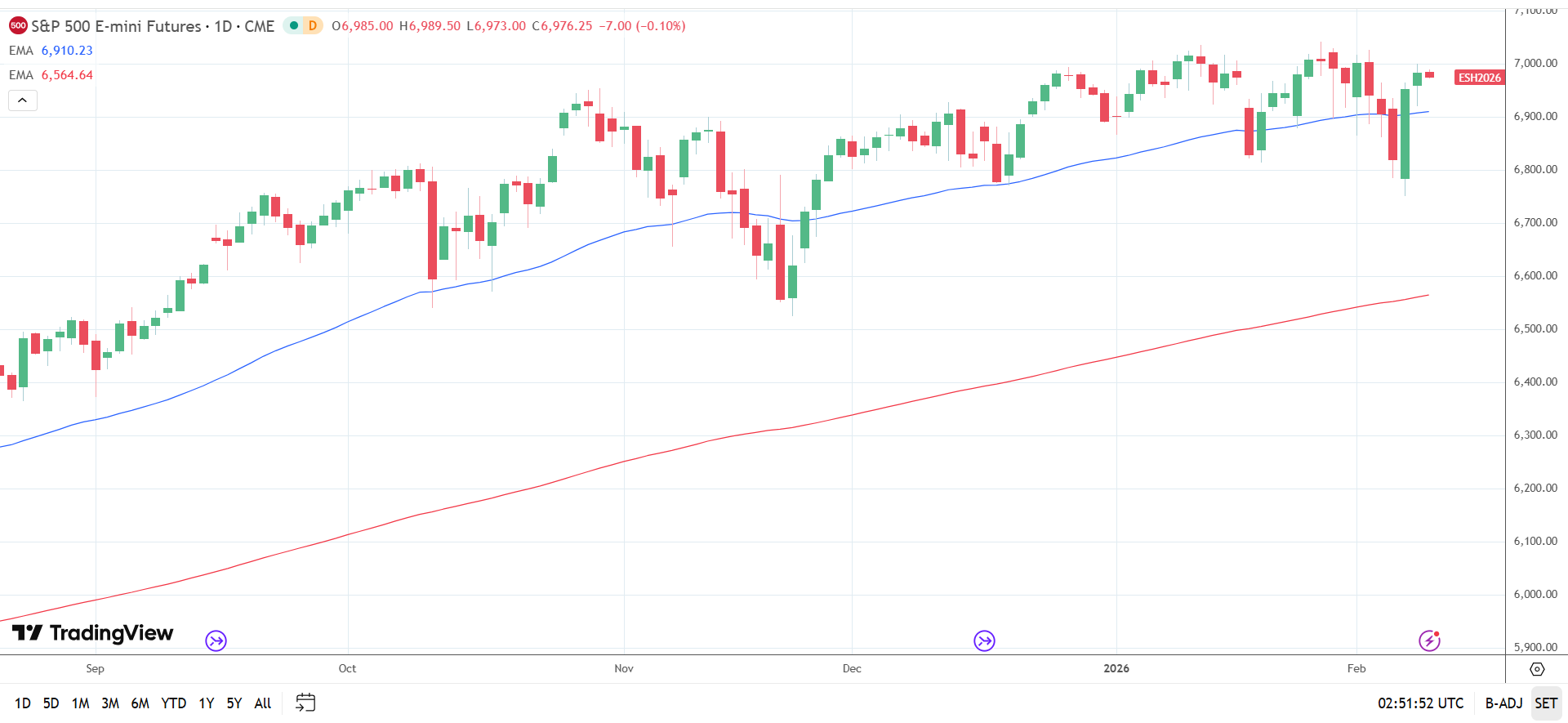
US futures posted modest losses during the Asian session on February 10. The Dow Jones E-mini slipped 5 points, while the Nasdaq 100 E-mini and the S&P 500 E-mini declined 57 points and 7 points, respectively.
Later on Tuesday, US retail sales figures will reflect consumer sentiment. Economists forecast retail sales will rise 0.4% month-on-month in December after a 0.6% increase in November. Rising retail sales would support the positive economic outlook and ease concerns that a weaker labor market would impact domestic demand.
With retail sales in focus and uncertainty about the labor market, traders should closely monitor FOMC members’ speeches. FOMC voting members Beth Hammack and Lorie Logan are slated to speak. Their views on inflation, the US economy, and rate cuts are also likely to influence sentiment.
Beyond the US economic calendar, the earnings calendar also warrants consideration. Coca-Cola (KO) and Ford Motor Company (F) are among the big names to release earnings results. Given that these are retail-focused companies, their outlooks will give further clues on the demand backdrop. Upbeat earnings and positive outlooks would likely boost demand for risk assets.
Key Technical Levels for Dow Jones, Nasdaq 100, and S&P 500
Despite a two-day winning streak, the morning pullback left the Nasdaq 100 E-mini trading below its 50-day EMA, while holding above its 200-day EMA. The EMA positions indicated a bearish near-term, but bullish longer-term outlook. Meanwhile, the Dow Jones E-mini and the S&P 500 E-mini remained above their 50-day and 200-day EMAs, signaling a bullish bias, aligning with positive fundamentals.
Near-term trends will hinge on geopolitical risks, earnings, US economic indicators, and central bank chatter. Key levels to monitor include:
Dow Jones
- Resistance: the February 9 record high of 50,339 and then 51,000.
- Support: the 50-day EMA (48,879), and then 48,500.
Nasdaq 100
- Resistance: the 50-day EMA (25,483), 26,000, and then the October 30 record high of 26,399.
- Support: 25,000, 24,500, and then the 200-day EMA (24,083).
S&P 500
- Resistance: the January 13 high of 7,036.
- Support: the 50-day EMA (6,910) and then the 200-day EMA (6,565).
Outlook: Fed Rate Cut Bets and Economic Momentum Reinforce Bullish Sentiment
In my opinion, the short-term price outlook is cautiously bullish. Meanwhile, bets on an H1 2026 Fed rate cut and positive sentiment toward broader Q4 earnings reinforce the bullish medium-term outlook. These positive fundamentals align with longer-term technicals for US index futures.
However, several events would derail the bullish medium-term outlook, including:
- Increased geopolitical tensions. Ongoing US-Iran talks will be key.
- The Bank of Japan declares a higher-than-expected neutral interest rate (potentially 1.5%-2.5%). Narrowing rate differentials could trigger a yen carry trade unwind. Such an event would invalidate the cautiously bullish short-term outlook.
- US economic indicators fuel recession risks and/or the Fed cools bets on an H1 2026 rate cut.
- Corporate earnings and outlooks miss consensus.
Conclusion: Constructive Bias Intact
In summary, rising bets on Fed rate cuts, robust earnings, and a cautiously hawkish BoJ reinforce the medium-term outlook for US stock futures.
However, traders should closely monitor BoJ rhetoric, yen intervention warnings, and USD/JPY trends. Hawkish BoJ policy cues, a dovish Fed rate path, and intervention threats could push USD/JPY toward 150, exposing US equity futures to yen carry trade unwind risks.
Despite the risk of yen carry trade unwinds, US stock futures are likely to target new highs if the Fed signals an H1 2026 cut. Importantly, Fed rate cuts are likely to overshadow yen carry trade risks, given the longer-term effect of lower borrowing costs on profitability and stock valuations.
Follow our live coverage and consult the economic calendar for real-time market updates.