Key Insights
- Gold and silver prices increase as a hedge against inflation.
- Benchmark yields moved higher following more hot inflation.
- Oil prices continued to make gains after stalling Russia-Ukraine talks.
USD/CAD moved lower following the Bank of Canada’s decision to raise rates by 50-basis points and begin Quantitative Tightening on April 25th. Benchmark yields moved higher following the release of more hot inflation data, countering the Fed’s aggressive rate hikes.
Oil prices continued to soar due to stalling Russia-Ukraine peace talks. An increased supply of oil reserves by EIA member nations will not replace supply losses from Russia. A slight easing of China’s lockdown protocols following the surge in COVID-19 increased demand and underpinned higher oil prices.
The producer price index, which measures the change in prices paid by producers, rose 11.2% y-o-y and 1.2% in March. Core PPI, which excludes food and energy, rose 0.9% month-over-month. Economists’ expectations were for a 0.5% increase.
Prices for final demand goods led with a 2.3% monthly rise. Services were up 0.9% compared to 0.3% in February.
Elevated producer and consumer prices indicate that there is spiraling inflation in the market. The Fed will continue to raise rates through a series of hikes this year after increasing rates by a quarter basis point in March.

Technical Analysis
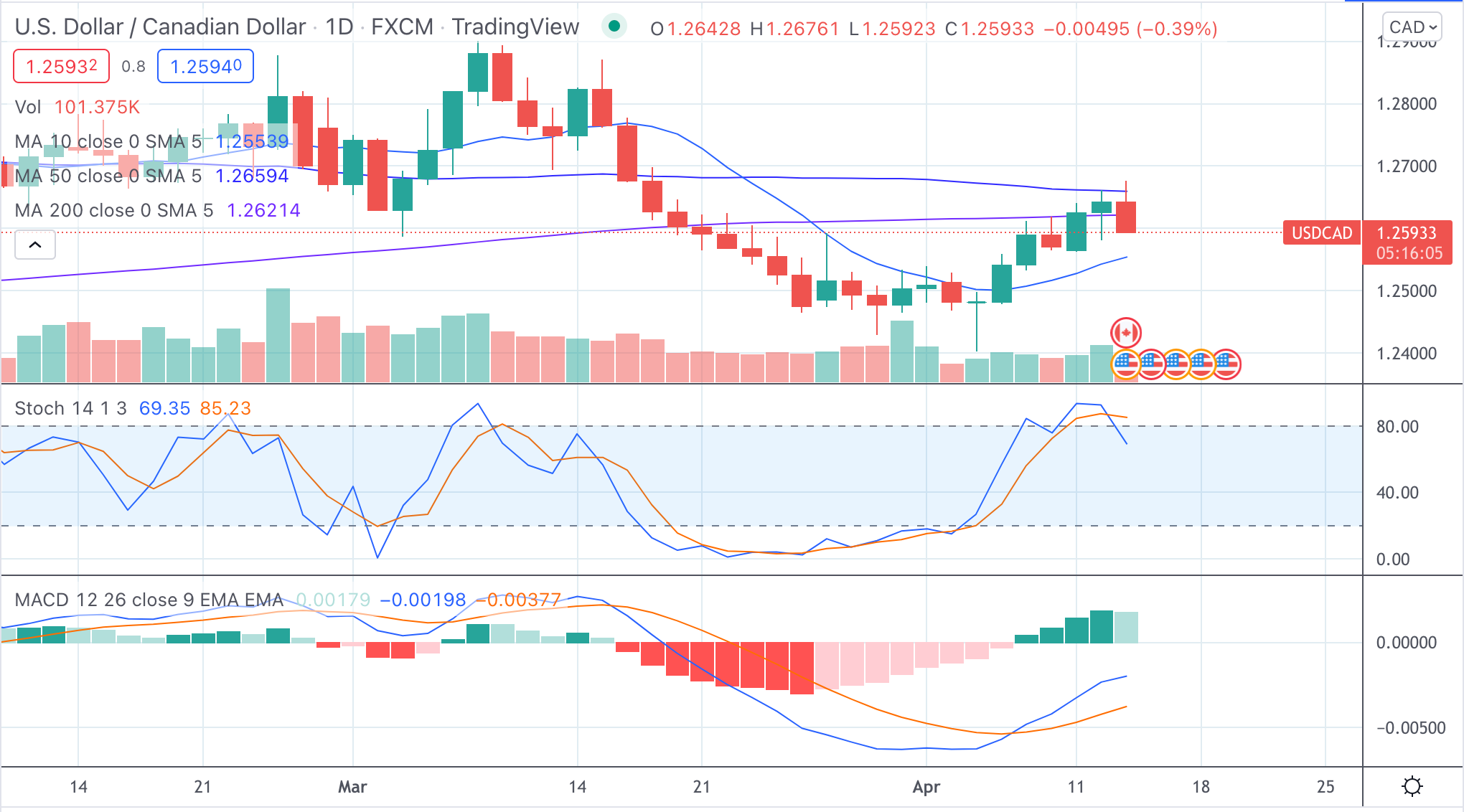
The USD/CAD dips in volatile trading after the BoC rate decision. The hawkish Fed could put upward pressure on the currency pair and favor the dollar. Resistance is seen near the critical psychological level of 1.270. Support is seen near the 10-day moving average of 1.255.
Short-term momentum is negative as the fast stochastic had a crossover sell signal. Medium-term momentum is positive as the MACD line generated a crossover buy signal.
This scenario happens when the MACD line (the 12-day moving average minus the 26-day moving average) crosses the MACD signal line (the 9-day MA of the MACD line).