
XRP faces increased selling pressure as traders react to the pushback on the Market Structure Bill, triggering a three-day losing streak.
This week, the US Senate Banking Committee postponed its Market Structure Bill markup vote, while the US Senate Agriculture Committee rescheduled its markup to January 27, cooling demand for XRP. Both committees had markups set for January 15.
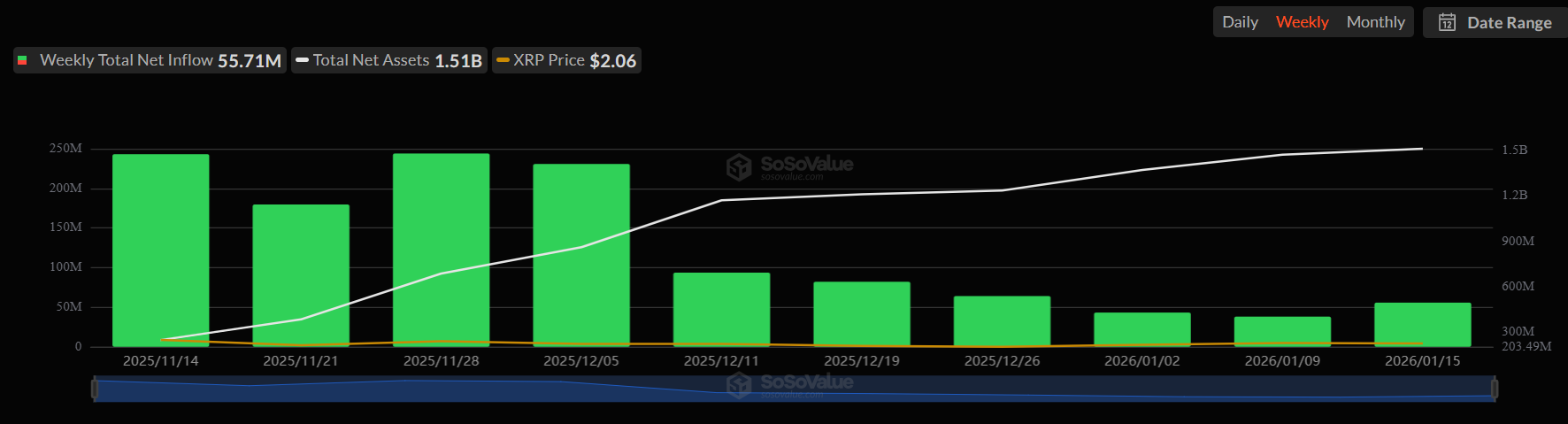
Meanwhile, the US XRP-spot ETF market extended its inflow streak to 10 weeks, cushioning XRP’s downside.
Despite the developments on Capitol Hill, the cautiously bullish short-term outlook and constructive medium-term outlook remain intact.
Below, I will explore the key drivers behind recent price trends, the medium-term (4-8 weeks) outlook, and the key technical levels traders should watch.

US Market Structure Bill Delays Trigger XRP Selling Pressure and Heighten Political Risk
The Market Structure Bill remained a flashpoint on Friday, January 16, after delays to the markup votes of the Banking Committee and Agriculture Committee.
Coinbase (COIN) CEO Brian Armstrong continued his criticism of the US Senate Banking Committee’s draft text of the Market Structure Bill. Speaking on Fox News, Armstrong stated:
“You know, the banks had their own concerns, and we reached a good outcome in the Genius Act. And now, the banks really are coming and trying to undermine the President’s crypto agenda. I mean, these are the same banks that debanked him and his family, right? And they want to come in and say that Americans should not be able to actually earn more money on their money.”
Armstrong aired his frustrations, adding:
They’re trying to protect their own profit margins, taking money out of the pockets of hardworking, average Americans and putting it into the coffers of these big banks that are hitting record profits. And so, our view is that there should be a level playing field, where banks and crypto companies can lean into stablecoin legislation as an opportunity, and that includes paying rewards to Americans so that they can earn money on their money.”
Crucially, reports surfaced that the White House might pull its support for the Market Structure Bill. Crypto in America host Eleanor Terrett stated:
Bitcoin Price Forecast
Every new Bitcoin analysis as it publishes, today's technical signal and key levels, live price — on one page.
See all Bitcoin forecasts“The White House is considering pulling its support for the crypto market structure bill entirely if Coinbase does not come back to the table with a yield agreement that satisfies banks and gets everyone to deal, a source close to the Trump administration tells me.”
Coinbase: A Key Player in Crypto Legislation
The White House’s support for the Market Structure Bill hinges on Coinbase’s involvement, underscoring the influence of CEO Brian Armstrong in the digital asset space. For context, Coinbase withdrew its support for the draft text of the Banking Committee’s Market Structure Bill. The Banking Committee responded by postponing its markup vote.
The Coinbase CEO highlighted key issues with the bill, including:
- A de facto ban on tokenized equities.
- DeFi prohibitions, giving the government unlimited access to your financial records and removing your right to privacy.
- Erosion of the CFTC’s authority, stifling innovation and making it subservient to the SEC.
- Draft amendments that would kill rewards on stablecoins, allowing banks to ban their competition.
Coinbase and Ripple have significant stakes in crypto-related legislation, given their legal battles with the SEC. Legislation giving the SEC greater regulatory authority than the CFTC exposes XRP and the broader crypto market to political risk.
While the Trump administration remains pro-crypto, a Democratic Party administration could reintroduce its anti-crypto agenda. If the Market Structure Bill gives the SEC overriding authority over the digital asset space, the agency may regulate through enforcement, as it did during the Biden presidency.
XRP Price Reaction Highlights Sensitivity to Regulatory Headlines and Legislative Momentum
XRP price action underscored the token’s sensitivity to crypto-related regulatory developments on Capitol Hill.
The token rallied 33% from December 31 to June 6, following the Banking Committee’s announcement of its January 15 markup vote. However, the token has fallen 6% since the Banking Committee postponed its markup vote. Previously, XRP surged 14.69% on July 17 after the US House of Representatives passed the Market Structure Bill to the Senate.
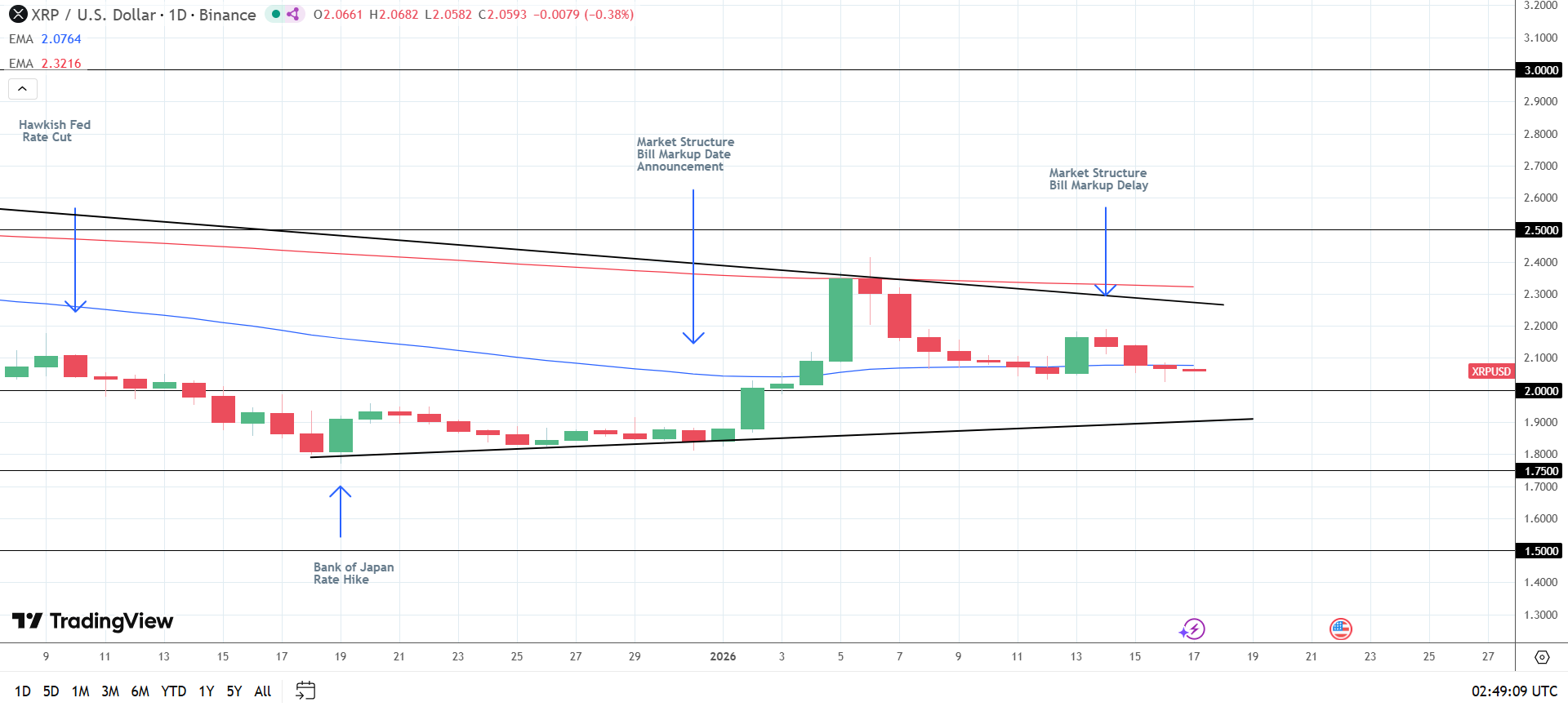
Despite the latest regulatory headwinds, the short-term outlook remains cautiously bullish and positive for the medium term. Robust demand for US XRP-spot ETFs and increased real-world utility tilt the supply-demand balance in XRP’s favor.
XRP-Spot ETF Inflows Provide a Critical Cushion Against Regulatory Headwinds
The US XRP-spot ETF market saw $55.71 million in net inflows in the reporting week ending January 16. Notably, inflows were up from the previous week’s $38.07 million, underscoring strong institutional demand. While analysts expect crypto-friendly legislation to boost demand for XRP, the token’s increased real-world utility remains a key consideration for investors eyeing supply-demand trends.
These two factors, coupled with the progress of the Market Structure Bill, are pivotal to the bullish medium-term price projection.
XRP Price Forecast: Key Short-Term, Medium-Term, and Longer-Term Targets Explained
Progress toward crypto-friendly legislation, strong demand for XRP-spot ETFs, and increased XRP utility affirm the cautiously positive short-term (1-4 weeks) outlook, with a $2.5 price target.
Additionally, expectations that the Senate will find common ground and pass crypto-friendly legislation reaffirmed the bullish longer-term price targets:
- Medium-term (4-8 weeks): $3.0.
- Longer-term (8-12 weeks): $3.66.
Key Downside Risks to the Bullish Price Structure
Several events could unravel the positive outlook. These include:
- The Bank of Japan announces a hawkish neutral interest rate (potentially 1.5%-2.5%), signaling multiple rate hikes. A higher neutral rate could trigger a yen carry trade unwind, derailing the short-term outlook.
- US economic indicators and the Fed are tempering expectations of an H1 2026 rate cut.
- US lawmakers challenge the Market Structure Bill, further delaying crypto legislation.
- XRP-spot ETFs report outflows.
These events would likely weigh on sentiment, pushing XRP below $2, which would signal a bearish trend reversal.
Technical Analysis: Levels to Watch
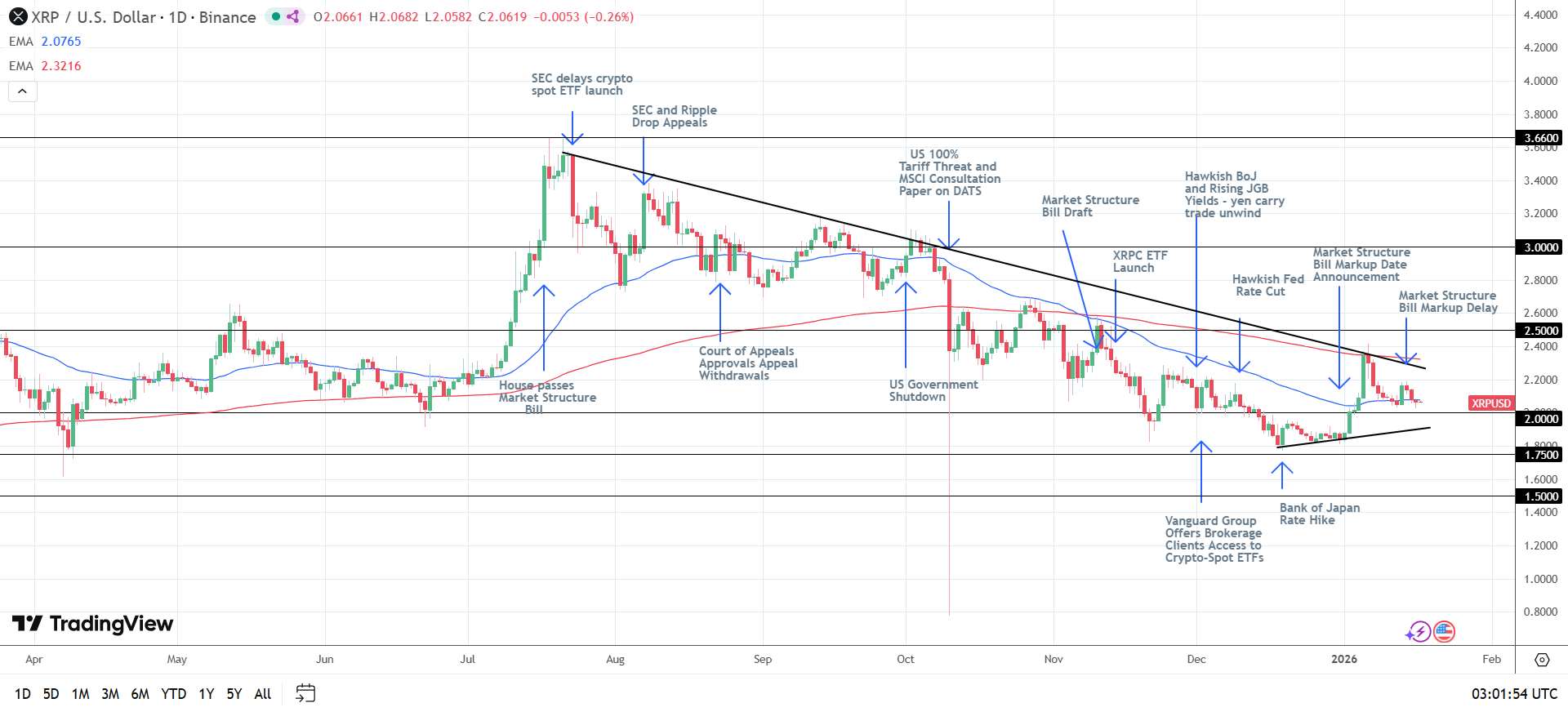
XRP fell 0.54% on Friday, January 16, following the previous day’s 2.77% loss, closing at $2.0672. The token faced heavier selling pressure than the broader crypto market cap, which declined 0.10%.
A three-day losing streak left XRP trading below its 50-day and 200-day EMAs, indicating a bearish bias. However, the bullish fundamentals remain dominant.
Key technical levels to watch include:
- Support levels: $2.0, $1.75, and then $1.50.
- 50-day EMA resistance: $2.0765.
- 200-day EMA resistance: $2.3216.
- Resistance levels: $2.5, $3.0, and $3.66.
Viewing the daily chart, a breakout above the 50-day EMA would signal a near-term bullish trend reversal, bringing $2.2 into play. A sustained move through $2.2 would pave the way toward the 200-day EMA.
Importantly, a breakout above the EMAs would reaffirm the bullish medium-term outlook and the medium- and longer-term price targets.
Fundamental Drivers to Watch
Near-term price drivers include:
- XRP-spot ETF flows.
- US economic data and the Fed’s rate path.
- US crypto-related regulatory developments on Capitol Hill.
Holding Above $2 Is Crucial to Preserve XRP’s Bullish Medium-Term Structure
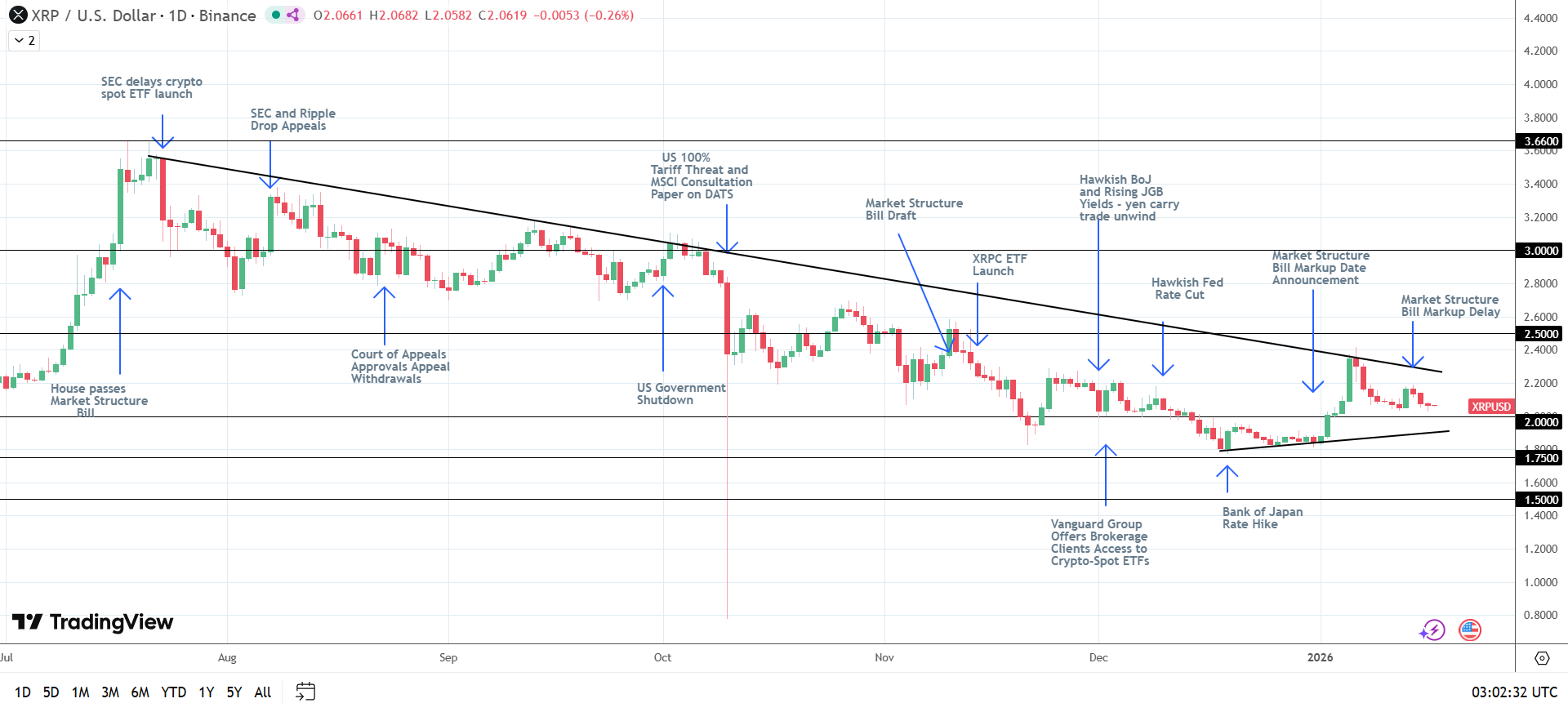
Avoiding a break below the $2 psychological support level remains key for the short- to medium-term outlook. Bullish fundamentals continue to counter bearish technicals, suggesting a rebound. The recovery from December’s $1.7712 low and the early gains of 11.93% in 2026 reinforced the bullish structure and short- to medium-term price projections.
A break above $2.2 would enable the bulls to target the upper trendline. A sustained move through the upper trendline would affirm the bullish trend reversal and validate the bullish structure, supporting the price targets:
- Medium-term (4-8 weeks): $3.0.
- Longer-term (8–12 weeks): target of $3.66.
However, a drop below $2.0 would bring the lower trendline into play. A breach of the lower trendline would invalidate the bullish structure, signaling a bearish trend reversal.
Outlook:
Looking ahead, crypto-related regulatory developments on Capitol Hill will be key. The US Senate Agriculture Committee plans to release its draft text of the Market Structure Bill on January 23. Positive reactions to the draft text would likely boost demand for XRP.
Meanwhile, central bank chatter and XRP-spot ETF flows will also influence the near-term price outlook.
Increased expectations of a March Fed rate cut, and a dovish BoJ neutral rate (potentially 1%-1.25%) would lift sentiment. Strong demand for XRP-spot ETFs and positive crypto-related developments on Capitol Hill would reinforce the constructive bias.
In summary, these factors support a medium-term (4–8 weeks) move to $3.0. Furthermore, a March Fed rate cut and the Senate passing the Market Structure Bill would reaffirm the longer-term (8–12 weeks) price target of $3.66.
Looking beyond 12 weeks, these scenarios are likely to send XRP to its all-time high of $3.66 (Binance). A breakout above $3.66 would reaffirm the $5 price target over a 6- to 12-month time horizon.