
XRP dropped for a sixth consecutive day on Monday, January 19, as trade war jitters and delays to crypto legislation weighed on sentiment.
US President Trump threatened tariffs on eight European nations over the weekend. The threat triggered a broad-based crypto market sell-off.
XRP had faced selling pressure ahead of Trump’s threat. Investors reacted to the US Senate Banking Committee’s postponement of its markup vote. XRP slid to a session low of $1.8502 before briefly reclaiming $2.
Despite the recent pullback, the medium-term outlook remains bullish. Robust demand for XRP-spot ETFs, increased XRP utility, and hopes for crypto-friendly legislation are likely to tilt the supply-demand balance in the token’s favor.
Below, I will explore the key drivers behind recent price trends, the medium-term (4-8 weeks) outlook, and the key technical levels traders should watch.

XRP Plunges on US-EU Trade War Risk
On Saturday, January 17, US President Trump intensified his push to acquire Greenland by announcing a 10% tariff on eight European nations. Denmark, Finland, France, Germany, Norway, Sweden, the Netherlands, and the UK were Trump’s targets.
Reports of the EU considering retaliatory measures risk jeopardizing the 2025 US-EU trade deal, raising the threat of an all-out trade war. The Kobeissi Letter commented on the EU’s potential response, stating:
“France’s President Macron calls for the EU to activate its most potent trade weapon against the US after President Trump’s tariff threat over Greenland. Macron is now calling for the use of the EU’s anti-coercion instrument. If used against the US, it would restrict US access to the EU market, potentially blocking US banks from EU procurement and targeting US tech giants. This trade weapon has never been used before.”
US stock futures saw heavy losses as the markets opened, triggering a broad-based crypto market sell-off. XRP slid from $2.06 to a low of $1.8502 in the first two hours of trading before briefly climbing to a January 19 session high of $2.0283. XRP’s recovery suggests that markets expect the EU and the US to reach an agreement.
President Trump has previously used tariff threats to pursue US policy. While XRP recovered on January 19, the risk of a US-EU trade war is likely to weigh on sentiment. The Guardian reported that the EU could target crypto companies, while stating that EU leaders agreed to hold off using the ACI, hoping that Trump would withdraw the threat. The 10% tariff will take effect on February 1.
Ripple Price Forecast
Every new Ripple analysis as it publishes, today's technical signal and key levels, live price — on one page.
See all Ripple forecasts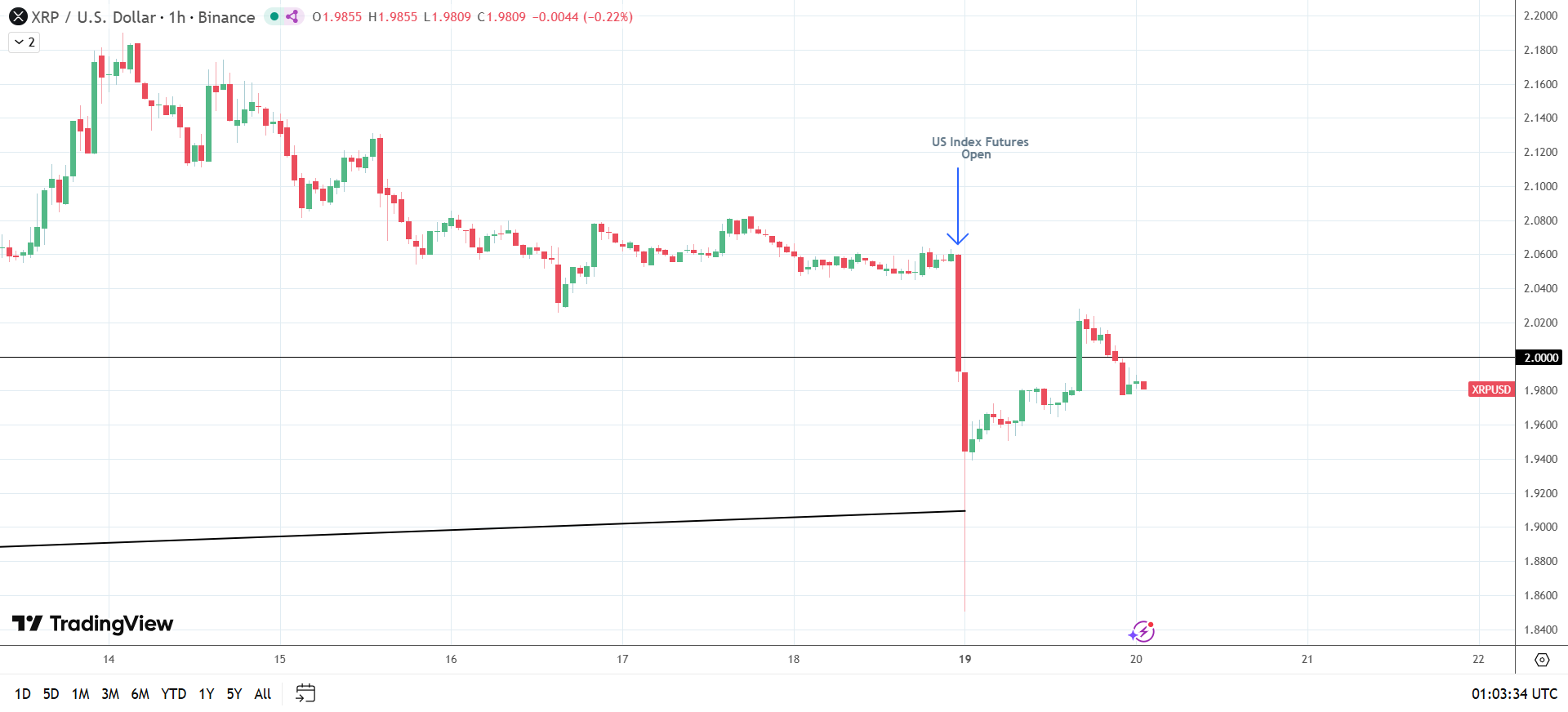
XRP Remains Exposed to Geopolitical Risks
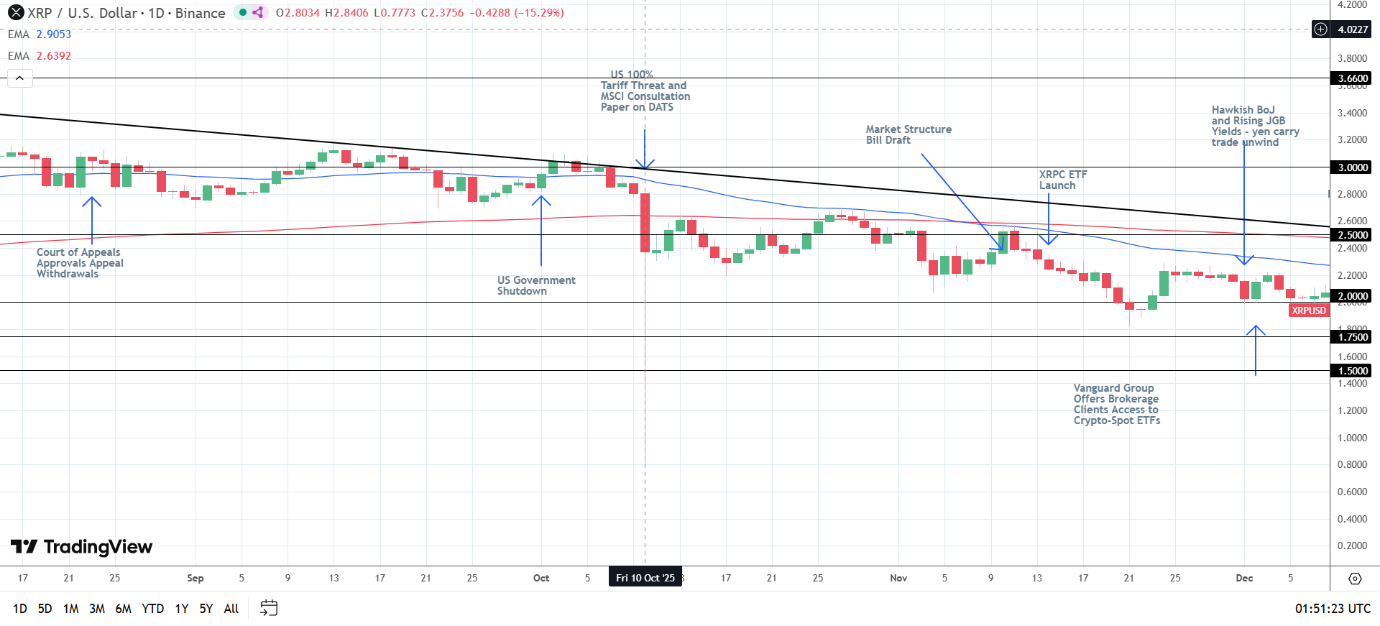
XRP and the broader crypto market remain sensitive to the threat of trade wars. In October, US President Trump threatened a 100% tariff on China. The crypto market experienced a flash crash, with XRP plunging from $2.8406 to $0.7773 on October 10 before closing down 15.29% at $2.3756.
XRP Price Forecast: Short-, Medium-, and Long-Term Targets
Despite the delays to the Market Structure Bill, the short-term (1-4 weeks) outlook remains cautiously bullish, with a target price of $2.5. Increased XRP utility and strong demand for XRP-spot ETFs remain key drivers.
Additionally, the likelihood that the US Senate will pass crypto-friendly legislation reaffirmed the bullish longer-term price targets:
- Medium-term (4-8 weeks): $3.0.
- Longer-term (8-12 weeks): $3.66.
Key Downside Risks to the Bullish XRP Outlook
Several scenarios could challenge the positive outlook. These include:
- The Bank of Japan declares a hawkish neutral interest rate (potentially 1.5%-2.5%), indicating multiple rate hikes. A higher neutral rate could lead to a yen carry trade unwind, mirroring events in mid-2024. A yen carry trade unwind would invalidate the short-term outlook.
- US economic data and the Fed are downplaying expectations of an H1 2026 rate cut.
- US lawmakers oppose the Market Structure Bill, delaying crypto legislation.
- XRP-spot ETFs report outflows.
These scenarios would likely weigh on risk assets, sending XRP below $1.85, which would indicate a bearish trend reversal.
Technical Analysis: Levels to Watch
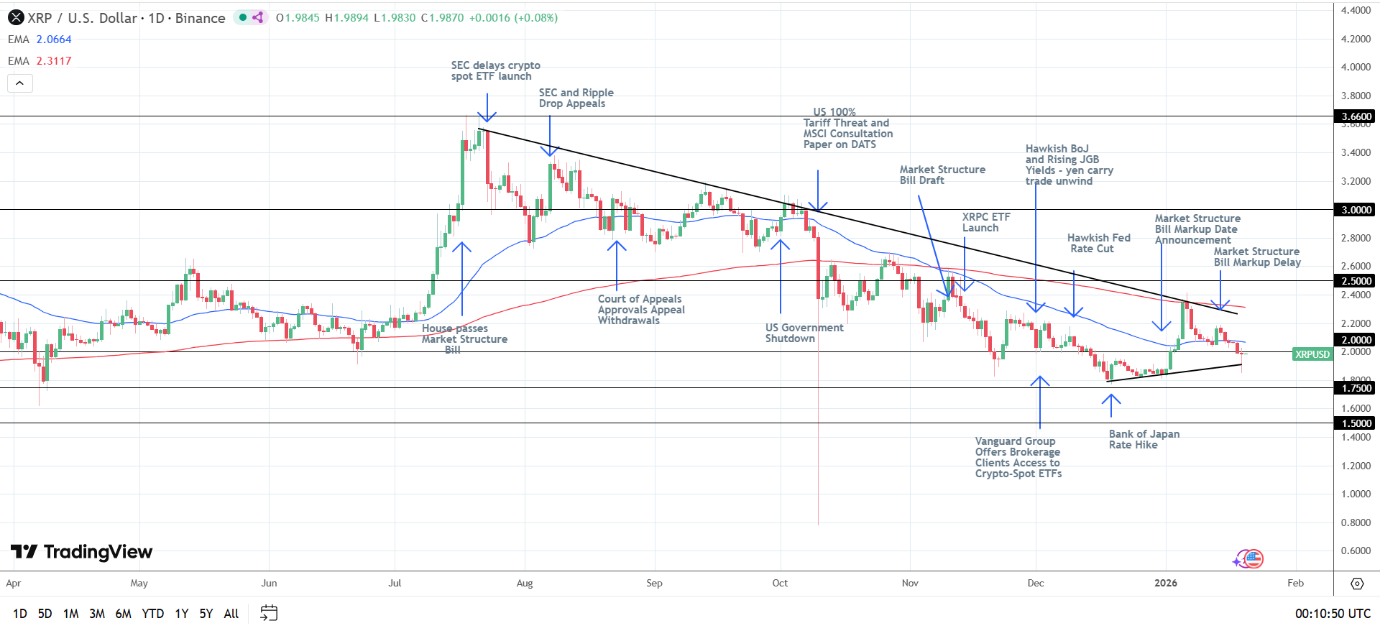
XRP fell 0.39% on Monday, January 19, following the previous day’s 3.4% slide, closing at $1.9837. The token faced less severe selling pressure than the broader crypto market cap, which dropped 1.27%.
A six-day losing streak left XRP below its 50-day and 200-day EMAs, indicating a bearish bias. However, the bullish fundamentals continue to counter technicals, limiting the downside.
Key technical levels to watch include:
- Support levels: $1.85, $1.75, and then $1.50.
- 50-day EMA resistance: $2.0664.
- 200-day EMA resistance: $2.3117.
- Resistance levels: $2.0, $2.5, $3.0, and $3.66.
Viewing the daily chart, a breakout above $2.0 would pave the way toward the 50-day EMA. A sustained move through the 50-day EMA would signal a near-term bullish trend reversal. A bullish trend reversal would bring $2.2 into play. A break above $2.2 would open the door to testing the 200-day EMA.
Crucially, a breakout above the EMAs would reinforce the bullish medium- and longer-term price targets.
Fundamental Drivers That Could Influence XRP Price Action Near Term
Near-term price drivers include:
- XRP-spot ETF flow trends.
- US economic indicators and the Fed’s policy stance.
- US crypto-related legislative developments.
- US-EU trade headlines.
Avoiding Sub-$1.85 Is Key for XRP’s Bullish Structure
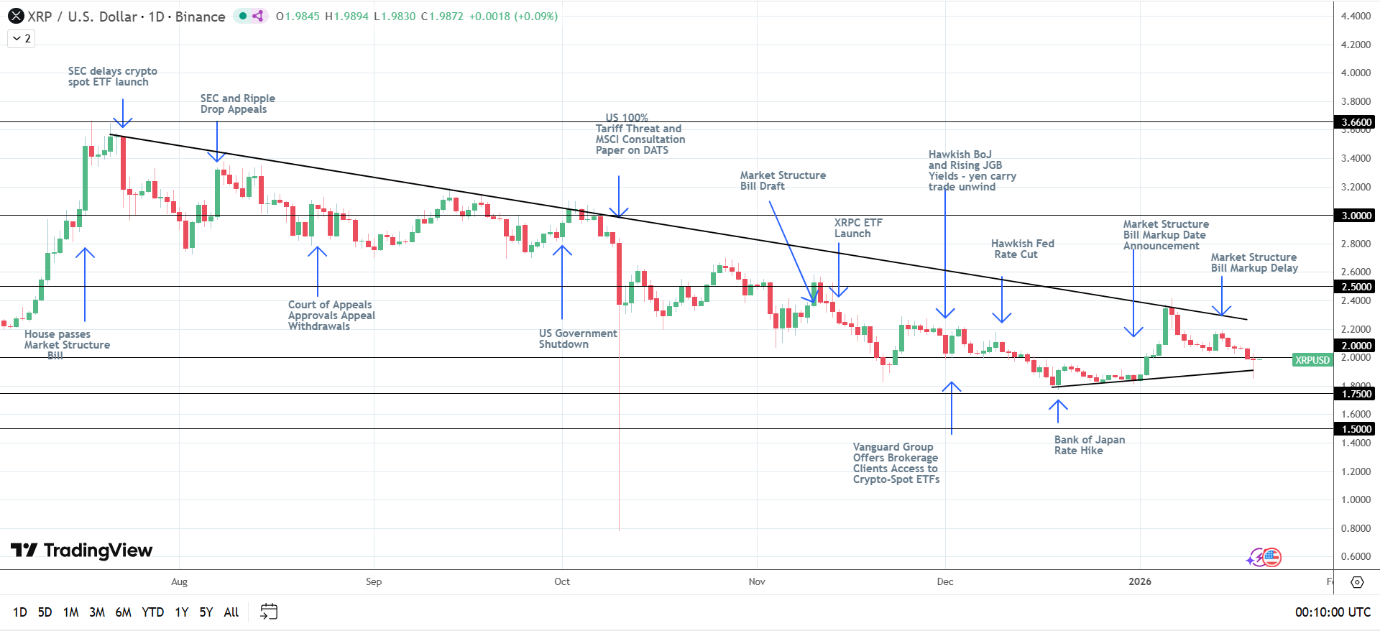
Avoiding a sustained drop below $1.85 will be pivotal to the short- to medium-term outlook. Bullish fundamentals, including spot ETF demand and increased XRP utility, continue to offset bearish technicals, signaling a near-term rebound. The token’s rally from a December low of $1.7712 and January gains of 7.48% reinforced the bullish structure and short- to medium-term price projections.
A break above $2.0 would enable the bulls to target the upper trendline. Moreover, a sustained move through the upper trendline would reaffirm the bullish trend reversal and validate the bullish structure, supporting the price targets:
- Medium-term (4-8 weeks): $3.0.
- Longer-term (8–12 weeks): target of $3.66.
However, a sustained drop below the lower trendline would invalidate the bullish structure, indicating a bearish trend reversal.
XRP Outlook Hinges on Trade Headlines, ETF Flows, and Central Banks
Looking ahead, trade-related news and crypto-related legislative developments are likely to influence XRP’s price outlook.
Traders should closely monitor updates from the Banking Committee and the Agriculture Committee. The Agriculture Committee will release its draft text on the Market Structure Bill on January 23 ahead of a markup vote on January 27.
Meanwhile, Ripple-related news, central bank rhetoric, and demand for XRP-spot ETFs will also influence the near-term price outlook.
Rising expectations of a March Fed rate cut, and a dovish BoJ neutral rate (potentially 1%-1.25%) would boost sentiment. Robust demand for XRP-spot ETFs, increased XRP utility, and the progress of the Market Structure Bill would reinforce the constructive bias.
In summary, these factors support a medium-term (4–8 weeks) move to $3.0. Importantly, a March Fed rate cut and the Senate passing the Market Structure Bill would affirm the longer-term (8–12 weeks) price target of $3.66.
Looking beyond 12 weeks, favorable developments are likely to drive XRP to its all-time high of $3.66 (Binance). A breakout above $3.66 would support a 6- to 12-month price target of $5.