XRP fell for a fifth consecutive day on Sunday, January 18, and extended its losses in early trading on Monday, January 19.
Delays to the US Senate Banking Committee’s Market Structure Bill markup vote triggered a sharp pullback from a January 6 high of $2.4151. However, increased geopolitical tensions added to the negative sentiment.
US President Trump announced fresh tariffs over the weekend, reviving the risk of a US-EU trade war. XRP and the broader crypto market previously came under selling pressure as President Trump rolled out tariffs in 2024.
Crucially, XRP dropped below the $2.0 psychological level, despite strong demand for XRP-spot ETFs through January. Nevertheless, the medium-term outlook remains bullish.
Below, I will explore the key drivers behind recent price trends, the medium-term (4-8 weeks) outlook, and the key technical levels traders should watch.

US Tariffs on Eight European Countries Hit Risk Sentiment
US President Trump announced a 10% tariff on eight European countries on Saturday, January 17, including Denmark, Norway, Sweden, France, Germany, the UK, the Netherlands, and Finland. The tariffs will take effect on February 1. Tariffs will then increase to 25% on June 1 as Trump pressures the EU to allow the US to acquire Greenland. Trump stated:
“This Tariff will be due and payable until such time as a Deal is reached for the Complete and Total purchase of Greenland.”
The EU is reportedly preparing to retaliate, fueling fears of a full-blown trade war. The Kobeissi Letter reported:
“The EU is preparing up to €93 billion in tariffs and other restrictions on US companies in response to President Trump’s 10% tariff and demands for Greenland. Expect a busy night ahead for tariff headlines. US stock market futures open in 4 hours.”
Notably, the Dow Jones E-mini fell 0.66% in early trading on Monday, January 19. The Nasdaq 100 E-mini and the S&P 500 E-mini slid 1.08% and 0.80%, respectively.
XRP and the broader market remain exposed to tariff risks. XRP plunged from $2.8406 to $0.7773 (Binance) on October 10 before closing down 15.29% at $2.3756 in response to Trump threatening a 100% tariff on China.
Bitcoin Price Forecast
Every new Bitcoin analysis as it publishes, today's technical signal and key levels, live price — on one page.
See all Bitcoin forecasts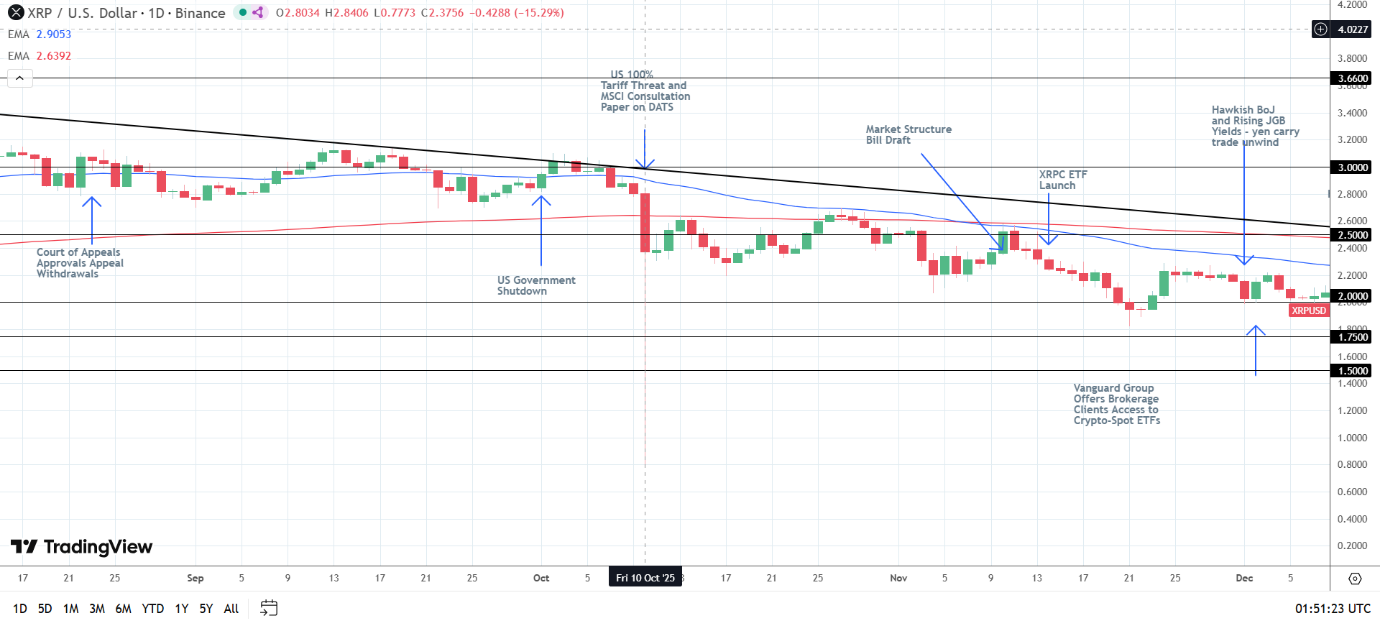
Market Structure Bill Chatter Weighs on XRP Demand
While markets reacted to the escalation in the US-EU trade war, analysts continued to criticize the efforts of US banks to block stablecoin rewards.
Last week, Coinbase (COIN) withdrew its support for the US Senate Banking Committee’s draft text of the Market Structure Bill. The Banking Committee responded by postponing its markup vote on the draft text, kick-starting XRP’s retreat. Coinbase CEO Brian Armstrong referenced text relating to stablecoin rewards, stating:
“Draft amendments that would kill rewards on stablecoins, allowing banks to ban their competition.”
US banks have warned that crypto legislation permitting stablecoin rewards could trigger more than $6 trillion in deposit outflows from the US banking system. The debate continued over whether US banks’ push to block stablecoin rewards is competition-related or protection-related.
Bloomberg Intelligence ETF Analyst James Seyffart commented on US banks’ concerns over stablecoin rewards, stating:
“I don’t fully understand the Banks’ argument here. There are so many high yield savings accounts out there that offer 3% or more. Betterment, Marcus/Goldman, CIT, SoFi, Amex, Wealthfront, etc. How are these not the same pressure on<0.1% yield deposits as stablecoin yields?”
XRP Remains Highly Sensitive to Regulatory Developments
Recent price action has highlighted XRP’s sensitivity to developments in crypto-related legislation.
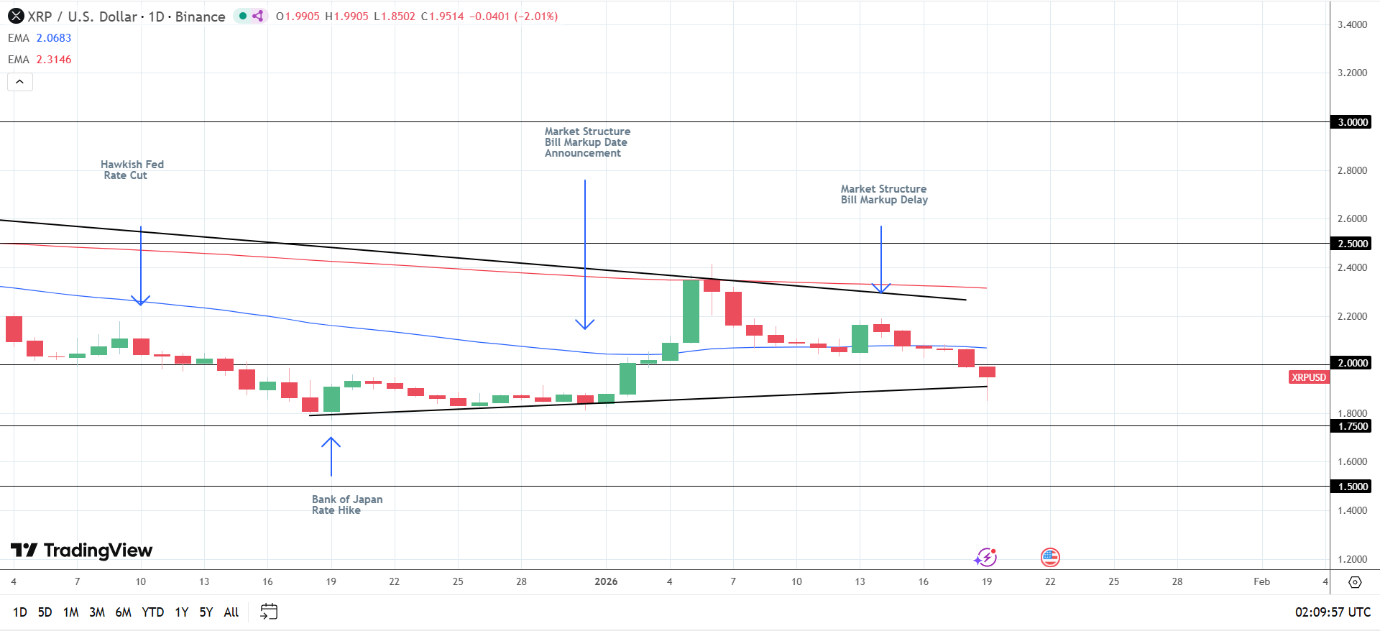
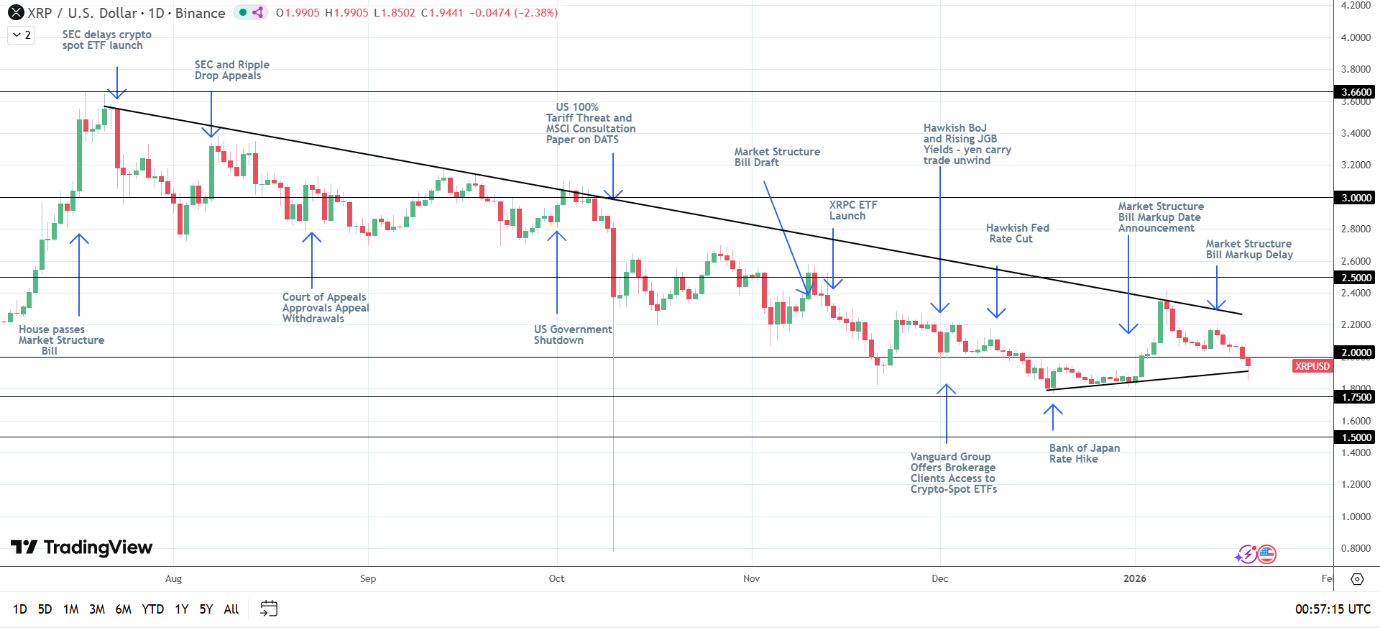
XRP rallied from $1.8103 on December 31 to a January 6 high of $2.4151 in response to the Banking Committee announcing a January 15 markup vote on the draft text. However, XRP has fallen to a January 19 low of $1.8502 following the Banking Committee’s postponement of the markup vote.
Despite the delays to the markup vote, optimism over US lawmakers delivering much-needed crypto legislation supports a bullish medium-term price outlook for XRP.
Coinbase CEO Brian Armstrong fueled the optimism after withdrawing support for the draft text, stating:
“I’m actually quite optimistic that we will get to the right outcome with continued effort. We will keep showing up and working with everyone to get there.”
XRP Price Forecast: Short-, Medium-, and Long-Term Targets
Strong demand for XRP-spot ETFs, the progress of the Market Structure Bill, and increased XRP utility reaffirm a cautiously positive short-term outlook (1-4 weeks), with a $2.5 price target.
Furthermore, hopes that US lawmakers will pass crypto-friendly legislation reinforced the bullish longer-term price targets:
- Medium-term (4-8 weeks): $3.0.
- Longer-term (8-12 weeks): $3.66.
Key Downside Risks to the Bullish XRP Outlook
Several events could change the positive outlook. These include:
- The Bank of Japan announces a hawkish neutral interest rate (potentially 1.5%-2.5%), signaling multiple rate hikes. A higher neutral rate could trigger a yen carry trade unwind, mirroring price action in mid-2024. A yen carry trade unwind would invalidate the short-term outlook.
- US economic indicators and the Fed are dampening expectations of an H1 2026 rate cut.
- US lawmakers roadblock the Market Structure Bill, delaying crypto legislation.
- XRP-spot ETFs report outflows.
These events would likely weigh on sentiment, sending XRP below $1.85, which would signal a bearish trend reversal.
Technical Analysis: Levels to Watch
XRP slid 3.4% on Sunday, January 18, following the previous day’s 0.27% loss, closing at $1.9915. The token faced heavier selling pressure than the broader crypto market cap, which declined 1.60%.
A five-day losing streak left XRP below its 50-day and 200-day EMAs, signaling a bearish bias. However, the bullish fundamentals continue to offset technicals, limiting the downside.
Key technical levels to watch include:
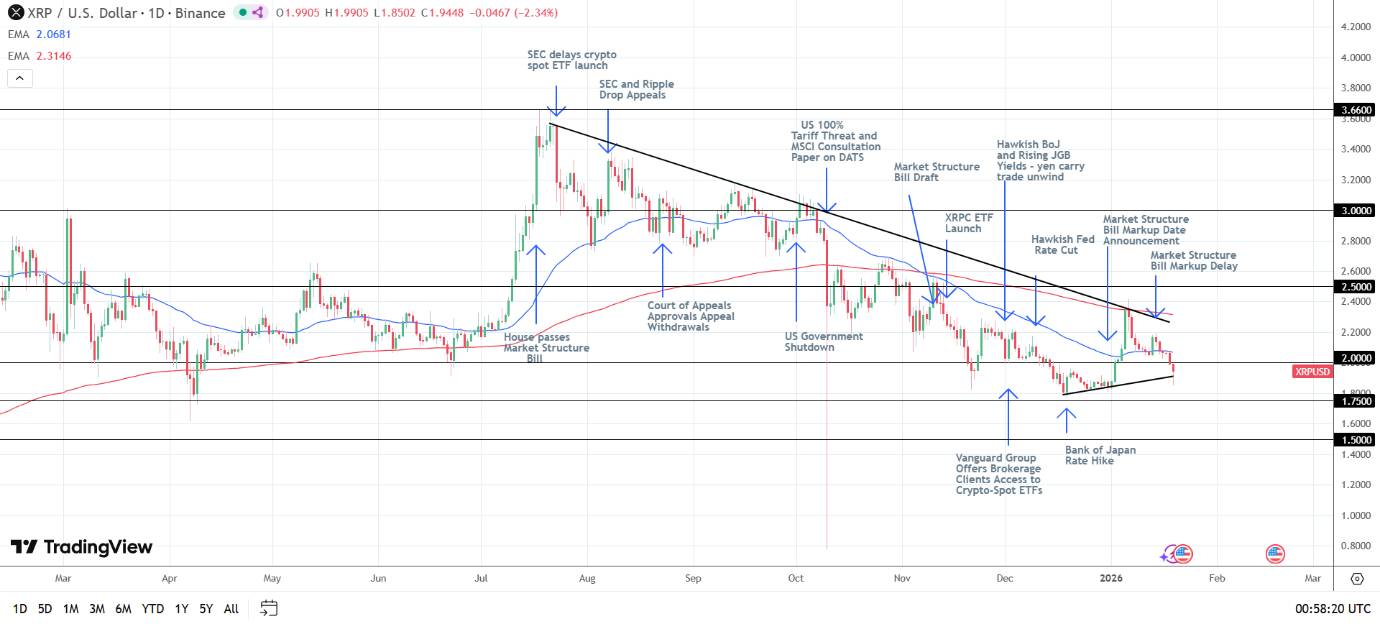
- Support levels: $1.85, $1.75, and then $1.50.
- 50-day EMA resistance: $2.0681.
- 200-day EMA resistance: $2.3146.
- Resistance levels: $2.0, $2.5, $3.0, and $3.66.
Viewing the daily chart, a break above $2.0 would bring the 50-day EMA into play. A sustained move through the 50-day EMA would indicate a near-term bullish trend reversal. A bullish trend reversal would open the door to testing $2.2. A breakout above $2.2 would enable the bulls to target the 200-day EMA.
Significantly, a breakout above the EMAs would reaffirm the bullish medium- and longer-term price targets.
Fundamental Drivers That Could Move XRP Near Term
Near-term price drivers include:
- XRP-spot ETF flows.
- US economic data and the Fed’s rate path.
- US crypto-related regulatory developments on Capitol Hill.
Holding Above $1.85 Is Critical for XRP’s Bullish Structure
Holding above $1.85 will be crucial for the short- to medium-term outlook. Positive fundamentals, including spot ETF demand and increased XRP utility, continue to counter bearish technicals, indicating a near-term recovery. The token’s recovery from a December low of $1.7712 and January gains of 6.25% reaffirmed the bullish structure and short- to medium-term price projections.
A breakout above $2.0 would pave the way toward the upper trendline. A sustained move through the upper trendline would affirm the bullish trend reversal and validate the bullish structure, supporting the price targets:
- Medium-term (4-8 weeks): $3.0.
- Longer-term (8–12 weeks): target of $3.66.
However, a sustained fall below the lower trendline would invalidate the bullish structure, signaling a bearish trend reversal.
XRP Outlook Hinges on Tariff Developments, Capitol Hill, and Central Banks
Looking ahead, trade developments and crypto-related regulatory headlines are likely to influence XRP’s price outlook.
Traders should closely monitor trade developments. Additionally, updates from the Banking Committee and Agriculture Committee will be key. This week, the Agriculture Committee will release its draft text on the Market Structure Bill. The Agriculture Committee has scheduled a markup vote on January 27.
Meanwhile, central bank chatter and XRP-spot ETF flow trends will also influence the near-term price outlook.
Increased bets on a March Fed rate cut, and a dovish BoJ neutral rate (potentially 1%-1.25%) would lift sentiment. Strong demand for XRP-spot ETFs and positive crypto-related news from Capitol Hill would reinforce the constructive bias.
In summary, these scenarios support a medium-term (4–8 weeks) move to $3.0. Meanwhile, a March Fed rate cut and the Senate passing the Market Structure Bill would reaffirm the longer-term (8–12 weeks) price target of $3.66.
Looking beyond the 12-week time horizon, these events are likely to drive XRP to its all-time high of $3.66 (Binance). A break above $3.66 would support a 6- to 12-month price target of $5.