The US XRP-spot ETF market’s inflow streak extended to 15 consecutive sessions on Friday, December 5. However, inflows weakened for the fourth trading day, suggesting waning institutional demand.
Softer inflows into spot ETFs weighed on demand for XRP, leaving the token hovering at the $2.0 psychological support level on Saturday, December 6. XRP failed to break $2.2 resistance this week, triggering a bout of profit-taking that left the token down 4.73% for the current week.
However, extended inflows, contrasted with the US BTC-spot ETF market’s weekly outflows of $87.7 million, support a bullish short- to medium-term outlook for XRP.
Below, I will explore the key drivers behind recent price trends, the medium-term (4-8 week) outlook, and the key technical levels traders should watch.

XRP-Spot ETF Inflow Streak Extends to Fifteen
The US XRP-spot ETF market saw net inflows of $10.23 million on Friday, December 5, taking the since-launch haul to $897.35 million. Key flow trends included:
- Canary XRP ETF (XRPC) topped the Friday table with $4.97 million in net inflows.
- Benefiting from a first-to-market advantage, Canary XRP ETF (XRPC) also leads the inflows since launch, with net inflows of $363.85 million.
- The US XRP-spot ETF market underperformed the BTC-spot ETF market, which saw net inflows of $54.8 million on Friday, December 5.
- XRP-spot ETF issuers saw net inflows of $230.73 million in the reporting week ending December 5.
XRP-spot ETF flow trends support a bullish short- to medium-term price outlook, with key regulatory developments likely to fuel institutional and retail demand.
Bitcoin Price Forecast
Every new Bitcoin analysis as it publishes, today's technical signal and key levels, live price — on one page.
See all Bitcoin forecasts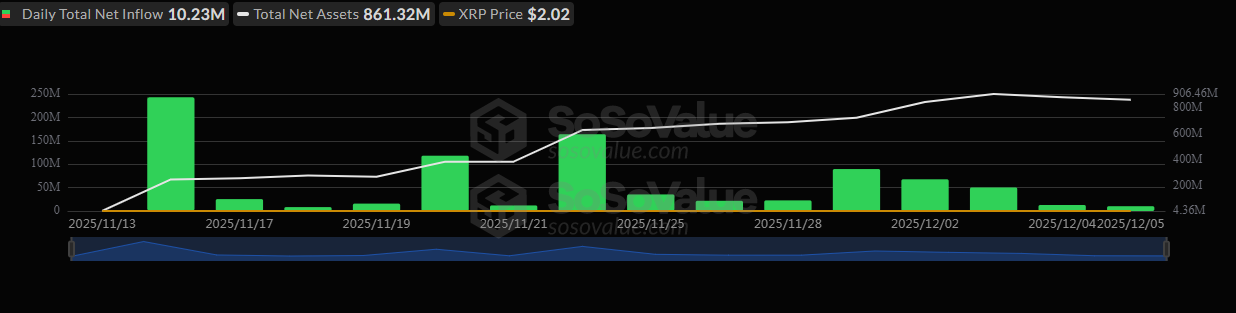
Market Structure Bill Key to XRP Price Trajectory
The Market Structure Bill’s progress on Capitol Hill remains a key price catalyst as 2025 draws to a close. Senate Banking Chairman Tim Scott (R-SC) reportedly signaled the prospect of holding a market structure markup on December 17-18.
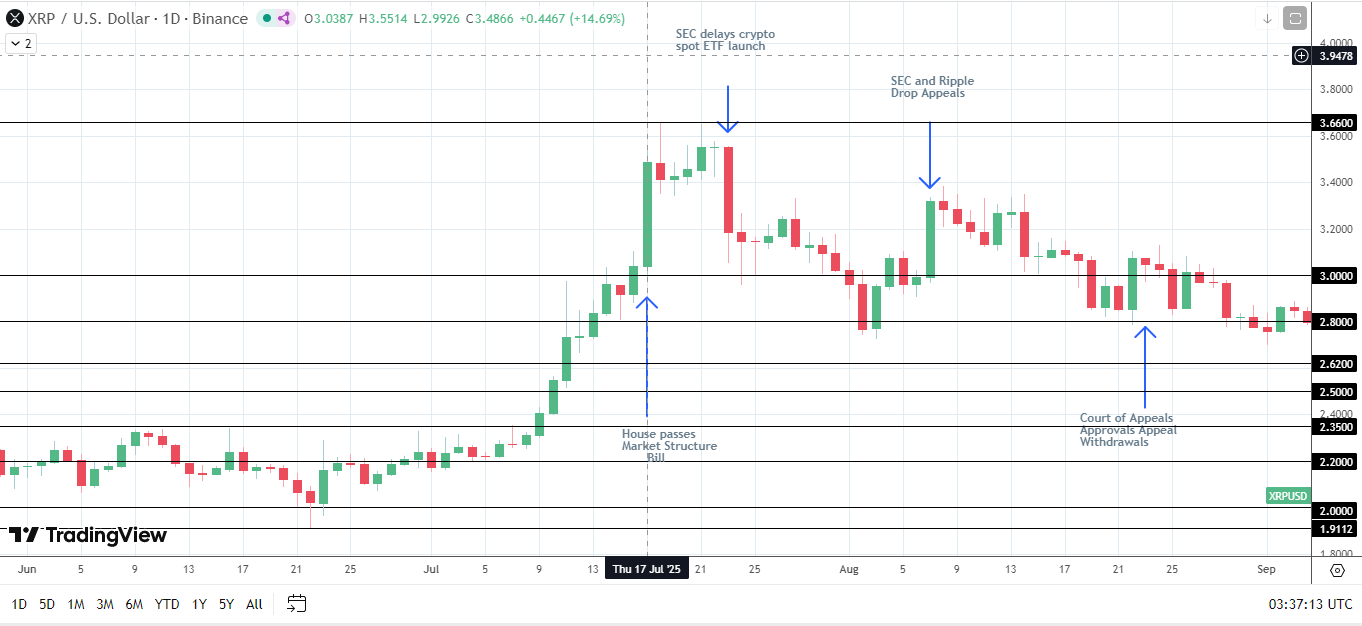
XRP soared 14.69% on July 17 after the US House of Representatives passed the Market Structure Bill to the Senate. The price action underscored the significance of crypto-friendly legislative developments on demand for XRP.
The token’s sensitivity to crypto-regulated developments stems from the SEC vs. Ripple case. The case officially ended after the US Court of Appeals approved Ripple and the SEC’s appeal withdrawal requests on August 23.
Notably, the Market Structure Bill’s slow progress on Capitol Hill contributed to XRP’s pullback from July’s all-time high of $3.66.
Fed Rate Cut and Economic Projections Loom
While the Market Structure Bill’s slow progress has been a headwind for XRP, expectations of a Fed rate cut have cushioned the downside.
Economists expect the Fed to cut rates by 25 basis points on Wednesday, December 10. Lower borrowing costs would likely boost demand for risk assets such as XRP. Barring a surprise rate hold, the FOMC Economic Projections will likely be the key event mid-week.
Downward revisions to inflation, upward adjustments to unemployment, and a more dovish Fed rate path would lift sentiment. However, uncertainty remains about the Fed’s policy outlook, given ongoing concerns about tariff-fueled inflation and a resilient labor market.
Typically, the FOMC Economic Projections are a major market event. However, Fed Chair Powell’s imminent departure and the annual recomposition of FOMC voting members may water down the effect of any hawkish projections on sentiment.
Ultimately, a Fed rate cut and forecasts for two to three rate cuts in 2026 would likely boost demand for XRP. According to the CME FedWatch Tool, there is an 86.2% chance of a December cut, with a 76.9% probability of a July cut.
Yen Carry Trade Unwind Risks Linger
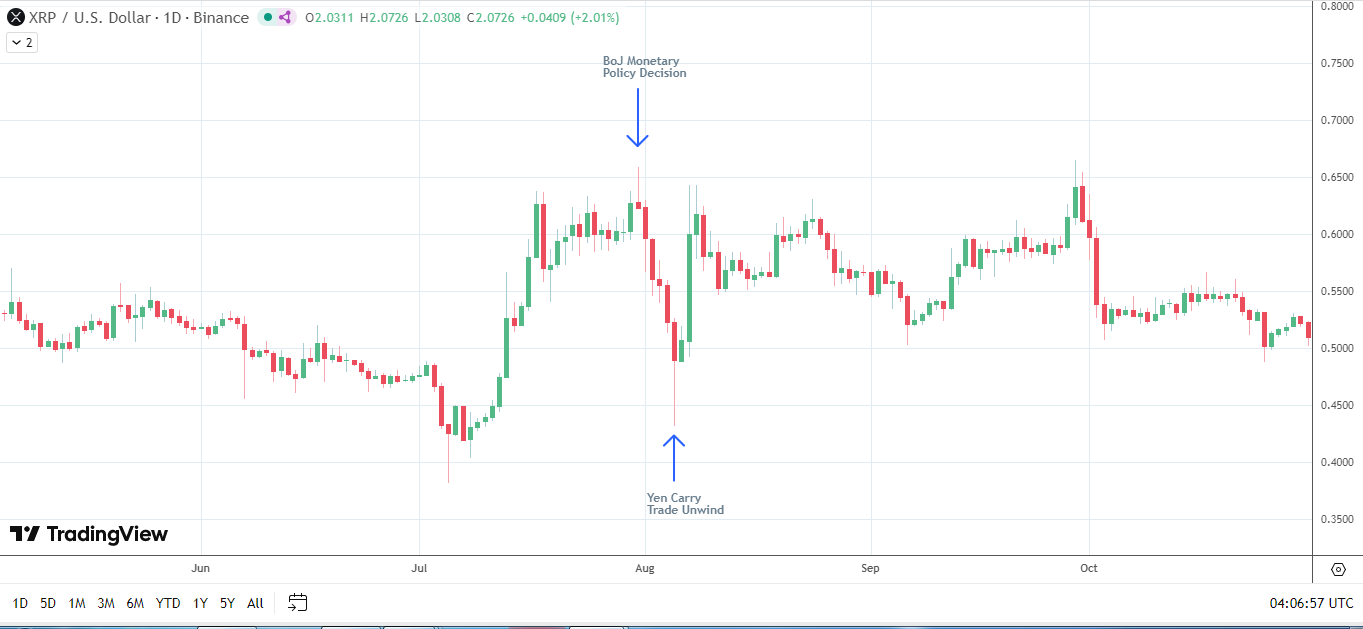
However, XRP and the broader market face a potential curveball, leaving investors cautious. Market bets on a Fed rate cut coincide with expectations of a December Bank of Japan rate hike. In July 2024, the BoJ cut purchases of Japanese Government Bonds (JGBs) and raised interest rates, triggering a yen carry trade unwind.
For context, higher yen borrowing costs and a narrowing US-Japan rate differential lead to selling risk assets and the buying back of the yen to repay cheap yen-based loans, defined as a yen carry trade unwind.
XRP slid from $0.6591 on July 31, 2024, to $0.4320 on August 5, 2024, before steadying, underscoring the effects of BoJ policy decisions on markets.
Bullish Medium-Term Outlook Intact
While the yen carry trade unwind risks linger, several key price events may act as tailwinds for XRP, including:
- Broadening investor access to spot ETFs.
- The progress of crypto-friendly legislation, including the Market Structure Bill.
- December and March Fed rate cut expectations.
In my view, these price catalysts support a near-term (1-4 weeks) move to $2.35 and a medium-term (4-8 weeks) climb toward $3.
Downside Risks to Bullish Outlook
Despite the bullish short- to medium-term outlook, several headwinds threaten the outlook. These include:
- The Bank of Japan and the Fed’s monetary policy decisions and forward guidance trigger a yen carry trade unwind.
- The MSCI delists digital asset treasury companies (DATs). Delistings could reduce demand for XRP as a treasury reserve asset.
- Delays to a Senate vote on the Market Structure Bill.
- OCC rejects Bitcoin’s application for a US-chartered banking license.
- XRP-spot ETFs report extended outflows.
These events could push XRP below $2, exposing the November low of $1.82 before a longer-term return to $3.
Despite the headwinds, in my opinion, resilient demand for XRP-spot ETFs, progress toward a crypto-friendly regulatory environment, and a dovish Fed will likely support a move toward $3.
In summary, the short-term outlook remains cautiously bullish, while the medium- to longer-term outlook is constructive.
Financial Analysis
Technical Outlook: EMAs Signal Caution
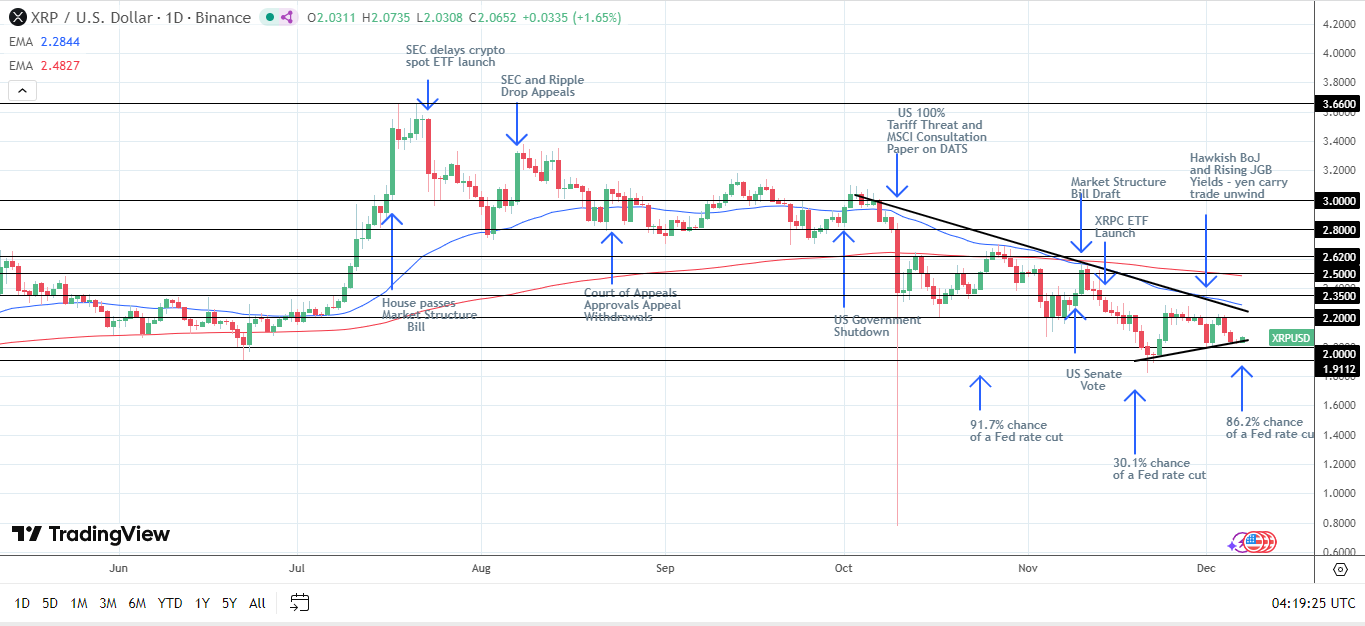
XRP slipped 0.22% on Saturday, December 6, following the previous day’s 2.9% loss, closing at $2.0317. Notably, the token underperformed the broader crypto market, which rose 0.07%.
A three-day losing streak left XRP trading below the 50-day and 200-day Exponential Moving Averages (EMAs), reaffirming a bearish bias. However, fundamentals are shifting from the technical trend, supporting a bullish outlook.
Key technical levels to watch include:
- Support levels: $2, $1.9112, and $1.8239
- 50-day EMA resistance: $2.2844.
- 200-day EMA resistance: $2.4827.
- Resistance levels: $2.2, $2.35, $2.5, $2.62, $2.8, $3.0, and $3.66.
Avoiding a drop below the $2.0 psychological support level would support a move to the 50-day EMA. A sustained break above the 50-day EMA would bring the $2.35 resistance level into play.
Notably, a break above the 50-day EMA would indicate a near-term bullish trend reversal. A bullish trend reversal would support a medium-term (4-8 weeks) climb to the 200-day EMA and the $2.5 level.
Fundamental Indicators: Corporate Signals, Policy Decisions
Near-term price drivers include:
- XRP-spot ETF daily flow trends.
- Blue-chip companies’ views on XRP as a treasury reserve asset.
- Regulatory milestones: Ripple’s application for a US-chartered bank license, the progress of the Market Structure Bill on Capitol Hill.
- MSCI’s decision on DAT listings.
- The Fed and the BoJ’s interest rate decisions and policy outlooks.
Bullish Structure: What Happens if $2.0 Holds?
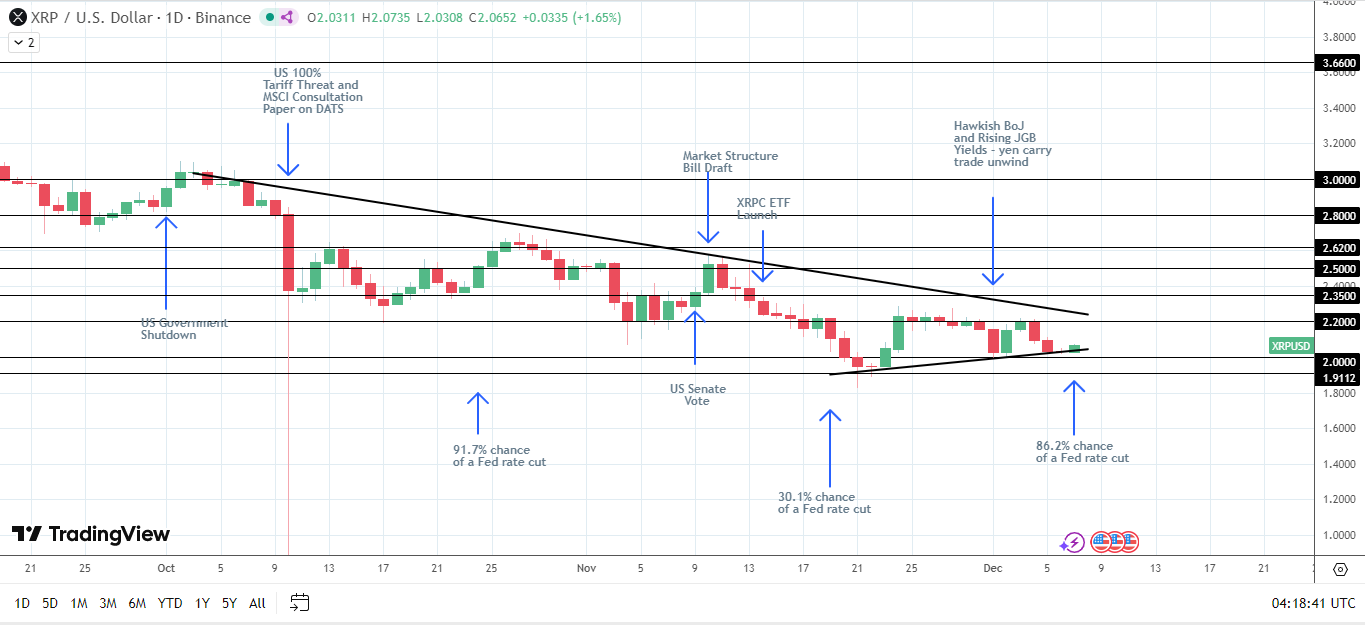
Holding above $2.0 and the lower trendline would support a move toward the upper trendline. Breaking resistance at the upper trendline would support the medium-term $2.5 price target and a longer-term (8-12 weeks) $3 projection.
However, a move below $1.8239 would invalidate the medium-term bullish structure.
Outlook: $2.0 Support Key to Medium-Term Outlook
XRP will face a crucial week ahead, with the $2.0 psychological support level firmly in play. Spot ETF inflows will be pivotal for near-term price trends. Strong inflows, a dovish Fed rate cut, and bipartisan support for the Market Structure Bill are likely to kickstart the next XRP rally.
Holding above $2.0 will be key ahead of the upcoming week’s main events.