
XRP took another plunge on Wednesday, December 17, as yen carry trade unwind fears triggered a crypto sell-off.
10-year Japanese Government Bond (JGB) yields soared to a session high of 1.983%, their highest level since April 2007. Upbeat Japanese trade data bolstered expectations of a Bank of Japan rate hike on Friday, December 19, sending JGB yields higher.
Yen carry trade unwind jitters overshadowed strong institutional demand through spot ETFs and positive updates on the Market Structure Bill.
Crucially, JGB yield trends ahead of the BoJ monetary policy decision support a cautiously bearish short-term outlook. Meanwhile, the medium-term outlook remains bullish.
Below, I will explore the key drivers behind recent price trends, the medium-term (4-8 weeks) outlook, and the key technical levels traders should watch.

JGB Yields Surge and Yen Carry Trade Fears
Traders have long memories, and the jump in 10-year JGB yields has made markets edgy. While economists expect a 25-basis-point rate hike, there is uncertainty about the BoJ’s neutral interest rate. The neutral interest rate is where rates are neither accommodative nor restrictive.
Last week, BoJ Governor Kazuo Ueda stated that he would share the neutral rate once consensus amongst policymakers had narrowed. The neutral rate is crucial for yen carry trades and market liquidity.
A higher neutral rate would mean a narrower US-Japan interest rate differential, making yen-funded leveraging positions less profitable. A stronger yen would send USD/JPY lower, adding to potential losses, forcing traders to exit levered positions in US assets.
The chart for 10-year JGB yields and XRP has underscored market jitters about narrowing US-Japan rate differentials since September. See the chart below for reference.
Bitcoin Price Forecast
Every new Bitcoin analysis as it publishes, today's technical signal and key levels, live price — on one page.
See all Bitcoin forecasts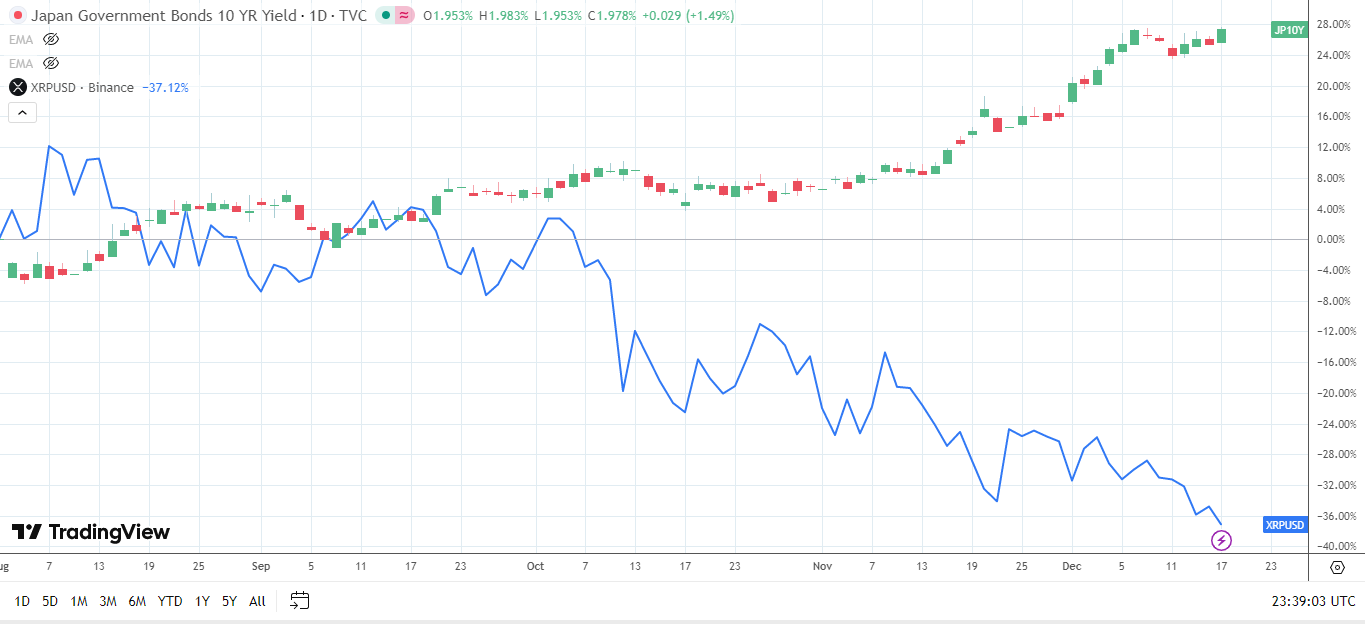
Lessons from the Mid-2024 Yen Carry Trade Unwind
Concerns about a rerun of the mid-2024 yen carry trade unwind event, and the XRP sell-off have fueled the inverse correlation between XRP and 10-year JGB yields.
For context, the Bank of Japan cut JGB purchases on July 31, 2024. This was expected. However, the BoJ also raised interest rates by 25 basis points to 0.5%. This was unexpected.
The yen strengthened on anticipation of the cut to JGB purchases in the run-up to the July 31, 2024, decision, and in response to the rate hike. Crucially, USD/JPY plunged from a July 2024 high of 161.951 to 152.643 on the eve of the BoJ decision, then to 141.684 on August 5.
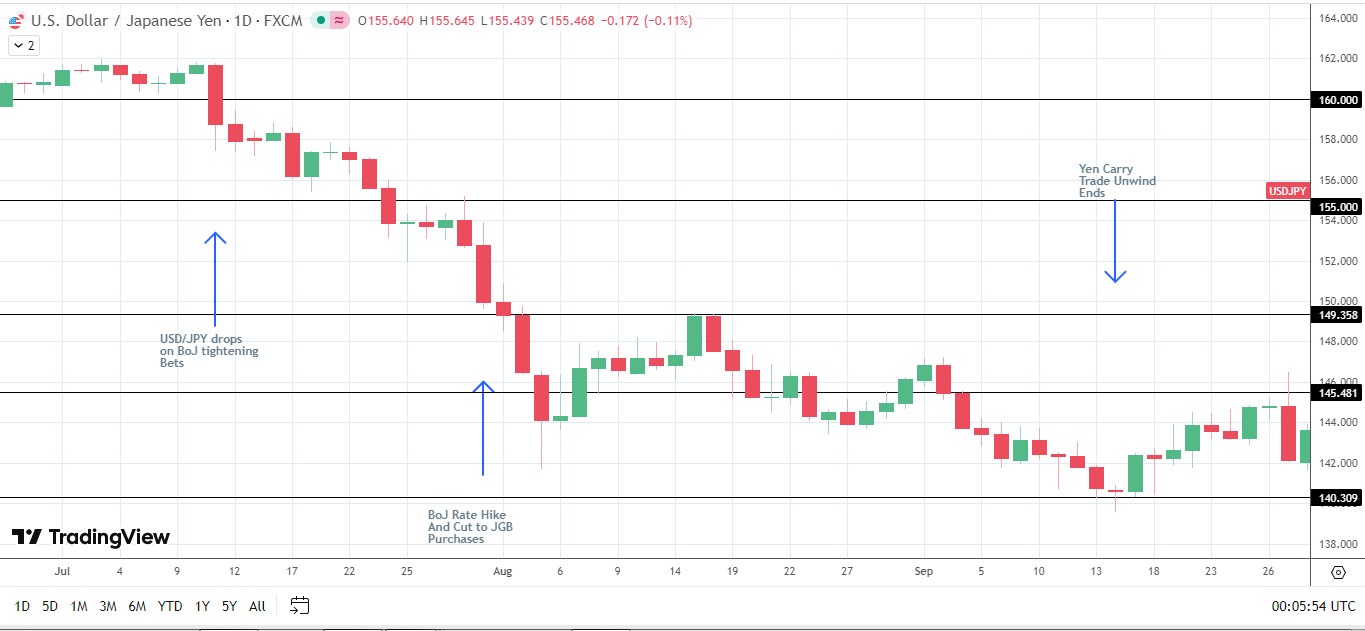
The USD/JPY plunge triggered a yen carry trade unwind, forcing traders to exit levered positions and repay yen-denominated loans. Repaying yen loans eventually sent USD/JPY to a September 16, 2024, low of 139.576.
XRP plunged from $0.6591 on July 31, 2024, to $0.4320 on August 5, 2024, logging a 34.5% loss.
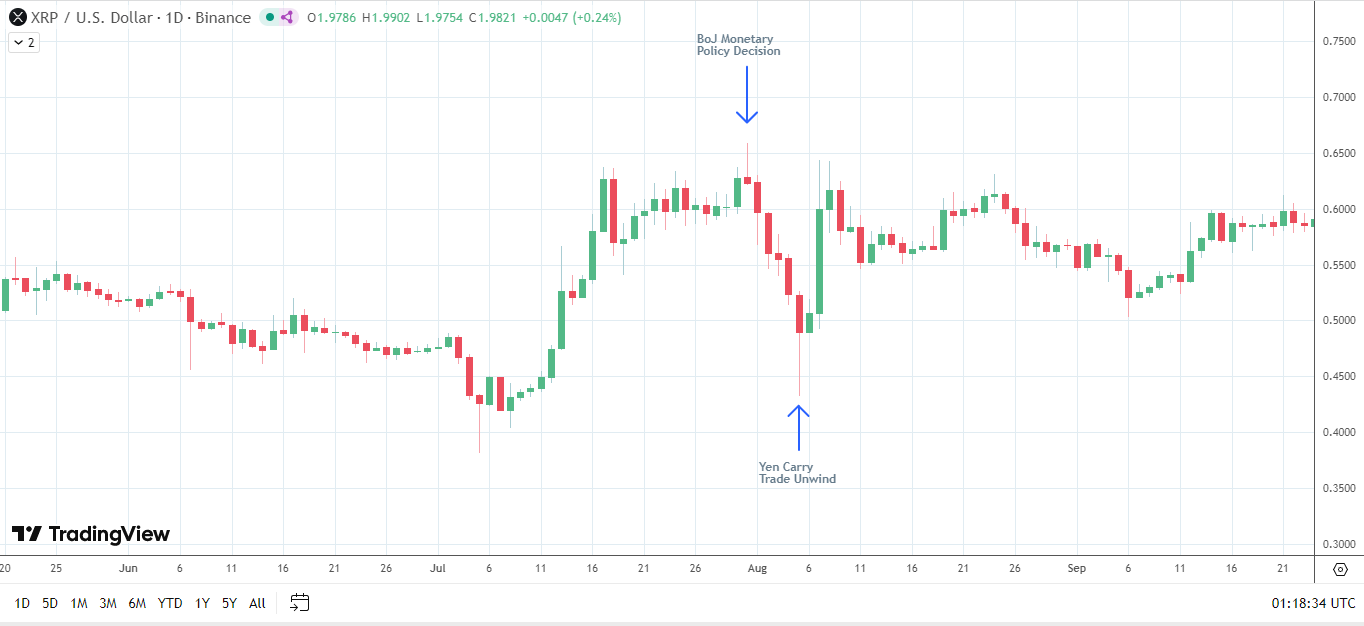
Market jitters over the threat of a BoJ-induced sell-off support the bearish short-term outlook for XRP, exposing the November 21 low of $1.8239.
XRP-Spot ETF Inflows Cushion Downside Risk
A potential yen carry trade unwind hasn’t dented institutional demand for XRP-spot ETFs. The US XRP-spot ETF market reported net inflows of $8.54 million on Tuesday, December 16, bringing total net inflows to $1.01 billion. A 22-day inflow streak underscored robust institutional demand, supporting a bullish medium- to longer-term price outlook.
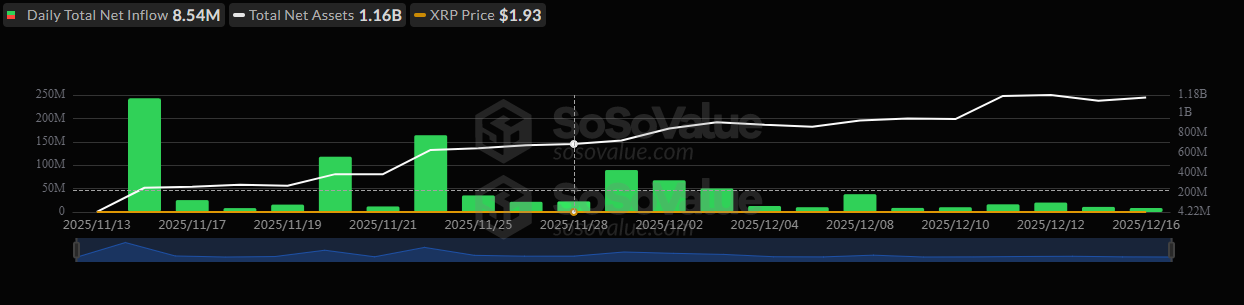
Notably, more XRP-spot ETFs are set to launch in the new year, including WisdomTree’s XRP ETF (XRPW). A bigger spot ETF playing field may draw more institutional inflows, crucial for the token’s longer-term price trajectory.
Medium- and Long-Term Outlook Remains Constructive
Robust XRP-spot ETF inflows and the imminent launch of new spot ETFs set the stage for a bullish outlook for XRP. The Market Structure Bill’s progress on Capitol Hill remains another tailwind, supporting a bullish medium- and longer-term price outlook.
In the near term, the BoJ monetary policy decision will be the key driver. However, traders should closely monitor US economic data and FOMC members’ rhetoric to consider the timeline for a Fed rate cut. On Thursday, December 18, the US CPI report will fuel speculation about a March cut.
Economists expect the annual inflation rate to rise from 3.0% in September to 3.1% in November. There were no October figures because of the US government shutdown. Higher inflation would temper bets on a March rate cut.
A more hawkish Fed policy stance would weigh on sentiment ahead of the BoJ decision on Friday, December 19.
Given the current market dynamics, the short-term (1-4 weeks) outlook remains cautiously bearish. Meanwhile, the medium-term (4-8 weeks) and longer-term (8-12 weeks) outlooks remain bullish, with price targets of $2.5 and $3.0, respectively.
Downside Risks to the Bullish Scenario
Several scenarios could derail the bullish medium- and long-term outlooks. These include:
- The Bank of Japan raises interest rates and signals multiple rate hikes in 2026.
- US inflation rises more than expected, indicating a more hawkish Fed policy stance.
- The MSCI delists digital asset treasury companies (DATs). Delistings would likely reduce interest in XRP as a treasury reserve asset.
- US Senate challenges the Market Structure Bill.
- XRP-spot ETFs report outflows.
These scenarios would likely send XRP toward the November low of $1.8239, supporting the bearish short-term outlook.
Nevertheless, resilient XRP-spot ETF inflows, increased XRP utility, and the Market Structure Bill’s progress support a longer-term move to $2.5. A return to $2.5 would bring $3 into play.
In summary, the short-term outlook remains cautiously bearish as fundamentals and the technicals align. Meanwhile, the medium- to longer-term outlooks are constructive.
Financial Analysis
Technical Outlook: EMAs Signal Caution
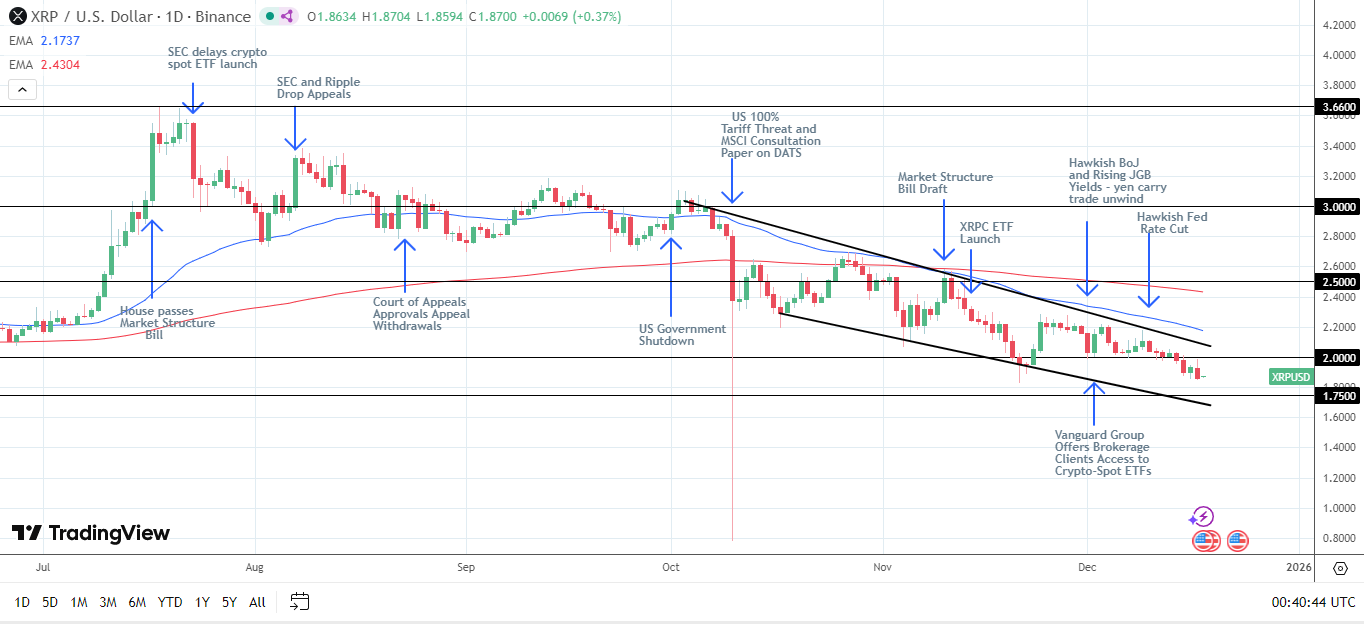
XRP slid 3.49% on Wednesday, December 17, following the previous day’s 1.64% loss, closing at $1.8631. The token faced heavier losses than the broader crypto market, which declined 2.39%.
Wednesday’s loss left XRP well below the 50-day and 200-day Exponential Moving Averages (EMAs), signaling a bearish bias.
Key technical levels to watch include:
- Support levels: The November 21 low of $1.8239 and then, $1.75.
- 50-day EMA resistance: $2.1737.
- 200-day EMA resistance: $2.4304.
- Resistance levels: $2, $2.5, $3.0, and $3.66.
Looking at the daily chart, a drop below the November 21 low of $1.8239 would expose the $1.75 support level. A sustained fall through $1.75 would reinforce the bearish short-term outlook.
However, a breakout above the $2 psychological level would pave the way toward the 50-day EMA. A sustained move through the 50-day EMA would signal a near-term bullish trend reversal.
A bullish trend reversal would indicate a medium-term (4-8 weeks) climb toward the 200-day EMA and $2.5. A break above the EMAs would reinforce the medium-term outlook, and a longer-term (8-12 weeks) $3.0.
Fundamental Indicators: BoJ, US Data ETF Demand, and Crypto Legislation
Near-term price drivers include:
- XRP-spot ETF flow trends.
- Crypto-related regulatory developments on Capitol Hill.
- US inflation data and March Fed rate cut bets.
- The BoJ’s interest rate decisions and the neutral interest rate.
Bullish Structure: What Happens if XRP Reclaims $2.0?
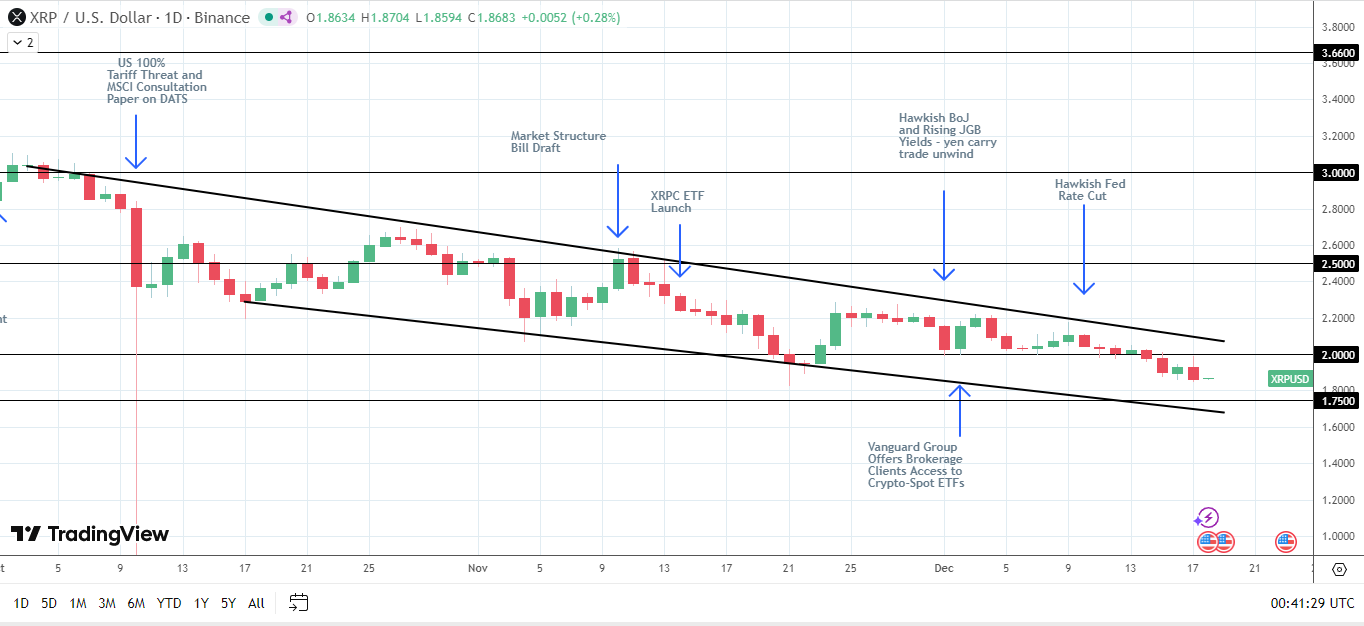
Failure to break above the $2.0 level would leave the November 21 low of $1.8239 in play. A sustained fall below $1.8239 would enable the bears to target the $1.75 support level and the lower trendline. Breaching the lower trendline would reaffirm a bearish trend reversal.
However, a breakout above the $2.0 handle would open the door to retesting the upper trendline. A sustained move through the upper trendline would support the bullish medium-term (4–8 weeks) target of $2.5 and longer-term (8–12 weeks) target of $3.0.
Importantly, rejection at the $2.0 psychological level and a drop below $1.75 and the lower trendline would invalidate the bullish medium-term outlook.
Outlook: $2.0 Remains the Pivot Level
Looking ahead, US inflation data, the BoJ’s monetary policy decision and neutral rate, and XRP-spot ETF flows will influence near-term trends.
Hotter inflation and XRP-spot ETF outflows are likely to exacerbate the effects of a hawkish BoJ.
To summarize, a hawkish BoJ rate hike would support a near-term drop toward $1.75. A break below $1.75 would affirm the near-term bearish trend reversal.
However, strong demand for XRP-spot ETFs and crypto-related legislative developments support a medium-term (4–8 weeks) move to $2.5. A March Fed rate cut and the Senate passing the Market Structure Bill would reinforce the longer-term (8–12 weeks) price target of $3.0.