
The Bank of Japan released its Summary of Opinions from December’s monetary policy meeting (MPM) on Monday, December 29, signaling a hawkish rate path. 10-year Japanese Government Bond (JGB) yields briefly climbed to 2.6%, sending USD/JPY down 0.30% to 156.031 on the day. Rising 10-year JGB yields and the stronger yen fueled fears of a yen carry trade unwind.
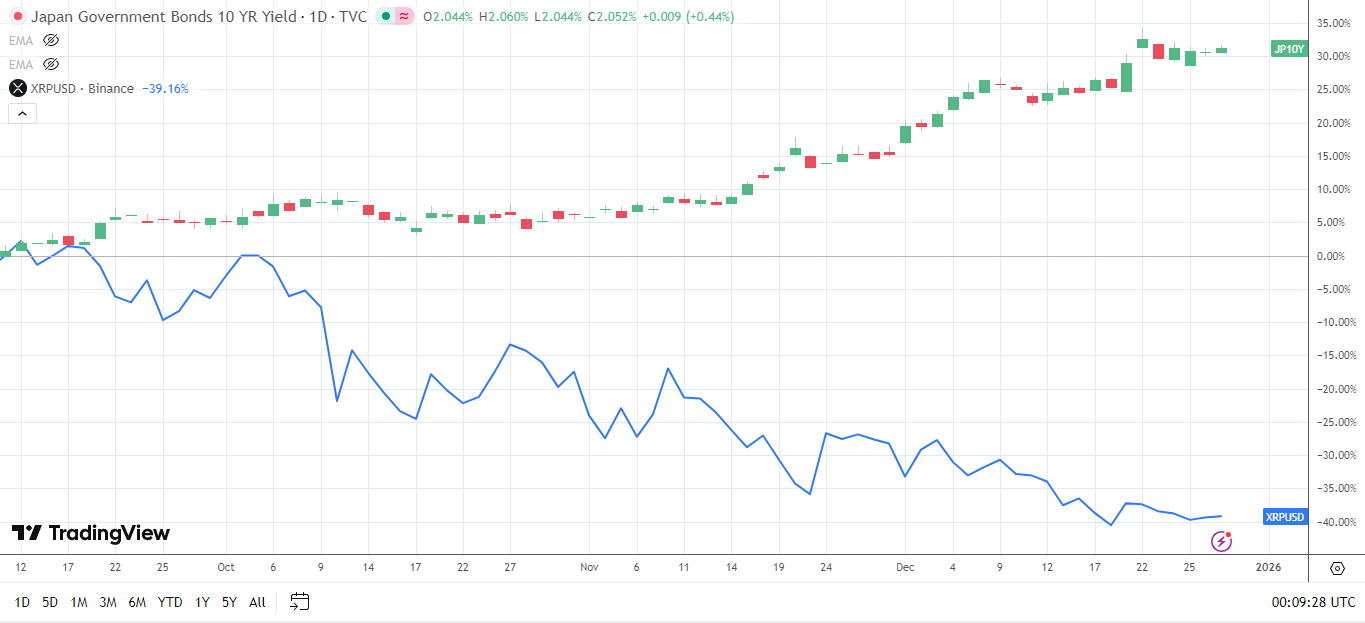
The upswing in yields left XRP in the red as the token’s inverse correlation with 10-year JGB yields remained intact, despite bullish fundamentals. The BoJ and the Fed’s rate paths remain key drivers for XRP price trends.
However, robust institutional demand and progress toward a crypto-friendly regulatory backdrop continued to support a bullish short- to medium-term price outlook for XRP.
Below, I will explore the key drivers behind recent price trends, the medium-term (4-8 weeks) outlook, and the key technical levels traders should watch.

Bank of Japan Summary of Opinions Triggers Profit Taking
The Bank of Japan raised interest rates by 25 basis points to 0.75% on December 19. XRP rallied 5.6% on the day as the BoJ’s Statement on Monetary Policy delivered a dovish policy outlook, easing fears of aggressive rate hikes and a potential yen carry trade unwind.
In contrast, the BoJ’s Summary of Opinions, providing policymakers’ views from the MPM, suggested multiple rate hikes. Notably, one policymaker supported rate hikes every few months given that there was still a sizeable distance to the neutral interest rate level.
XRP’s inverse correlation with 10-year JGB yields strengthened in September amid growing speculation over the BoJ preparing for multiple rate hikes, leaving the token down 35% in the fourth quarter.
Ripple Price Forecast
Every new Ripple analysis as it publishes, today's technical signal and key levels, live price — on one page.
See all Ripple forecastsXRP Price Analysis: Yen Carry Trade Risks Echo the Mid-2024 Selloff
For context, narrowing US-Japan rate differentials makes yen carry trades less profitable. Furthermore, rising JGB yields make Japanese assets more attractive.
These scenarios, coupled with a stronger yen, would reverse yen carry trades, drying up liquidity, and weighing on demand for risk assets such as XRP. XRP faced intense selling pressure in August 2024 after the BoJ cut JGB purchases and unexpectedly raised interest rates.
USD/JPY plunged from 161 levels ahead of the July 2024 MPM to a September 2024 low of 139.576. XRP tumbled 34.5% from the July 31, 2024, interest rate decision to an August 5, 2024, low of $0.4320. However, the yen carry trade unwind was short-lived, given the BoJ’s dovish policy outlook. XRP rebounded within a week.

Fast forward to 2025, and one BoJ policymaker is supporting multiple rate hikes, challenging the positive short- to medium-term outlook for XRP. However, December’s Summary of Opinions also highlighted caution against aggressive rate hikes, with policymakers wanting to assess the effect of December’s rate hike on the economy, prices, and financial markets.
These comments suggest that policymakers would want to avoid causing similar market disruption to the events in mid-2024. Lower bets on multiple BoJ rate hikes would weaken the yen, supporting the constructive short- to medium-term bias. USD/JPY rose 0.16% to 156.285 in early trading on Tuesday, December 30.
Medium- and Long-Term Outlook Remains Bullish
While the BoJ’s policy outlook continues to influence sentiment, legislative developments and strong demand for XRP-spot ETFs reinforce the bullish price outlook.
Given the current market dynamics, the short-term (1-4 weeks) outlook remains cautiously bullish, with a $2.0 price target. The medium-term (4-8 weeks) and longer-term (8-12 weeks) outlooks remain bullish, with price targets of $2.5 and $3.0, respectively.
Key Downside Risks Expose Bullish Outlook
Several scenarios could unravel the positive outlook. These include:
- The Bank of Japan declares a higher neutral interest rate of between 1.5% and 2.5%, signaling aggressive rate hikes.
- US economic data and the Fed are tempering bets on a March rate cut.
- The MSCI delists digital asset treasury companies (DATs). Delistings would likely dampen interest in XRP as a treasury reserve asset.
- Lawmakers oppose the Market Structure Bill.
- XRP-spot ETFs report outflows.
These scenarios would likely push the token toward $1.75, indicating a bearish trend reversal.
Technical Indicators Continue to Signal Caution
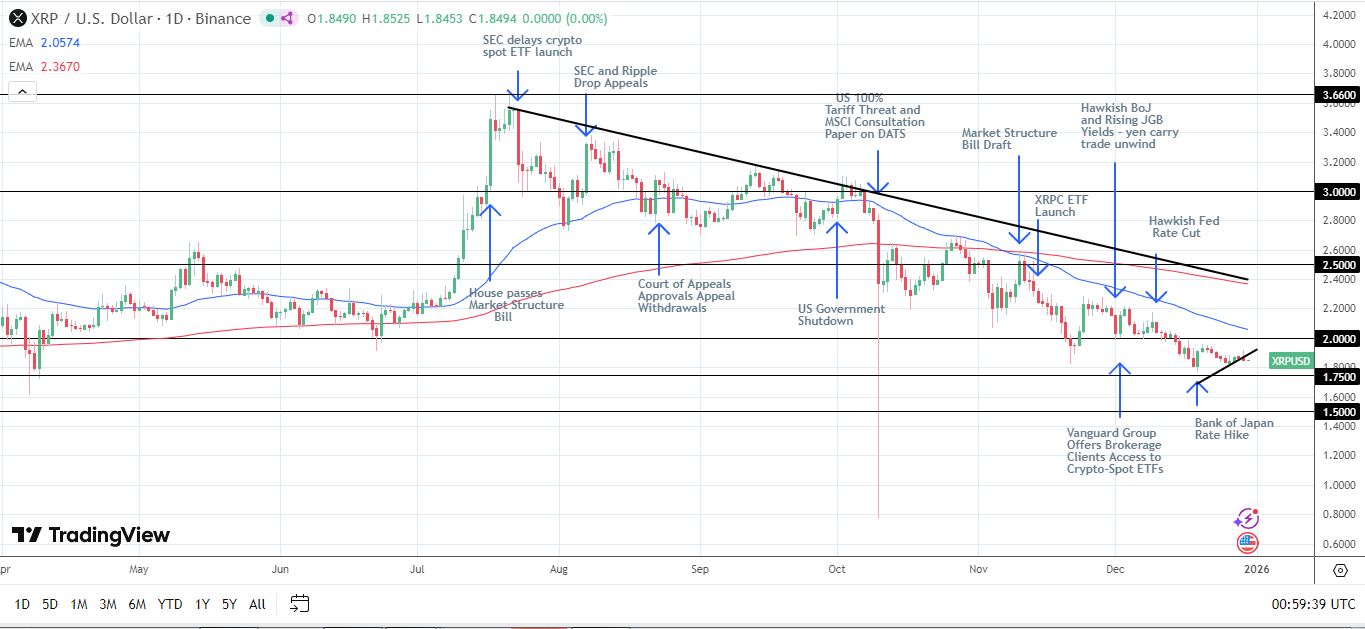
XRP fell 0.77% on Monday, December 29, following the previous day’s 0.47% loss, closing at $1.8494. The token tracked the broader crypto market, which declined 0.79%.
Monday’s loss left XRP trading below the 50-day and 200-day Exponential Moving Averages (EMAs), signaling a bearish bias. While technicals remain bearish, bullish fundamentals are evolving, countering the technical structure.
Key technical levels to watch include:
- Support levels: $1.75, and then $1.50.
- 50-day EMA resistance: $2.0574.
- 200-day EMA resistance: $2.3670.
- Resistance levels: $2, $2.5, $3.0, and $3.66.
Looking at the daily chart, a break above the $2.0 psychological level would enable the bulls to target the 50-day EMA. A sustained move through the 50-day EMA would signal a near-term bullish trend reversal, paving the way toward the 200-day EMA and the $2.5 resistance level.
A sustained break above the EMAs would reinforce the bullish medium-term outlook and the longer-term (8-12 weeks) $3.0 price target.
Fundamental Indicators: Crypto Regs, BoJ, Fed, and Spot ETFs
Near-term price drivers include:
- XRP-spot ETF flow trends.
- US economic data and March Fed rate cut bets.
- US crypto-related legislative developments.
- The BoJ’s neutral interest rate.
$2.0 Remains Key for the Bullish Structure
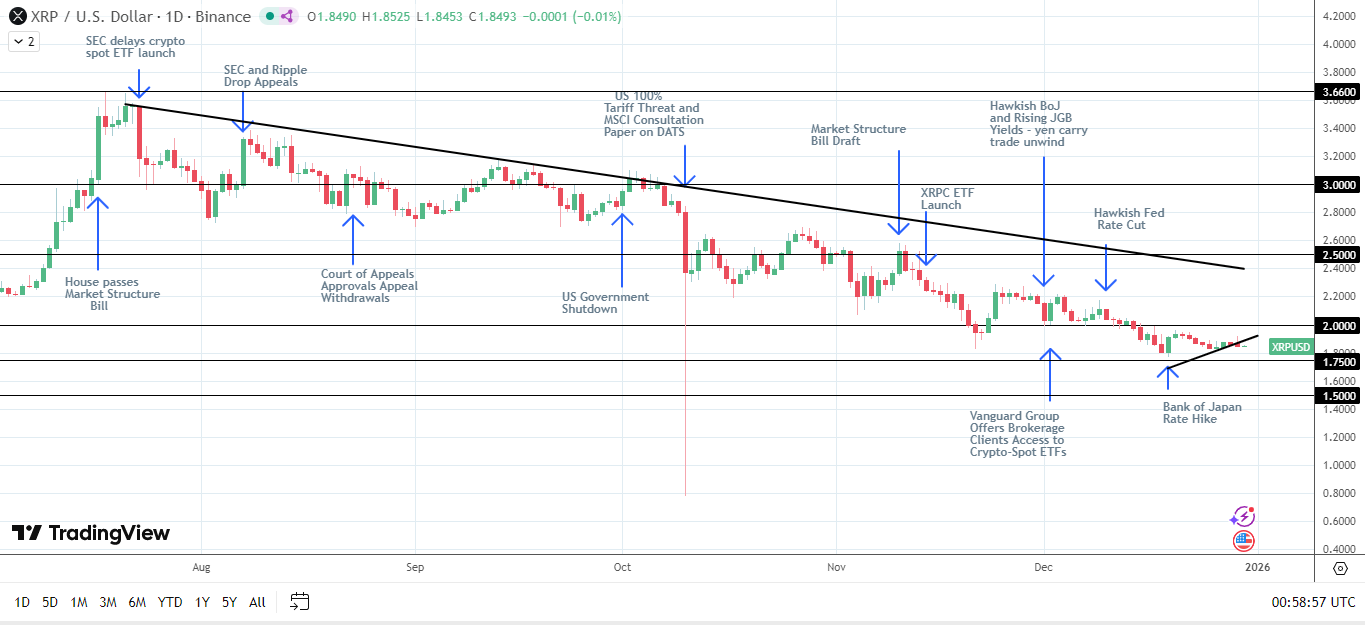
XRP has avoided a drop below $1.8 in recent sessions, supporting the bullish structure and the positive price outlook.
Reclaiming $2.0 would open the door to testing the upper trendline and the $2.5 resistance level. A sustained breakout above the upper trendline would indicate a bullish trend reversal, reaffirming the price targets.
- Medium-Term (4-8 weeks): $2.5.
- Longer-term (8–12 weeks): target of $3.0.
However, rejection at $2.0 and a sustained drop below the lower trendline would invalidate the bullish structure and signal a bearish trend reversal.
Outlook:
Looking ahead, BoJ and Fed rhetoric, US economic data, Market Structure Bill-related news, and XRP-spot ETF flows are likely to influence near-term price trends.
Increased expectations of a March Fed rate cut and a less hawkish BoJ rate path would likely lift sentiment. Strong demand for XRP-spot ETFs and bipartisan support for the Market Structure Bill would add to the bullish outlook.
In summary, increasing institutional demand for XRP-spot ETFs and crypto regulatory developments support a medium-term (4–8 weeks) move to $2.5. A March Fed rate cut and the Senate passing the Market Structure Bill would reinforce the longer-term (8–12 weeks) price target of $3.0.
Looking beyond the medium term, these positive scenarios are likely to send XRP to its all-time high $3.66 over the 6-12 month time horizon.