
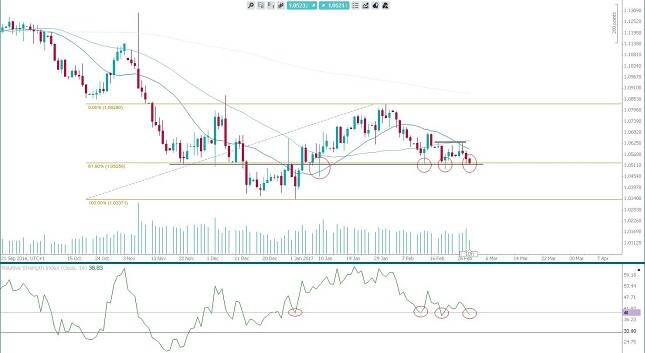
EUR/USD is flirting with 1.05, a price floor that has been holding since the start of the year. In the last gasps of 2016, the euro fell beneath 1.04 to the US dollar to reach its lowest since 2003.
If 1.05 gives way, there’s a strong chance of a breakdown below last year’s lows. The chart below shows 1.05 as support since November and as the 61.8% Fibonacci of the rally in January. The 40 level in Relative Strength Index (RSI) has also been decisive.
But the reason is not entirely economic. We interpret euro weakness as mostly political. From a purely Eurozone economic data perspective, the euro is undervalued.
Eurozone inflation for February has struck 2%, meeting the European Central Bank’s policy objective for the first time since 2013. Growth looks to have risen in the fourth quarter too. Surveys of the services and manufacturing sectors have indicated the fastest output growth in five-and-a-half years. On face value, quantitative easing should be stopped and the ECB should start preparing its first rate hike.
The Eurozone continues to lag the US in both growth and inflation. The Federal Reserve is setting the stage for its third rate hike at its March meeting. Beyond March, the ECB will be buying assets worth €60bn per month until December. The policy divergence right now is stark. The question that needs answering to determine the future direction of the euro is: Will the divergence grow or shrink?
The Fed raising rates faster than expected while the ECB continues QE at the current or a higher pace will mean more divergence. The Fed slowing its pace of rate hikes and/or the ECB tapering or stopping QE would mean less divergence.
Clearly the ECB will not act based on one month’s data, which could be an aberration, but the case for aborting its QE program has never been stronger. If inflation is still above 2% by the end of the second quarter, there is going to be significant pressure on ECB Mario Draghi to tighten monetary policy.
Whether Draghi is forced to succumb to any pressure to end the ECB’s ultra-accommodative policy stance will depend on the outcome of this year’s European elections. A win for populist candidates like Wilders in the Netherlands and Le Pen in France would likely see the ECB act to stabilise the potential upset in markets. The French election in particular could put the ECB on the defensive. Marine Le Pen has put a referendum on Eurozone membership at the heart of her Presidential campaign, making her a direct threat to the breakup of the Eurozone.
The Eurozone breakup threat from the French Presidential election is likely to mean the ECB avoids any discussion of tapering its bond-buying program. As long as the Fed hikes in March, or at least stays hawkish this should keep EUR/USD under pressure until the result of French elections in May.
However, should one of the mainstream candidates, likely Emmanuel Macron end up victorious, then the ECB will have to face up to higher inflation. If political risk subsides, economic data will be at the forefront, making a bigger rebound in EUR/USD much more likely.

This article is written by Jasper Lawler, a senior market analyst at LCG