



It’s been a quieter Eurozone economic calendar this morning. The stats didn’t help the EUR, however.
Key stats included factory orders from Germany and retail sales figures for the Eurozone.
The German Economy
In August, factory orders slumped by 7.7% versus a forecasted 2.1% decline. Orders had risen by 4.9% in July.
According to Destatis,
- The sharp decline was preceded by strong increases in the previous two months.
- Excluding major orders, a 5.1% decline in new orders in manufacturing was recorded in August 2021.
- New orders in manufacture of motor vehicles, trailers, & semi-trailers were down 12.0%.
- Issues with delivery bottlenecks of intermediate products also contributed to a 9.6% slide in the manufacture of basic metals.
- Domestic orders were down 5.2%, while foreign orders tumbled by 9.5%.
- New orders from the euro area increased by 1.6%, while orders from other countries slid by 15.2%.
The Eurozone
In August, retail sales rose by 0.3%, month-on-month, partially reversing a 2.6% slide from July. Economists had forecast a 0.8% increase.
According to Eurostat,
- Non-food product retail trade increased by 1.8%, while automotive fuel (-0.1%) and food, drinks, & tobacco (-1.7%) weighed.
- Malta (+2.7%) and Ireland (+2.5%) recorded the largest increases, while Estonia and France both saw retail sales fall by 1.2%.
- Year-on-year, retail trade remained stable.
Market Impact
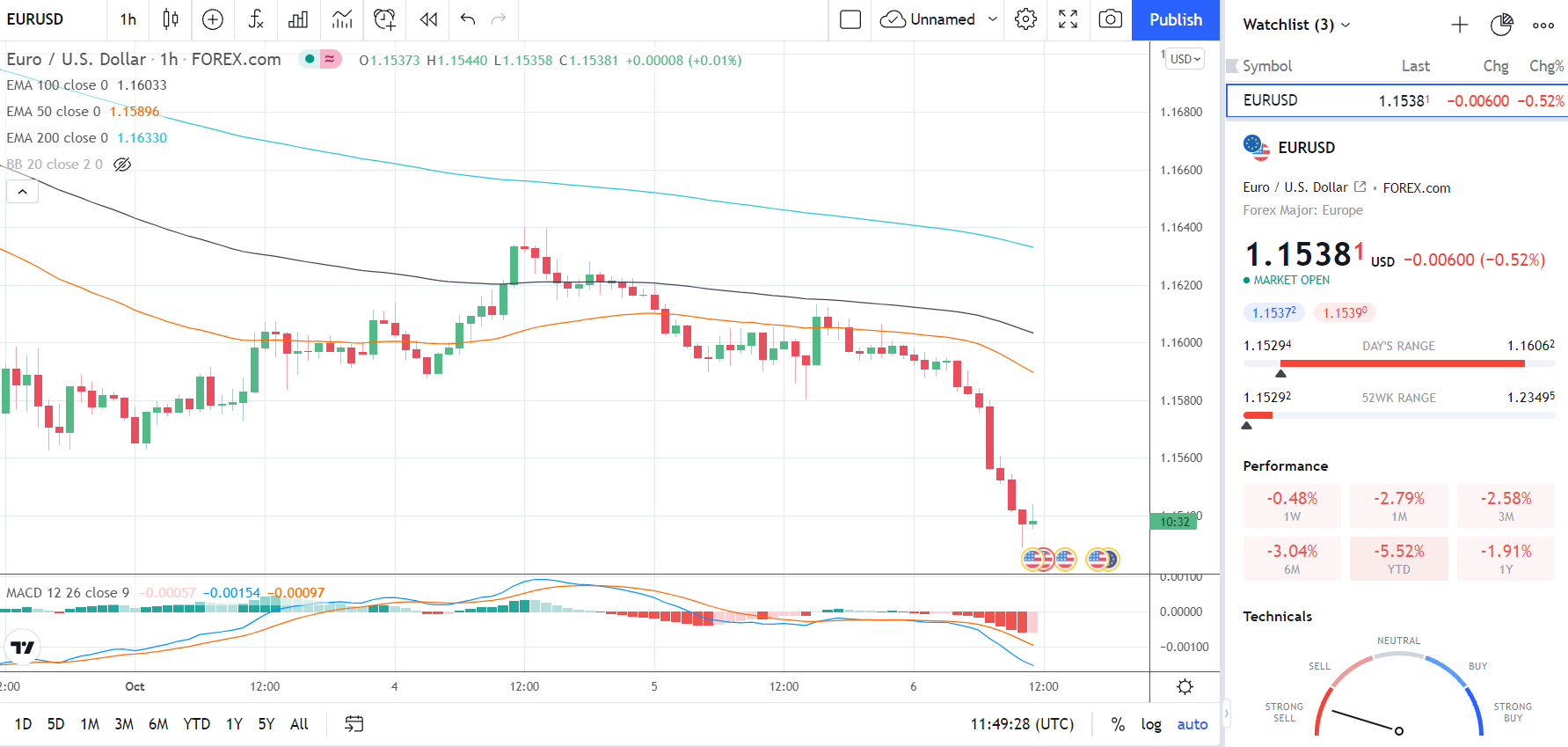
Ahead of today’s figures, the EUR had risen to a pre-stat and current day high $1.16062 before sliding back to sub-$1.16 levels.
In response to today’s stats, the EUR rose to a post-stat high $1.15842 before falling to a post-stat and current day low $1.15294.
At the time of writing, the EUR was down by 0.52% to $1.15381.
Next Up
ADP Nonfarm Employment Change figures from the U.S. With persistent inflation, another sharp increase in hiring is expected to force the FED into action…