



Light Crude Oil Futures Slide on Supply Glut and Weak Global Demand
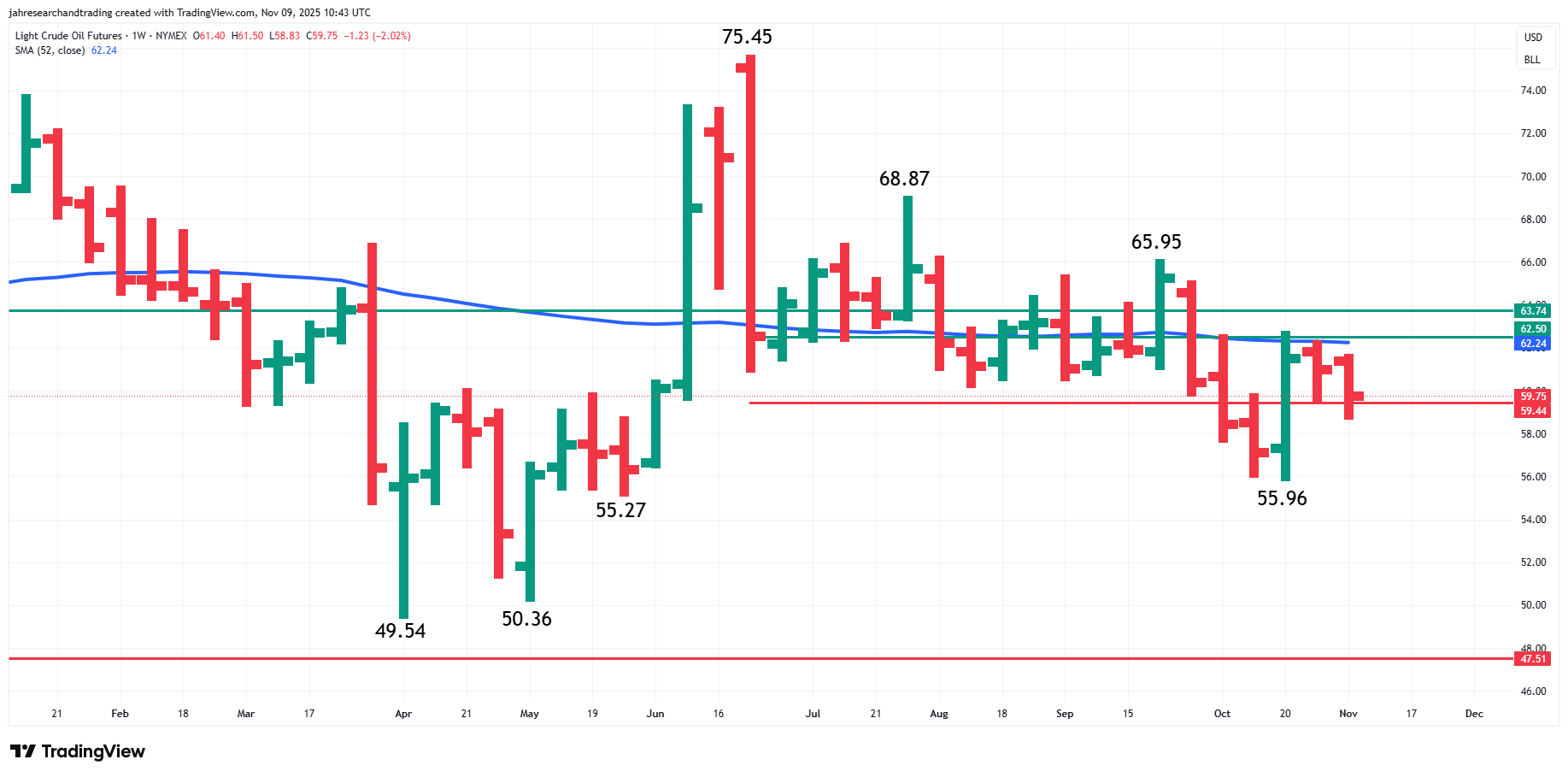
Light crude oil futures closed lower last week, with the December contract settling at $59.75, down $1.23 or -2.02%. The market faced broad-based selling pressure as a combination of rising inventories, resilient U.S. production, and slowing global demand overshadowed modest OPEC+ actions and signs of firming Chinese imports.
Rising U.S. Inventories and Production Weigh on Market Sentiment
The primary drag on prices last week was the bearish inventory data out of the United States. The Energy Information Administration (EIA) reported a 5.2 million barrel build in crude stocks, lifting total inventories to 421.2 million barrels. This followed an earlier surprise build of 6.52 million barrels from the American Petroleum Institute (API), which caught many traders off guard.
Meanwhile, U.S. crude oil production remains elevated. August output hit a record 13.8 million barrels per day (bpd), extending months of strong growth that continues to offset both geopolitical disruptions and voluntary OPEC+ restraint. Refineries also ran at lower capacity, further contributing to the stock build.
OPEC+ Strategy Falls Flat as Saudi Arabia Cuts Prices
OPEC+ tried to shore up prices by confirming a modest 137,000 bpd increase for December while signaling a pause in further hikes in early 2025. However, the move was viewed by traders as insufficient to address growing surplus concerns.
Market confidence took another hit after Saudi Arabia cut its official selling prices to Asian buyers for December deliveries, signaling weak regional demand and intense competition among suppliers.
Brent Oil Price Forecast
Every new Brent Oil analysis as it publishes, today's technical signal and key levels, live price — on one page.
See all Brent Oil forecastsThis pricing move underscored concerns that the market remains oversupplied despite OPEC+ efforts, especially with global refinery margins under pressure.
Demand Fades Across Key Economies
Demand signals remained weak across major economies. In the U.S., data showed soft gasoline consumption and reduced shipping activity. Globally, JPMorgan revised its 2024 oil demand growth forecast down to 850,000 bpd from 900,000 bpd, citing fading momentum in freight and travel.
China’s manufacturing sector contracted for a seventh consecutive month in October, while Japan’s PMI fell to an 18-month low, highlighting declining exports.
Although China’s crude imports rose 2.3% month-over-month in October, driven by strong refinery runs, this demand has not been enough to offset weakening consumption elsewhere.
Fundamental Outlook: Bearish Bias Persists on Supply Overhang
Looking ahead, the fundamental backdrop for crude oil remains tilted to the downside. Elevated U.S. production, ongoing inventory builds, and sluggish demand across key markets continue to pressure prices. Even with seasonal product drawdowns and modest Chinese buying, the global supply-demand balance appears increasingly loose.
Unless traders see a meaningful decline in inventories or a surprise disruption to physical supply, oil prices are likely to remain under pressure this week. The market’s bearish bias is expected to persist unless fundamentals shift significantly in favor of tighter supply or firmer demand.
Technically, the main trend is down with the market closing for a sixth-straight week on the bearish side of the 52-week moving average at $62.24. This is both resistance and our trend indicator.
Look for the selling pressure to continue on weakness under the Fibonacci level at $59.44. If this creates enough downside momentum then look for the selling to extend into the recent swing bottom at $55.96. Further downside pressure is expected if this price level fails to hold.
More Information in our Economic Calendar.