
EURUSD 2026 Outlook: Dollar Weakness Takes Center Stage
The euro enters 2026 with one of its strongest fundamental backdrops in years, supported by broad expectations of sustained Federal Reserve easing, moderating U.S. growth, and a revival in eurozone demand. Analysts across major banks project EURUSD to climb into the 1.20–1.25 range by year-end, with the balance of evidence pointing to a materially weaker dollar as global capital reallocates away from U.S. assets.

Fed Easing Sets the Tone for 2026
The Federal Reserve’s December 2025 rate cut to 3.50–3.75% marked a turning point. Although the move matched market pricing, the meeting’s three dissents underscored deep internal debate about the state of the economy. Chair Jerome Powell emphasized increased uncertainty and acknowledged rising risks to employment—signals that the Fed is preparing to maintain an accommodative stance even if inflation remains slightly above target.
A 43-day U.S. government shutdown left policymakers with limited fresh data, yet the Fed pressed ahead with easing due to weakening labor conditions and slowing activity. Most research desks expect two to three additional cuts in 2026, taking the policy rate toward a 2.75–3.00% neutral zone by mid-year. With inflation hovering near 2.8% and unemployment at a post-2021 high of 4.4%, analysts argue the Fed will remain focused on supporting employment rather than defending nominal yield differentials.
The implication for FX markets is clear: the U.S. real-rate advantage that defined 2022–2024 is eroding, setting the stage for dollar depreciation.
Banks Converge on a Stronger Euro
Goldman Sachs: 1.25 on Structural Dollar Weakness
EUR/USD Price Forecast
Every new EUR/USD analysis as it publishes, today's technical signal and key levels, live price — on one page.
See all EUR/USD forecastsGoldman sees one of the strongest upside cases for EURUSD, maintaining a 1.25 target based on fading U.S. exceptionalism and a persistent diversification trend away from dollar assets. The bank highlights deteriorating performance for EUR-based investors in U.S. equities—down 8% in 2025 after currency adjustment—as a catalyst for renewed interest in European markets.
J.P. Morgan: 1.20 by Year-End
J.P. Morgan expects two Fed cuts in the first half of 2026 and argues that relative real yields will increasingly favor the euro. Softening U.S. labor data and policy uncertainty related to tariffs are expected to undermine foreign appetite for U.S. assets, helping EURUSD gradually lift toward 1.20–1.22.
Morgan Stanley: Early Strength, Late-Year Pullback
Morgan Stanley forecasts a rise to 1.23 by spring, followed by a retracement to 1.16 by year-end as U.S. economic activity stabilizes and the Fed’s easing cycle winds down. The bank maintains that early-2026 euro strength will be driven more by dollar softness than a decisive improvement in eurozone fundamentals.
UBS: Trimmed Forecast at 1.20
UBS recently revised its end-2026 view to 1.20, citing the euro’s muted performance due to political uncertainty in France. The bank sees scope for appreciation as U.S. data weakens post-shutdown and the ECB nears the end of its easing cycle, improving the rate backdrop for the single currency.
Deutsche Bank: Bullish Case for 1.25
Deutsche Bank places EURUSD at 1.25 by end-2026, anchored by a rebound in global growth, a large German infrastructure program, and a potential improvement in geopolitical conditions. A recovery in Asian currencies—particularly the yen and yuan—is a key assumption behind their expectation of broad-based dollar softness.
Technical Analysis: Solid Support Base to Drive Uptrend
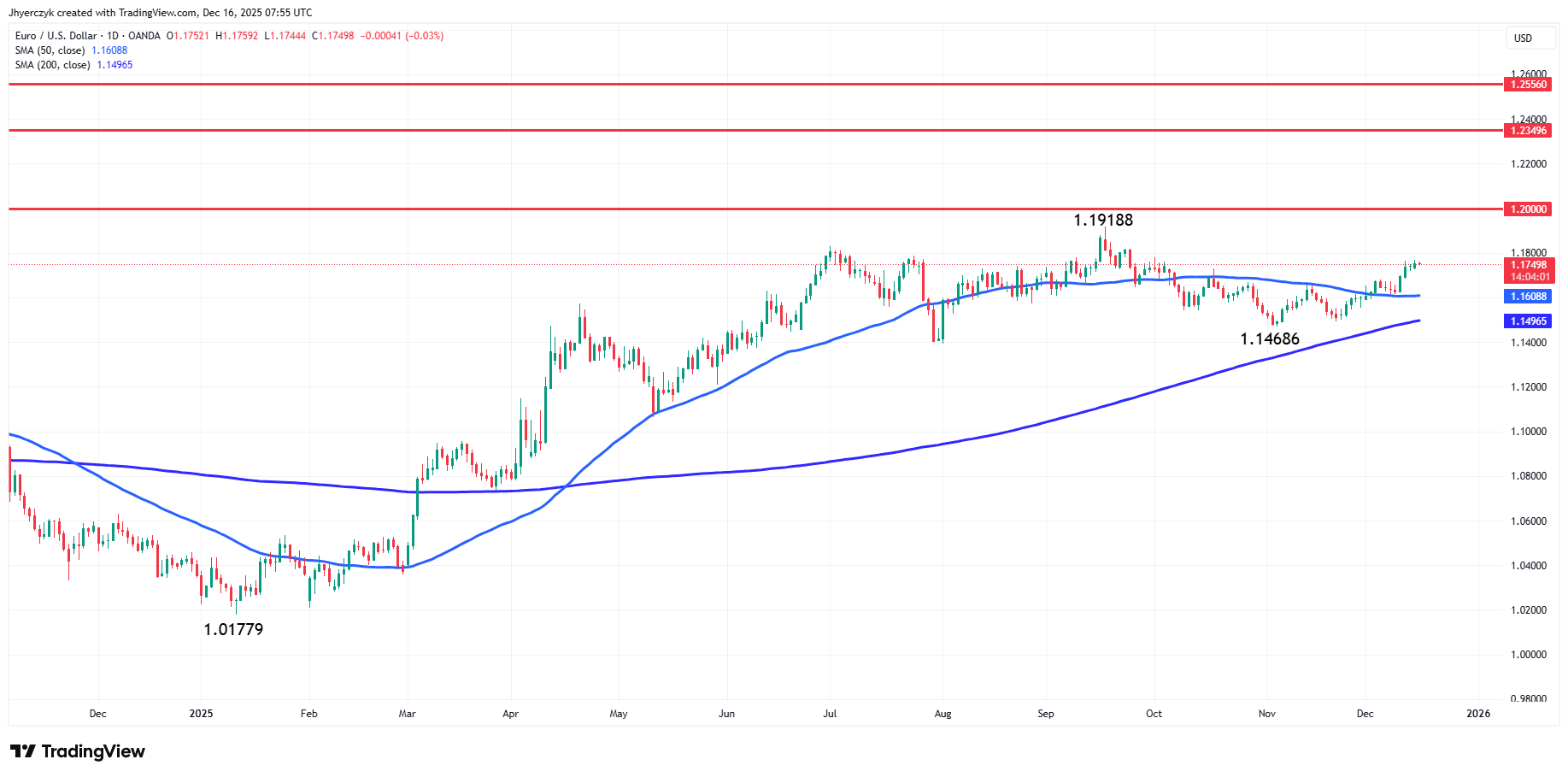
With the 200-day moving average at 1.14965 providing solid support since March 2025 and a recent breakout to the strong side of the 50-day moving average at 1.16088, reaffirming the uptrend, the EUR/USD will begin 2026 in a position to challenge the high of the year at 1.19188.
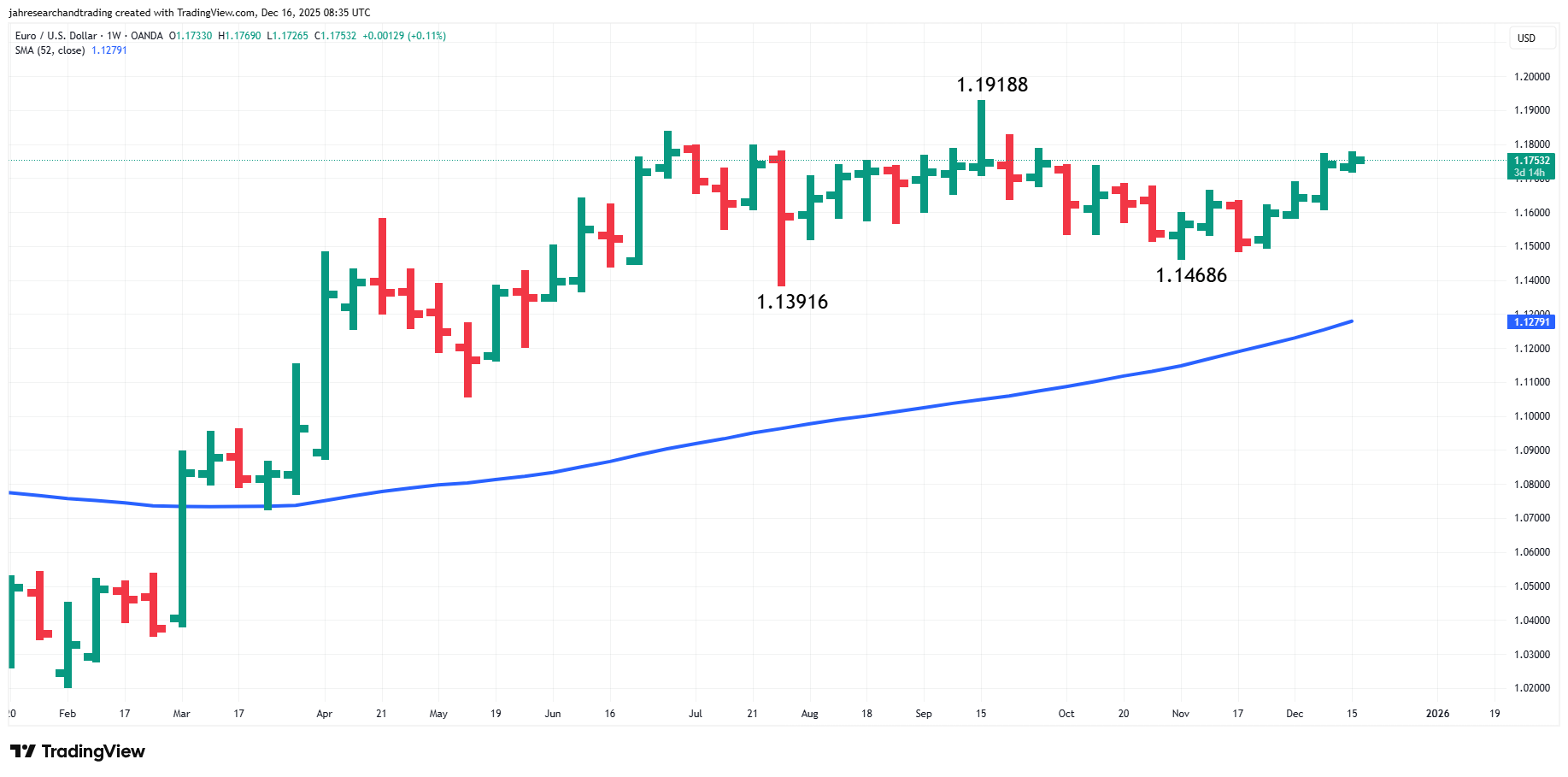
The weekly chart is also showing a bullish pattern with the EUR/USD well above the uptrending 52-week moving average at 1.12791. This strong trend is helping to support the “buy the dip” strategy which has been in play since March 2025. This was demonstrated by key swing bottoms at 1.10649, 1.13916 and 1.14686.
Three ascending bottoms and a well-defined uptrending moving average help to support the case for a test of the main top at 1.19188 in early 2026 with more to come throughout the year.
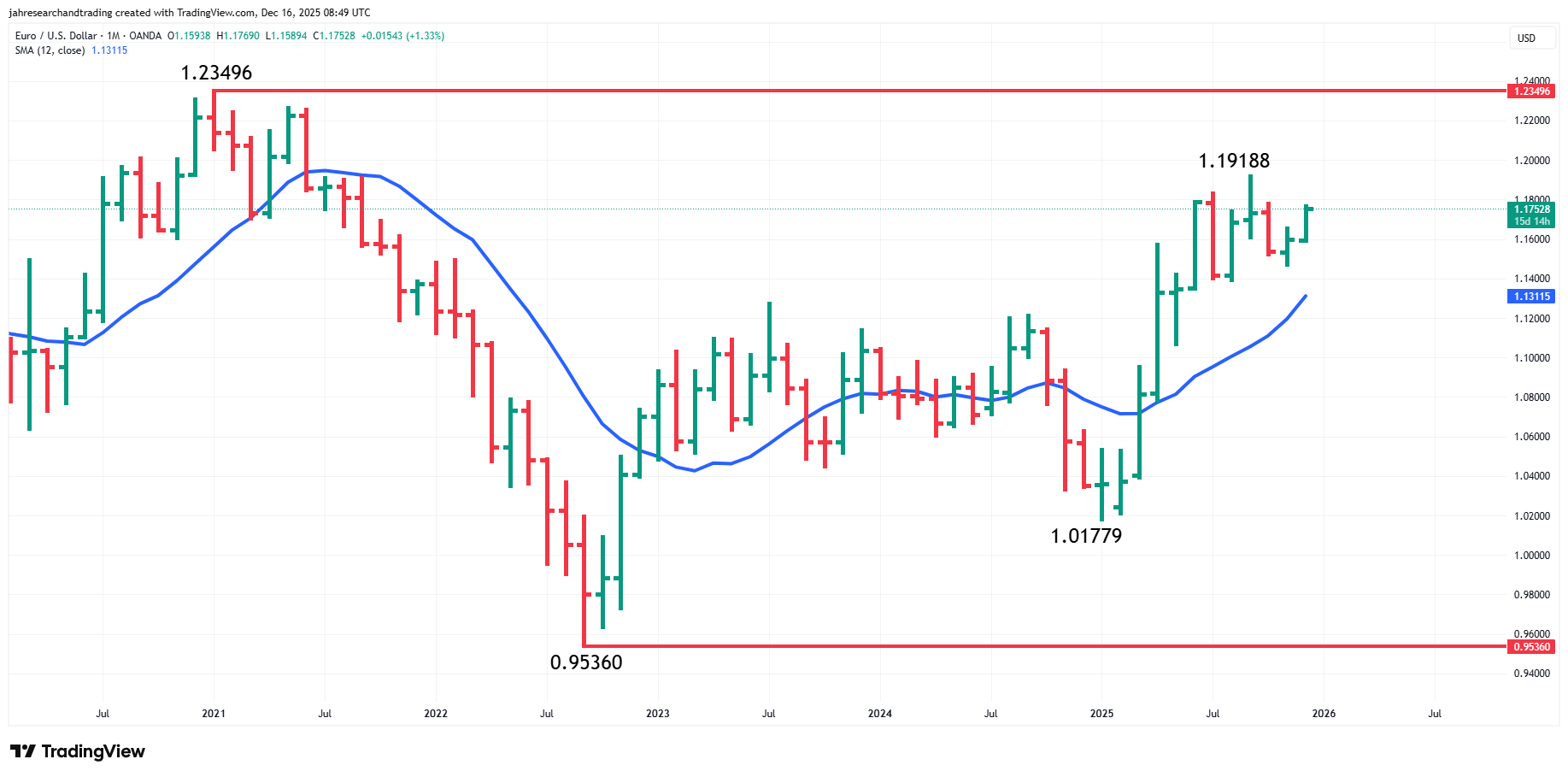
The monthly chart is in an uptrend with the 12-month moving average at 1.13115 providing support and guidance. This puts 1.19188 on the radar as the trigger point for an acceleration into the multi-year high at 1.23496 in 2026.
Forces Reshaping the Dollar-EUR Balance
U.S. Exceptionalism Is Losing Momentum
After years of outperformance, the U.S. economy is cooling. Manufacturing PMIs have been in contraction for nine months, services activity is slowing, and policy uncertainty around tariffs and regulation has weighed on investment. The long shutdown further dampened Q4 output and delayed critical statistical releases, reducing market visibility into economic conditions.
The key shift: the U.S. is no longer clearly outgrowing the eurozone, a major break from the 2020–2024 narrative that supported the dollar.
ECB Nears the End of Its Cutting Cycle
The ECB has already lowered the deposit rate to 2.0%, and President Christine Lagarde signaled that policy is “in a good place.” With the Fed expected to continue easing while the ECB pauses, rate differentials should narrow in the euro’s favor.
Eurozone fundamentals are also improving. Germany’s €500 billion infrastructure program is set to lift investment and offset years of under-spending. J.P. Morgan forecasts 1.5% eurozone growth in 2026, up from 0.9% in 2025. As Europe regains cyclical traction, capital inflows should strengthen.
Capital Reallocation Is Now a Structural Theme
Years of concentrated positioning in U.S. tech and high-beta assets have left global portfolios overweight dollars. With U.S. valuations stretched and economic momentum softening, investors are rotating toward regions offering better risk-adjusted returns.
European equity funds have returned to net inflows for the first time since 2021, and currency-adjusted performance is increasingly favorable for non-dollar investors. This reallocation requires buying euros, reinforcing structural demand for the currency through 2026.
Risks to the Bullish Euro View
A constructive EURUSD outlook rests on several assumptions:
- U.S. Data Does Not Reaccelerate.
If growth surprises to the upside, the Fed could pause its cutting cycle earlier than markets expect, extending the dollar’s yield advantage. - European Politics Do Not Deter Capital.
France remains a swing risk, and prolonged political uncertainty could slow foreign investment. Wells Fargo’s alternative scenario sees EURUSD falling back toward 1.12 if U.S. resilience outperforms expectations. - Geopolitics Do Not Trigger a Dollar Safety Bid.
Trade tensions or fresh tariff implementations could send investors temporarily back into the dollar, even if fundamentals argue for medium-term weakness.
Conclusion: Euro Strength Still the Base Case for 2026
Across the institutional landscape, the euro’s constructive outlook rests on aligned monetary conditions, moderating U.S. growth, and an improving relative macro story in Europe. With the Fed expected to continue easing while the ECB nears its terminal rate, yield spreads should compress in favor of the euro throughout 2026.
Coupled with structural capital redeployment away from the U.S. and a gradual improvement in eurozone demand, the balance of evidence supports EURUSD rising into the low-1.20s by year-end. Upside toward 1.25 is plausible if European political risks fade and global growth stabilizes.
For traders and corporate hedgers, 2026 is shaping up as a year defined by dollar softness, with implications for carry strategies, earnings translation, cross-border flows, and global risk allocation.
More Information in our Economic Calendar.