
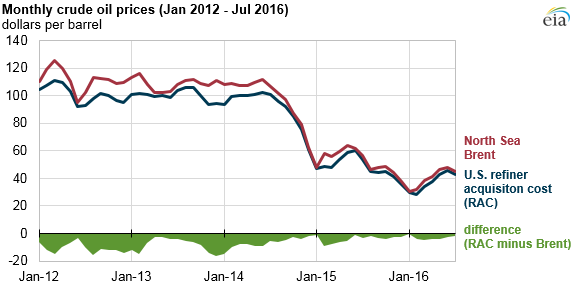
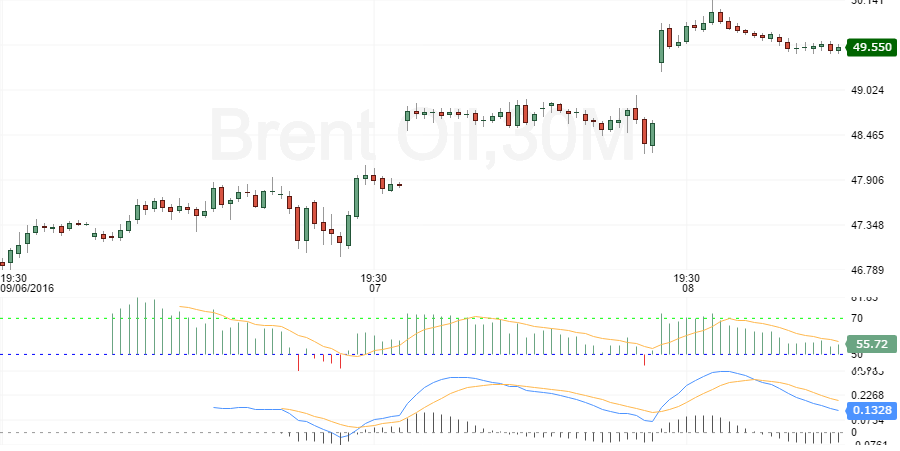
WTI oil prices soared almost 4% after the release of the weekly EIA inventory report, which was delayed until Thursday due to the Monday US holiday. Oil prices added 1.73 to trade at 47.24 and Brent oil climbed to 49.72 but not anywhere near the $51 price level just a month ago. Ahead of the data, oil prices have rallied in recent days thanks to a softer dollar which makes greenback-denominated crude cheaper for holders of rival currencies.
Industry-compiled data Wednesday from the American Petroleum Institute meanwhile showed that US crude inventories fell 12.1 million barrels last week, helping also to lift oil prices.
Crude futures were winning support also from news that overall imports to China – the world’s top energy consumer – rose in August for the first time in 22 months, raising hopes the huge economy is stabilizing after years of slowing.
The developments come as Russia and OPEC are due to meet in Algeria later this month to discuss how to deal with a supply glut that has dragged down oil prices for the past two years. Russia and Saudi Arabia signed a memorandum on joint actions to support the stability of the oil market and guarantee a sustainable level of investments. The signatures were made on Sept. 5 by the countries’ energy ministers Alexander Novak and Khalid al-Falih.
Details of the agreement are still unknown, but immediately after it was announced prices grew by 5 percent.
“This agreement can actually be called historic, since for the first time such a document is signed by an OPEC country and one that is not part of the cartel,” said, a leading analyst at Analytical Online.
In his words, “Saudi Arabia and Russia are the largest oil exporters in the world and their statements on a production freeze are enough for prices on black gold to increase.”
Recent comments from OPEC kingpin Saudi Arabia and major non-OPEC producer Russia, coupled with Iranian president Hassan Rouhani’s commitment to “stabilizing the market”, have raised hopes of a possible production cap.
Ahead of OPEC’s meeting later this month in Algeria, oil markets have developed a misplaced obsession with the possibility of the cartel agreeing an oil production cap.
Oil prices have moved almost daily depending on the public musings of Saudi and Iranian officials, rising at hints that differences can be put aside, falling when political rivalries reassert themselves. Most recently they spiked then fell after Saudi Arabia and Russia announced a nondescript plan on Monday to cooperate to “stabilize” oil prices.
The uncomfortable truth for anyone hoping for higher oil prices is that whatever is decided when OPEC meets in the Algerian capital of Algiers on Sept. 26 won’t make any difference to the supply and demand imbalance that is weighing on oil prices.
Goldman Sachs put its finger on the problem earlier this week, noting that an OPEC production cap at current levels would still leave supply outweighing demand into early 2017. “Even if a freeze is agreed to it won’t be sufficient, especially given the fact Saudi Arabia is producing at a record level,” noted Goldman analysts Eugene King and Abhinandan Agarwal.

That, of course, assumes that the partners can agree a cap, which is far from certain, and then that they stick to it, which is also in doubt.