
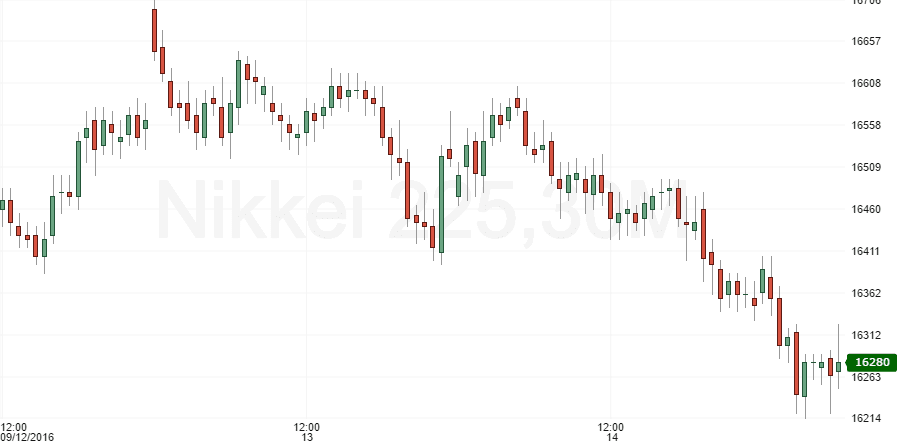
Asian stocks fell for a sixth day, the longest losing streak since May, as the outlook for global central bank stimulus grew uncertain. Wall Street closed mostly lower on Wednesday, with energy weighing, as oil prices fell sharply despite bullish inventories data. Asian markets are down with Japan’s Nikkei down 1.39% after a report said that the BOJ was considering an interest-rate cut at next week’s policy meeting, taking rates deeper into the negative territory while Shanghai is closed on account of mid-autumn festival. U.S. stocks closed mixed as energy shares declined on the back of low oil prices and ahead of FOMC meeting scheduled next week. According to the Chicago Mercantile Exchange’s FedWatch tool, the market believes there is a 15% chance of an interest-rate rise in September, with a near 55% chance of a rate increase in December. Oil prices fell after The U.S. Energy Information Administration reported that crude inventories fell 559,000 barrels during the week ended Sept. 9. vs. an expectation of 3.8 million barrels while U.S dollar index is down 0.05%. On the data front, Retail sales, current account and industrial production data will be released today and inflation data tomorrow.
US markets closed mixed, Dow Jones Industrial Average closed at 18035, declining 32 points, S&P 500 was down 1 point to close at 2126 and Nasdaq gained 19 points to close at 5174.
European markets also closed mixed, FTSE advanced by 8 points to close at 6673, CAC was down 17 points to close at 4370 and DAX lost 8 points to close at 10378.
Import prices in the U.S. saw a modest decrease in the month of August, the Labor Department revealed in a report released late yesterday. The report also showed a notable decline in export prices during the month. The report said import prices dipped by 0.2 percent in August after inching up by 0.1 percent in July. Economists had expected import prices to edge down by 0.1 percent. With the decrease in August, import prices moved lower for the first time since a 0.5 percent decline in February.
US dollar continued to remain in demand as investors flocked to its safety. Limited economic data would enable the trend to continue. The greenback edged up 0.24% in the Asian session to trade at 95.55. The euro climbed after opening at 1.1229 Made a high of 1.1268 and was trading with side wise to negative bias, during the day after violating the supports of 1.1260 the pair is having strong supply coming in above 1.3 mark and not able to close above the said levels so any rise in the pair is shorting opportunity with MACD indicator remaining on the neutral side. Euro against dollar plunged around 0.12 percent on Tuesday on account of weak global market sentiments coupled with stronger dollar index. However, sharp downside in the currency was prevented due to favorable economic data from the region. German ZEW Economic Sentiment unchanged at 0.5-mark in the current month. Euro Zone ZEW Economic Sentiment grew by 0.8 points to 5.4-mark in September from 4.6-level in August.
The pound plunged by more than 1 percent in Tuesday’s trade as a result of strength in the dollar. Further, weak global market sentiments along with unfavorable economic data from the country led to negative movement in the currency. The pound is trading at 1.3217 down 0.32%.
UK’s Consumer Price Index unchanged at 0.6 percent in the month of August. Producer Price Index Input fell to 0.2 percent in August as against a rise of 3.1 percent in July. Retail Price Index dropped marginally to 1.8 percent in August from 1.9 percent a month ago.
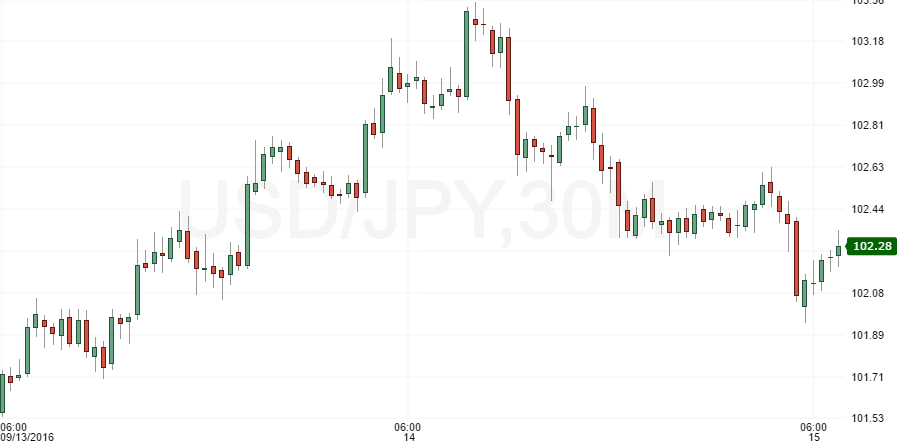
The Japanese Yen against dollar depreciated around 0.7 percent in today trading session due to rise in risk appetite in global market sentiments in early part of the trade which led to decline in demand for the low yielding currency. The yen is trading at 102.41.

News from Australia was disappointing this morning with the jobs market collapsing sending the Aussie to trade at 0.7461 while the kiwi was hit by a lackluster GDP print weighing on the kiwi to trade at 0.7266.