
Highlights
- UK retail sales tumbled 3.2% in December.
- 2023 retail sales were the weakest since 2018, raising the threat of a UK recession.
- Next up, US consumer sentiment and Fed speeches.
UK Retail Sales Report
The UK economy was in the spotlight again on Friday. UK retail sales slid by 3.2% in December after surging by 1.4% in November. Economists forecast retail sales to fall 0.5% in December.
According to the Office for National Statistics,

- Non-food store sales volumes tumbled by 3.9% in December, reversing a 2.7% increase from November.
- Food stores reported a 3.1% slide in sales after rising by 1.1% in November.
- Online retailers also reported a marked decline in sales. Sales declined by 2.1% after falling 1.1% in November.
- Automotive fuel sales fell by 1.9%, reversing a 0.8% increase from November.
- UK retail sales were down 2.8% in 2023, the weakest recording since 2018.
Bank of England Monetary Policy Implications
The UK retail sales figures for December will draw the interest of Bank of England Monetary Policy Committee voting members. The downward trend in consumer spending could dampen demand-driven inflationary pressures.
The recent UK Inflation Report may leave the BoE in a holding pattern until inflationary pressures soften. However, the retail sales figures could give the BoE reasons to begin discussing rate cuts. The retail sales figures paint a grim picture of the UK economy. UK private consumption contributes over 60% to the UK economy.
GBP/USD Reaction to the UK Retail Sales Report
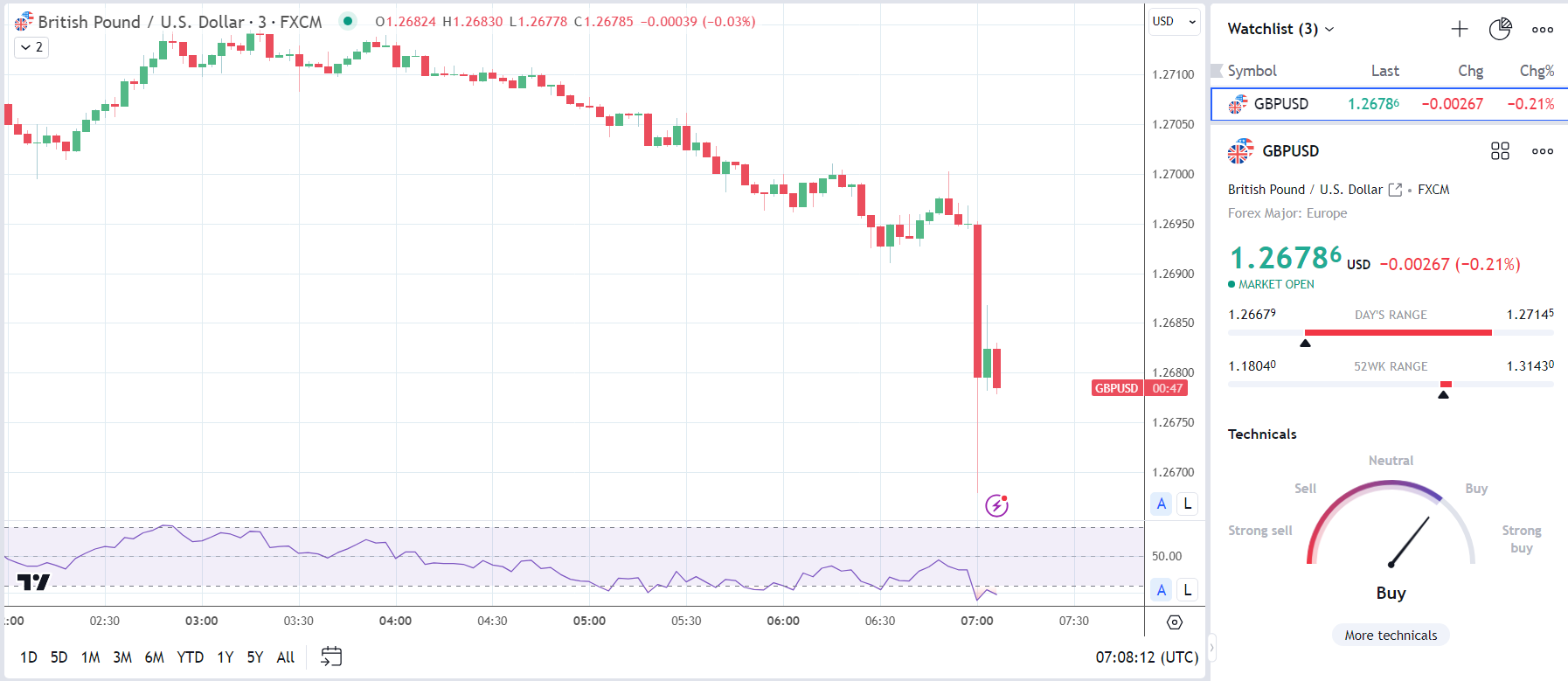
Before the UK retail sales report, the GBP/USD fell to a low of $1.26876 before rising to a high of $1.27145.
However, in response to the numbers, the GBP/USD rose to a high of $1.26952 before sliding to a low of $1.26679.
US Dollar Index Price Forecast
Every new US Dollar Index analysis as it publishes, today's technical signal and key levels, live price — on one page.
See all US Dollar Index forecastsOn Friday, the GBP/USD was down 0.21% to $1.26786.
Up Next: US Consumer Sentiment and Fed Speakers
On Friday, the Michigan Consumer Sentiment Index will draw investor interest. A rise in consumer confidence could signal a positive trend in consumer spending. An upward trend in consumer spending could fuel demand-driven inflation.
In an environment of persistent inflation, the Fed may opt for a ‘higher-for-longer’ interest rate strategy to curb consumer spending and dampen inflationary pressures.
Economists forecast the Michigan Consumer Sentiment Index to increase from 69.7 to 70.0 in January. Beyond the headline figure, investors must consider the sub-components, including inflation and employment.
However, investors must also consider FOMC member speakers. FOMC members Michael Barr and Mary Daly are on the calendar to speak.