


Retail vs. Professional Traders – What is the Difference?
Here's an insight into how we make money. While we strive to be comprehensive, the compensation we receive can influence the products, companies, or services we showcase and review. Not all available options may be featured on this page.
Intro
Key Points:
- Retail traders typically operate with smaller amounts of capital and have limited access to leverage, while professionals benefit from larger capital reserves and greater leverage.
- Retail traders often rely on publicly available trading platforms, tools, and research, whereas professional traders have access to proprietary software and exclusive content.
- Retail trading is usually part-time, while professional traders generally trade full-time.
- Retail traders often have limited formal training in the markets, while professional traders usually possess an academic background in finance and have undergone professional training.
- Professional traders often employ complex strategies and implement advanced risk management strategies, while retail traders tend to use simpler approaches. and often lack well-defined risk management practices.
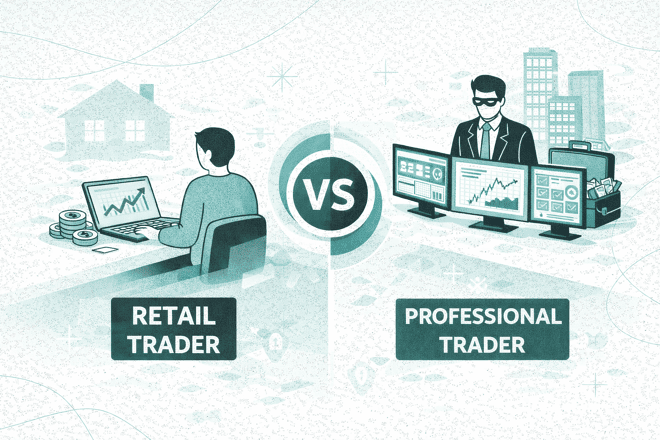
Participants in the world of trading are diverse, ranging from individuals trading small accounts from their bedrooms to large institutions managing billions of dollars. At the forefront of this financial ecosystem are two primary categories of traders: retail and professional. While both groups aim to profit from the market, their approaches, resources, and outcomes are quite distinct. In this article, we’ll delve into the main characteristics that set retail and professional traders apart.
Retail Traders 🧑💻
A retail trader is an individual who trades their own money and does not depend on trading profits as their primary source of income. They trade through personal accounts via retail brokers and do not manage money for others. Often trading part-time, retail traders typically have a full-time job in a completely different field.
Characteristics of Retail Traders
- Often trade part-time
- Have a relatively small amount of capital
- Usually using simple trading strategies
- Working with widely available platforms, tools, and research
- Self-educated
- Limited risk management
- Low market impact
Retail traders typically have less capital to work with and limited access to professional-grade tools, platforms, and research. They employ relatively simple strategies, for example, basic trend-following or mean reversion strategies using moving averages, trend lines, and momentum oscillators.
A common strategy among retail traders is to capitalize on pure momentum when an instrument is trending strongly up or down, using indicators like volume and oscillators or no indicators at all. News trading is also popular, as major economic releases like Nonfarm Payrolls usually generate high volatility and potential trading opportunities.
Retail traders commonly use MetaTrader 4 (MT4) and MetaTrader 5 (MT5), which offer robust charting, advanced order types, and automated trading. TradingView, a charting platform and social network, is another popular resource used by millions of retail traders worldwide.
Risk management among retail traders is often overlooked. Trading from emotion, using excessive leverage, and failing to limit losses are among the main factors leading to high failure rates among retail traders.
Due to their smaller trade sizes, retail traders generally have minimal impact on market prices. This gives them an advantage over professionals trading more contracts: retail traders can be more nimble and more easily get in and out of the market.
Professional Traders 🥷
A professional trader is an individual who trades full-time, relying on trading profits as their primary source of income. They typically manage money for others, such as clients or firms, and often trade through institutional accounts or professional-grade platforms. Unlike retail traders, professional traders dedicate their time exclusively to trading and are generally more experienced, with access to advanced tools, research, and larger capital.
Characteristics of Professional Traders
- Trading is their full-time job
- Managing large amounts of capital
- Access to advanced platforms and tools
- Use of institutional-level research
- Lower trading costs
- Advanced risk management strategies
- Formal education and training in finance
Trading is a primary occupation and source of income for professional traders. They often work for financial institutions like banks, hedge funds, and proprietary trading firms, though some may operate independently.
Professional traders typically manage large sums of money and have access to sophisticated tools and proprietary research. In some cases, they are supported by a team, including dedicated analysts and risk managers.
Tools like the Bloomberg Terminal, which provides real-time data, news, and analytics, are examples of resources typically limited to professionals. With costs running into thousands of dollars per month, such tools are generally out of reach for most retail traders. Another similar tool is Thomson Reuters Eikon, which offers comprehensive data on financial markets and news. For quantitative analysis and algorithmic trading, MATLAB is a widely used professional-grade tool.
Professional traders often specialize in algorithmic, quantitative, and high-frequency trading. At banks, hedge funds, and proprietary trading firms, purely discretionary trading has become less common. Discretionary traders make decisions based on individual judgment and intuition, unlike systematic traders who work with clearly defined, objective rules.
Professional traders can sometimes move markets when executing large orders, especially in thinly traded markets with low liquidity. To manage this and get optimal prices, they may use specialized execution strategies. This is one area where retail traders have an advantage, as their smaller trades are less likely to impact market prices significantly.
Professional Accounts at CFD Trading Brokers – How to Qualify
CFD traders in the UK and Europe can apply for Professional Accounts, which allow greater leverage of up to 1:500. Professional Account holders are not subject to ESMA’s restrictions, which came into force in September 2019 to protect retail investors. To apply for a Professional Account, the trader must meet at least two of the following three criteria:
- You must have carried out significantly large transactions in the relevant market, on average 10 per quarter over the previous four quarters.
- The size of your financial instrument portfolio, including cash deposits and financial assets, must exceed 500,000 EUR.
- You currently work or have worked in the financial sector for at least one year in a professional position.
Key Differences Between Retail and Professional Traders
| Feature | Retail Traders | Professional Traders |
| Available Capital | Limited personal funds | Greater amounts of capital from clients, institutions, or their own |
| Available Leverage | Limited leverage | Access to greater leverage |
| Market Access | Limited access via retail brokers | Direct access to markets |
| Costs and fees | Higher fees, spreads, and commissions | Lower costs and fees |
| Trading Tools | Publicly available trading platforms and tools | Advanced trading platforms, sophisticated analytical tools |
| Education and Training | Self-taught or limited formal training | Extensive formal education, certifications |
| Risk Management | Limited risk management strategies | Sophisticated risk management strategies |
| Time Commitment | Part-time, often at the same time as holding a full-time job | Trading full-time as their primary occupation and source of income |
| Regulations | Subject to broad market regulations | Subject to stricter regulations and compliance requirements |
| Research and Analysis | Basic technical and fundamental analysis that is openly available | Advanced proprietary research and analysis |
| Goals and Objectives | Often a short-term focus for fast gains | Long-term growth and consistent returns |
The Bottom Line
Trading is highly competitive, and those dedicated to it professionally naturally have a higher chance of success. Access to greater capital, professional-grade tools, and a structured environment tip the scales in favor of professionals.
At the same time, retail traders have a continually improving world of resources at their disposal; from rock-bottom fees to advanced platforms and active online communities where ideas are openly shared.
About the Author
Starting his career in finance on the floor of the Chicago Mercantile Exchange, Dan later gained insight into the forex industry during his time as a Series 3 licenced futures and forex broker. Dan also traded at a couple of different prop trading firms in Chicago.


